
Whippet: nature, care, health and everything you should know
Published 30. 8. 2026
The Whippet is a medium-sized breed of sighthound from Great Britain, classified in FCI Group 10 among short-haired sighthounds (Short-haired Sighthounds section, standard no. 162). Males measure 47–51 cm at the withers, females 44–47 cm, and with proper care they live to be 12–15 years old. Their body is slender, muscular and streamlined, adapted to fast running, their coat is short and requires virtually no care.
In terms of temperament, this is a dog with two faces - at home it is calm, quiet and likes to spend time relaxing on the couch, but outside it turns into a persistent sprinter with a high need for exercise. Thanks to its low barking and almost no drooling, it is also suitable for an apartment, if the owner can provide enough free movement and opportunities to sprint. The Whippet is friendly towards children and gets along well with dogs, but its relationship with cats needs to be assessed individually. It is suitable as a beginner breed due to its medium training requirements and low demands on coat care.
Quick overview
What is a Whippet like?
The Whippet is a slender, short-haired, medium-sized sighthound originating from Great Britain, classified in FCI Group 10 (Short-haired Sighthounds section, standard no. 162). Males measure 47–51 cm at the withers, females 44–47 cm, and with proper care they live to be 12 to 15 years old. The body has an aerodynamic, muscular build with a deep chest and a distinctly tucked-up belly – a build destined for sprinting.
By temperament, this is a breed with a high level of activity, but at home it surprises with its calmness - after the run, the Whippet likes to spend time relaxing on the couch. Training is medium-demanding, as it tends to be sensitive and responds better to a patient, positive approach than to harsher methods. Its need for mental stimulation and companionship is medium, and its barking is low.
The Whippet is rather friendly towards dogs, its relationship with cats is individual and depends on socialization. It is rather suitable for an apartment due to its low demand for coat care and low shedding, and is rather suitable for children. It is a breed suitable even for beginners who expect regular exercise outdoors.
Origin and history
The Whippet comes from Great Britain and is a short-haired sighthound - in the FCI classification it is included in group 10 (Sighthounds), section Short-haired Sighthounds, under standard no. 162.
Appearance and size
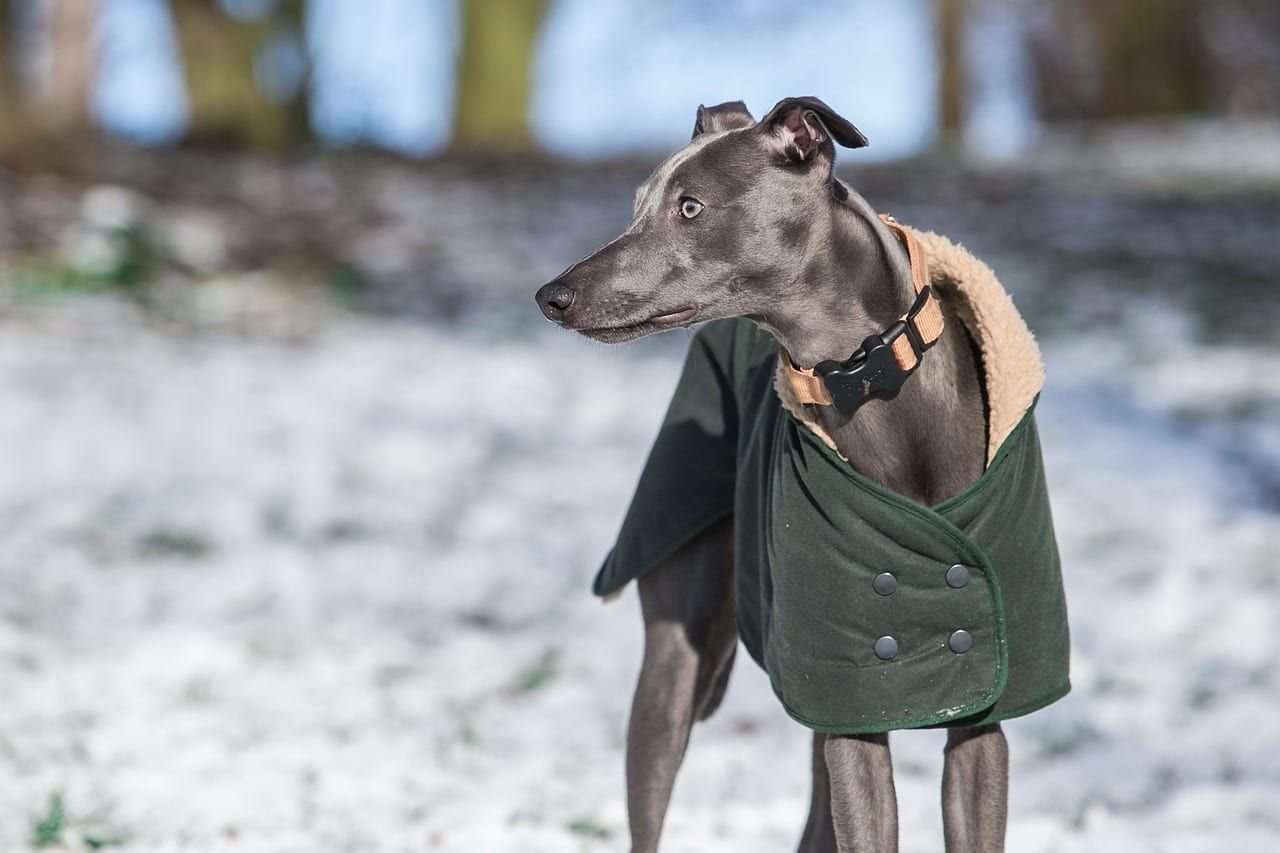
The Whippet is a slender, streamlined, medium-sized sighthound with a deep chest and a distinctly tucked-up belly, giving its body a typical S-shaped profile. The back is slightly arched, the rump is muscular, and the musculature on the thighs is noticeable even under the short coat - the whole build reveals a dog built for speed. The head is long and wedge-shaped, with a flat forehead and a delicate stop, the ears are small, rose-shaped and close to the head. The neck is long and muscular, the tail is long, carried low and tapering towards the tip.
The coat is short, dense and fine, lying close to the body and requiring almost no grooming. This type of coat makes the Whippet easily susceptible to cold weather, but at the same time, its appearance is very easy to care for.
Males reach a height of 47–51 cm, females tend to be slightly smaller, 44–47 cm. The overall impression is symmetrical and light – the Whippet does not appear cumbersome or angular, on the contrary, its silhouette is characterized by flowing lines and visible muscle definition, typical of breeds built to chase prey by sprinting over short distances.
Whippet Colors
The FCI standard for the Whippet does not restrict the coat color in any way - any color and their combination is recognized, including white with pigment spots. The standard therefore does not list an exact list of shades and patterns, and from this point of view, the Whippet is one of the few breeds with such a free color.
However, the wide tolerance of the standard is often abused to market non-standard and risky colors, especially merle . In the Whippet, the merle factor did not occur in the original population, and its introduction by crossing with other breeds is associated with an increased risk of congenital defects of vision and hearing, especially in individuals with the double merle gene. Similarly, one should be cautious when approaching advertisements appealing for "exclusive" blue or chocolate Whippets - the color itself does not matter in the standard, but the problem arises when it is associated with uncontrolled crossing and insufficient selection of breeding individuals.
When choosing a puppy, it is therefore more appropriate to focus on the health and origin of the parents than on the unusual coat color.
Whippet personality
The Whippet is a breed of interesting contrast – at home it seems calm and composed, but outside it can turn into an explosive sprint full of energy. This dual nature is typical of it: it has a high level of activity, needs regular exercise and the opportunity to run free, but after running around it can rest for hours on the couch or in its bed.
In relation to the family, the Whippet is rather calm and affectionate, with a moderate need for company - it appreciates the proximity of people, but is not pathologically dependent on them. It behaves gently towards its people, without unnecessary dominance or aggression. It is rather suitable for children, which makes it suitable for families with offspring, as long as care is taken to respect its quiet moments.
It tends to be more reserved towards strangers, but not timid. It has a low barking rate, so frequent vocalizations are not bothersome. It gets along well with dogs, but its relationship with cats needs to be assessed individually due to its hunting instincts. The training difficulty is medium - the whippet is intelligent, but its attention is easily distracted by moving stimuli, which needs to be taken into account during training.
Whippet and children
The Whippet is generally good with children, and its calm, friendly nature makes it a good companion for families with children. Thanks to its low barking rate and even-tempered nature, it does not create a chaotic atmosphere in the home, which is especially appreciated by families looking for a quieter breed.
However, it is important to take into account its body structure - the Whippet is a slim and slender dog without a significant layer of fat, so it does not like rough handling, pulling on its fur or rough hugging. Small children should therefore be taught how to handle the dog sensitively, and contact between a smaller child and a dog should always be supervised.
Due to its high activity level and need for exercise, the Whippet will appreciate a family that can offer it regular free running and quiet moments of rest at home - after expending energy, it is typically very calm and likes to rest on the couch with the family. The medium need for companionship means that the Whippet will appreciate being part of the family's activities, but does not require constant attention.
For families with older children who respect his more sensitive nature, the whippet is usually a trouble-free and devoted companion.
Whippet and other dogs and pets
The Whippet gets along well with other dogs and works well in many packs – whether it's another Whippet or a dog of a completely different breed. This is also helped by its low barking rate and generally non-conflicting nature, which makes it less likely to be a source of tension between dogs in the household.
The relationship with cats and other small animals needs to be assessed individually – FACT assesses it as neutral , i.e. neither clearly problem-free nor risky. As a sighthound, the whippet has a strongly developed visual hunting instinct, which can be manifested mainly when a small animal moves – a quick dash of a cat or rodent across a room or garden can easily attract its attention. Cohabitation therefore usually works better where the whippet grows up with the same animal from puppyhood and has the opportunity to gradually get used to them.
With new or unfamiliar small animals, caution and gradual, controlled introduction are in order, rather than relying on the situation to resolve itself.
Is the Whippet suitable for an apartment?
Despite its sporty appearance, the Whippet is more suitable for an apartment - at home it is a surprisingly calm and undemanding companion. Thanks to its short coat with low shedding, it does not leave much hair indoors and its barking is low, so it is not one of the dogs that would disturb the neighbors in a block of flats.
It is crucial to understand that the whippet operates on the "all or nothing" principle: at home, it spends most of its time relaxing on the sofa or in its bed and saves its energy for outdoor activities. Its high level of activity is not reflected in constant movement around the apartment, but in the need for regular, intensive running outside. However, it will not be satisfied with an apartment without a sufficient enclosure - it must find space to move around outside the home.
Due to their low need for mental stimulation and moderate need for companionship, the Whippet will adapt to a smaller apartment as long as the owner has time for walks and adequate exercise. Colder weather can be a problem for them due to their short coat, so they will appreciate the warmth of a home and a soft place to sleep.
How much exercise does it need?
The Whippet has a high activity level and needs a combination of regular exercise and free running. It is a sprinter – it appreciates short, intense bursts of full speed rather than long walks. Therefore, a daily walk supplemented with time in a secure area where the dog can run around in peace and safety is ideal.
Due to its strongly developed hunting instinct, it is advisable to let a whippet off the leash only in fenced or otherwise secure locations - the sight of small game moving can trigger an immediate and very fast chase, which is difficult to interrupt by calling.
In addition to physical exercise, the Whippet also appreciates mental stimulation, although its need is rather moderate. Dog sports that are built to utilize its speed and sprinting nature are suitable - for example, coursing, track racing or lure coursing, where it can fully express its natural movement. Thanks to the medium level of training, it can also be involved in agility or obedience, although these disciplines are not its main domain.
After the active movement phase, the Whippet is typically very calm and likes to rest in the warmth of the home, which makes it a breed with a relatively balanced daily rhythm - short intense activities alternated with long periods of rest.
Training and education
The Whippet is intelligent and docile, but the training difficulty is rather medium - it is a typical hunting dog with a strong hunting instinct, which can forget all commands when looking at a moving object. Training must therefore take into account that recalling in the field with wild game or other fast-moving stimuli will always be a risky discipline, and it is advisable to work on it gradually, with high motivation and in a safe, fenced area.
Whippets respond well to positive reinforcement – praise, play and treats – but harsh or directive methods can easily lead to insecurity and withdrawal. Short, frequent and fun training sessions work better than long repetitions of one exercise, as whippets get bored quickly.
In addition to classic obedience, this breed benefits from channeling its energy into physical activities such as coursing or track sports, where it can fully utilize its speed and at the same time learn controllability. Socializing a puppy with various stimuli, people and dogs, is the basis for a balanced adult.
Hair care and hygiene
The Whippet's short, close-fitting coat is one of the easiest to maintain of all breeds. A weekly brushing with a rubber brush or smooth glove will remove loose hair and keep the coat shiny. Due to the low shedding rate, no special techniques or more frequent grooming are required.
Bathing is only necessary occasionally if the dog is visibly dirty - excessive washing could disrupt the natural skin protection. Thanks to the very low drooling, the Whippet does not need to be cleaned frequently around the muzzle or the surrounding area.
Since the Whippet does not have drooping, heavy ears prone to moisture retention, it is sufficient to check them regularly and clean them gently if necessary. It is advisable to trim or grind the claws regularly, as they naturally do not wear down sufficiently in active dogs that do not spend as much time on hard surfaces.
Dental care should be part of regular hygiene - brushing teeth or using appropriate dental tools helps prevent tartar formation, which generally applies to all breeds, regardless of coat type.
Feeding
The Whippet is a lean, muscular sighthound with a high level of activity, which should be reflected in its diet. Given its typical lean body structure and minimal subcutaneous fat, it needs a high-quality, energy-dense diet with a sufficient proportion of animal proteins to support muscle mass maintenance. Fats should be present in a reasonable amount as a source of energy for athletic performance, but it is necessary to monitor the total energy intake according to the actual load of the individual.
The amount of food should be adjusted to the current physical activity - a whippet that regularly sprints or does coursing will need more than a dog with a calmer regime. Thanks to its slim constitution, it is easy to overlook the beginnings of overweight and underweight in this breed, so it pays to regularly check its condition by feeling its ribs and watching the silhouette at the waist.
It is advisable to divide the feeding into several smaller portions a day, which helps prevent digestive problems and is gentler on the body before and after demanding physical exertion. Due to the low layer of subcutaneous fat and short coat, the whippet may consume slightly more energy to maintain body temperature in colder weather, which is advisable to take into account when planning the diet.
How long does a Whippet live?
The Whippet lives an average of 12 to 15 years , which makes this breed one of the dogs with an above-average lifespan, especially considering its size and athletic build.
Life expectancy is influenced by a combination of genetics, nutrition, and exercise. The Whippet has a high level of activity and needs regular exercise to keep its muscles and cardiovascular system in good condition. Conversely, long-term lack of exercise or overexertion of a young, still growing individual can have a negative impact on health.
Due to its thin skin and low body fat, the Whippet is more sensitive to cold and mechanical injuries, so it is recommended to adapt its walks to the weather and use appropriate clothing in the winter months. Regular veterinary examinations and maintaining an appropriate weight are essential for the dog to live out its full potential life without unnecessary complications.
A quality diet appropriate to the dog's age and activity level, along with sufficient mental stimulation, contributes to overall vitality even in advanced age.
Who is the Whippet suitable for?
The Whippet is a sighthound with a high need for exercise, but at the same time a calm nature in the home environment, which makes it a breed suitable for a fairly wide range of households - as long as they can offer enough space for sprinting while respecting its more sensitive nature.
This breed may be right for you if…
- Are you looking for a dog suitable for an apartment that can handle low levels of grooming and almost does not drool?
- you will appreciate less barking and a dog that doesn't make unnecessary noise at home
- you can provide him with space for free movement and exercise every day, corresponding to his high activity level
- you are interested in a family with children, where a whippet is a more suitable companion
- you plan to live with another dog – whippets tend to get along well with other dogs
- you are willing to engage in moderate-level training and ongoing mental stimulation
Consider another breed if…
- you do not have the opportunity to regularly ensure enough movement and space for fast running
- you are looking for a dog with low demands on human company – the whippet needs moderate but regular contact with its owner
- you plan to live with cats or small animals without gradual socialization, because the whippet's relationship to them is neutral and individual
- you prefer a breed with clearly low training requirements without the need for consistency
Interesting facts about the breed
The Whippet has the same official name as the Czech one and is registered under the FCI standard No. 162 in group 10, section Short-haired Sighthounds. It comes from Great Britain and is a medium-sized breed - males grow to 47–51 cm, females 44–47 cm.
What is interesting is the combination of the typical sighthound appearance with characteristics that are not expected in this group of breeds: the whippet barks very little, almost does not drool, and its short coat causes almost no shedding. Thanks to this, it is also suitable for an apartment, despite the fact that it is a dog with a high need for exercise.
Breeds to which the Whippet is often compared include the Greyhound, Sloughi, Italian Greyhound, Hungarian Greyhound, Spanish Greyhound, and Azawakh – all of which share a similar body structure adapted for fast running. The Whippet also boasts a relatively long lifespan of 12-15 years, which is above average for this type of sighthound.
Health and health predispositions
The Whippet is one of the breeds with a higher rate of longevity, which in itself indicates a solid genetic basis. However, it pays to actively monitor the dog's health and not rely solely on its slim and athletic appearance - this does not mean automatic immunity to all health complications.
Given that this is a breed with a distinctive body structure and a low body fat percentage, it is advisable to pay attention to common matters, such as protection from the cold or gentle handling during high physical exertion. Regular preventive veterinary examinations, including joint, heart and vision checks, help to detect potential problems early, when they can be addressed with less risk and lower costs.
Prevention should also include dental care and maintaining adequate fitness - due to its build, the whippet quickly gains excess weight if the exercise does not match the amount of food it eats. Owners are advised to consult a veterinarian directly about the appropriate vaccination, deworming and preventive care regimen, which will take into account the individual condition of the individual.
Known predispositions
The breed is described to have an increased predisposition to:
- to dilated cardiomyopathy and other heart diseases.
- to hip dysplasia.
- to patellar luxation (dislocation of the kneecap).
- to hereditary retinal diseases such as progressive retinal atrophy (PRA).
- to von Willebrand's disease, a hereditary blood clotting disorder.
- to primary lens luxation (displacement of the eye lens).
Discussed risks
- The breed may experience increased sensitivity to some anesthetics and medications due to the low body fat percentage and different metabolism typical of greyhounds and sighthound breeds.
- to hearing loss associated with certain coat colors.
What to buy for a Whippet
Practical basis that is suitable for this breed:
- Car seats for dogs – Car seats and safety equipment for transporting a dog by car.
- Toys – Dog toys – fetching, chewing and interactive.
- Cosmetics – Shampoos, conditioners and hair care products.
- Bowls – Feed and water bowls, anti-swallow bowls and stands.
- Collars – Dog collars – leather, textile and semi-tight.
- Beds – Beds and mattresses for dogs of all sizes.
- Leashes – Leashes, switch leashes and tracking lines.
Useful instructions
Practical tips that are useful when caring for a dog:
Frequently asked questions
Is a whippet suitable for an apartment?
Yes, the Whippet is more suitable for an apartment - it is calm at home and rests for long hours, and its short coat almost does not shed. However, it needs enough exercise outside every day to burn off energy outside the home.
How much exercise does a whippet need?
The Whippet has a high level of activity and will appreciate regular free exercise and the opportunity to run around freely, ideally in a secure area. Outside of these runs, however, it is undemanding at home and rests contentedly.
How long does a whippet live?
The average lifespan of a Whippet is between 12 and 15 years, which is among the higher values for dogs of this size.
Is the Whippet suitable for children?
The Whippet is rather suitable for children, it is a calm and non-conflicting breed with low barking. Due to its slender body structure, it is advisable to appropriately guide play with smaller children.
Can even a beginner handle a whippet?
Yes, the Whippet is more suitable for beginners – training is moderately demanding and the breed does not require experience with complex management. However, it will appreciate an owner who provides it with enough exercise.
How much does a Whippet shed and how difficult is coat care?
The Whippet has a short coat with low shedding and is easy to care for, requiring only occasional brushing. Drooling is also very low in this breed.
Does the whippet bark a lot?
No, the whippet is a breed with low barking, which makes it a quiet neighbor even in an apartment building.
Does the whippet get along with other dogs and cats?
Whippets tend to get along well with other dogs. Their relationship with cats is individual and depends on the individual and their socialization.
How difficult is training a whippet?
The difficulty of training a Whippet is medium - the breed is docile, but like a sighthound it can react to the movement of prey, so it is advisable to work on reliable recall.
Is a whippet suitable for seniors?
The Whippet's suitability for seniors is neutral - it is unpretentious and calm at home, but the need for regular exercise and a run must be ensured even in the owner's advanced age.
Resources and expert documents
- FCI Standard No. 162 – Whippet – Fédération Cynologique Internationale
- Source of body measurements – fci.be
Professional cooperation
This breed overview was created in cooperation with the Veterinary Clinic VYVET sro and MVDr. Adam Hylák .