
Published 13. 10. 2026
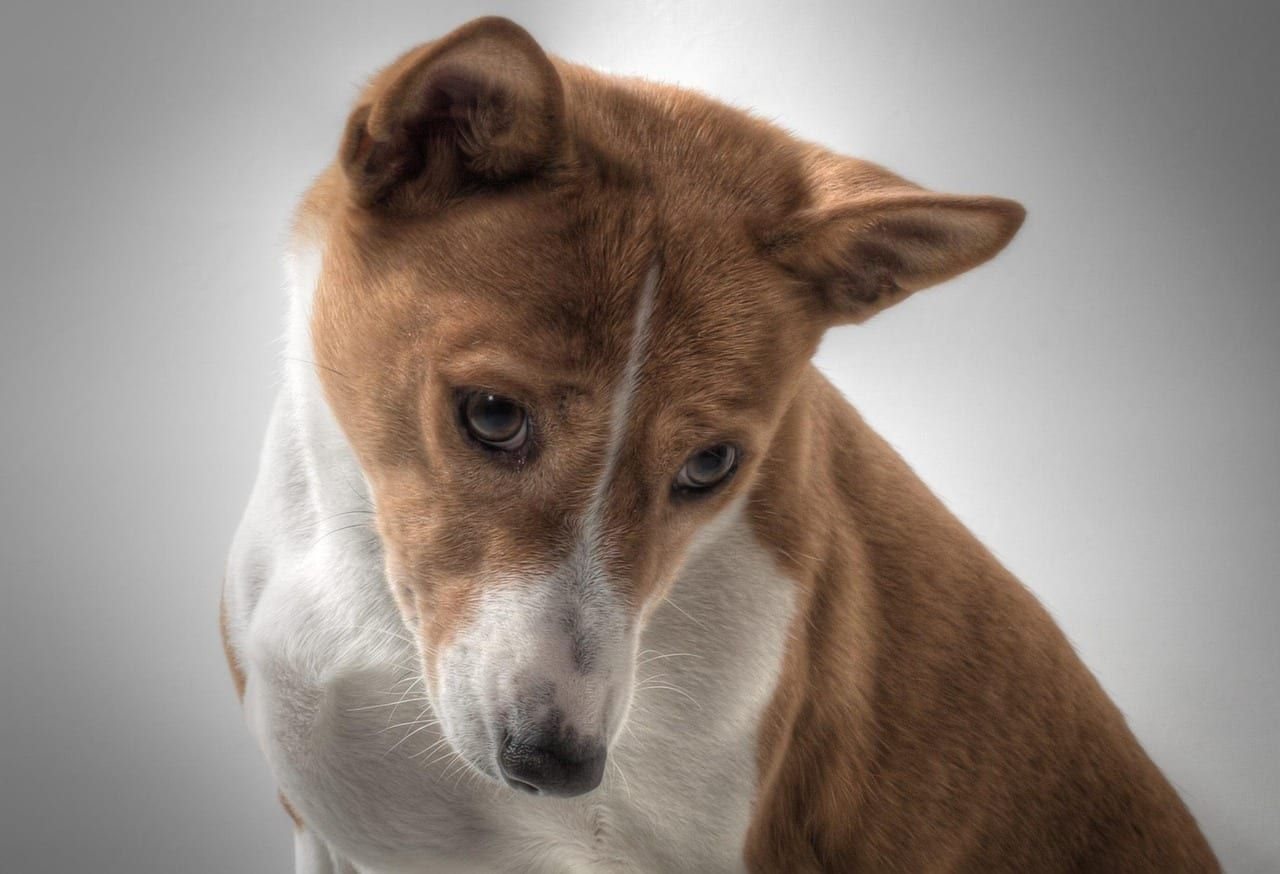
Basenji (Basenji) is a medium-sized breed from Central Africa, classified in FCI group 5 among primitive types of dogs (standard no. 43). The male dog measures 43 cm at the withers and weighs around 11 kg, the female is slightly smaller – 40 cm and 9.5 kg. It has a short coat that does not require demanding care and only minimal shedding. The most striking feature is the absence of a classic bark – the basenji instead makes quiet sounds reminiscent of yodeling.
In terms of temperament, it is an independent and intelligent dog with a high need for exercise and mental stimulation, which has retained much of its original, independent character. Training requires patience and consistency, which is why the Basenji is more suitable for more experienced owners with an active lifestyle than for beginners. It is neutral towards children and other dogs, coexistence with cats can be problematic. It lives for 13–14 years.
Professionally consulted
The content was created in cooperation with the veterinary clinic Veterinární klinika VYVET sro and MVDr. Adam Hylák.
Quick overview
What is a Basenji like?
The Basenji is a medium-sized breed of primitive type originating from central Africa, where it has been used for centuries to hunt in dense vegetation - hence its extraordinary alertness and independent thinking. The male dog measures 43 cm at the withers and weighs around 11 kg, the female is smaller, 40 cm and 9.5 kg. It is famous for not barking - instead it makes more of a yodeling or growling sound, which makes it a quiet but certainly not inconspicuous companion.
By nature, this is an independent, intelligent dog with a high need for mental stimulation and exercise. Training requires patience and consistency, as the Basenji likes to try to solve situations on its own.
- More suitable for more experienced and active owners
- He is neutral towards children and other dogs, but can be a problem with cats.
- Easy-care coat, minimal shedding
Origin and history of the Basenji
The Basenji is one of the oldest known dog breeds, with its roots stretching back to Central Africa, specifically the Congo River basin. The ancestors of today's Basenji accompanied indigenous tribes on their hunts for millennia, and dogs resembling the Basenji can be seen in ancient Egyptian depictions - reliefs and objects from tombs have survived, depicting dogs with erect ears, curled tails, and a slender body structure typical of this breed.
In its native region, the Basenji served as a versatile hunting companion. Local tribes used it to drive small game from dense undergrowth toward nets or hunters – the dog working silently, guided by sight and smell rather than barking. This practice shaped one of the breed’s most striking characteristics: the Basenji does not bark in the classical sense, but instead makes characteristic drawn-out sounds.
The Basenji only reached Europe during the 19th and early 20th centuries thanks to travelers and colonizers who noticed the breed for its unusual appearance and behavior. The first attempts to establish it in Europe were accompanied by health complications of imported individuals, and more successful breeding was only started a little later, when the Basenji began to appear at exhibitions and gradually gained a breeding base outside the African continent.
The breed was subsequently recognized by international canine organizations and included in the FCI group of primitive types, where it represents dogs with minimal targeted breeding intervention in their original character and appearance. Even today, the Basenji retains many of the traits of its African ancestors - independence, alertness and a strongly developed hunting instinct.
Appearance and size
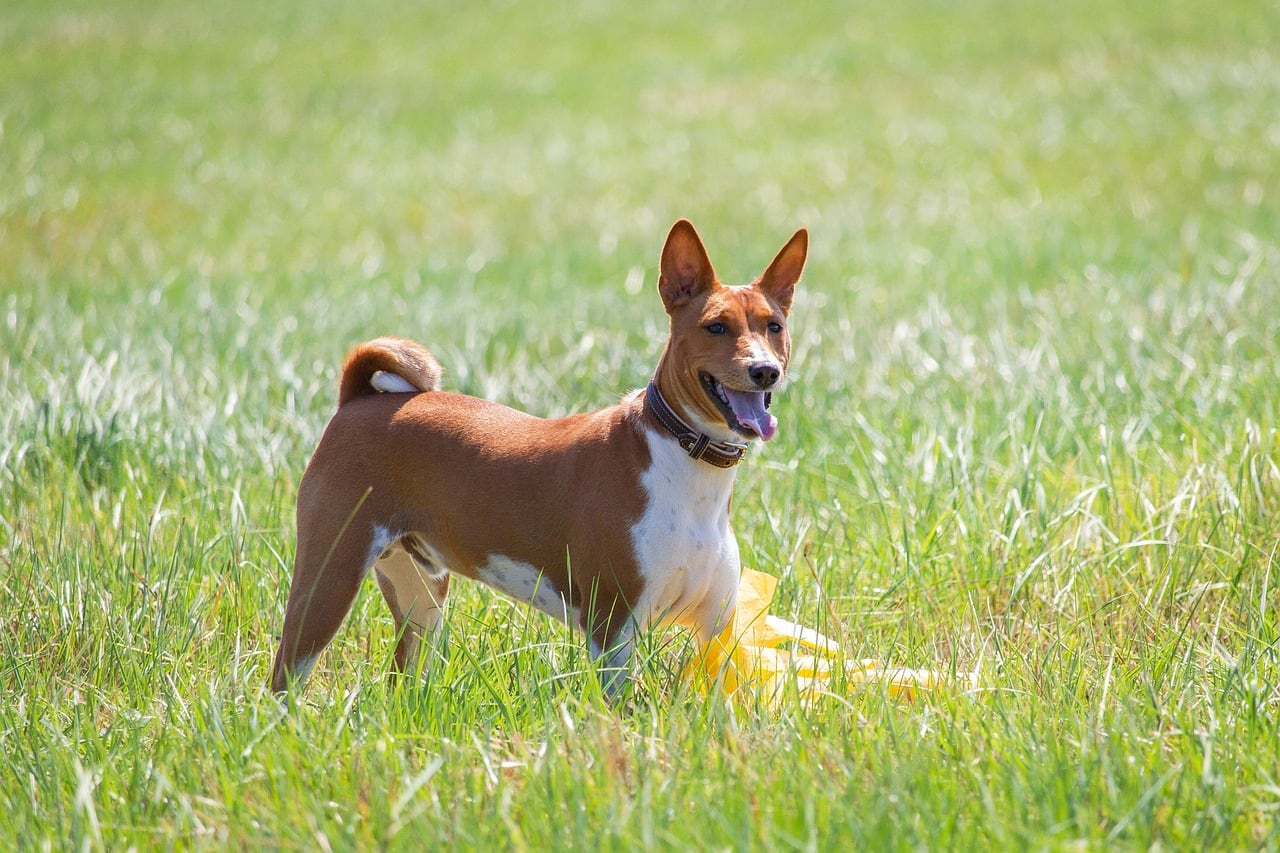
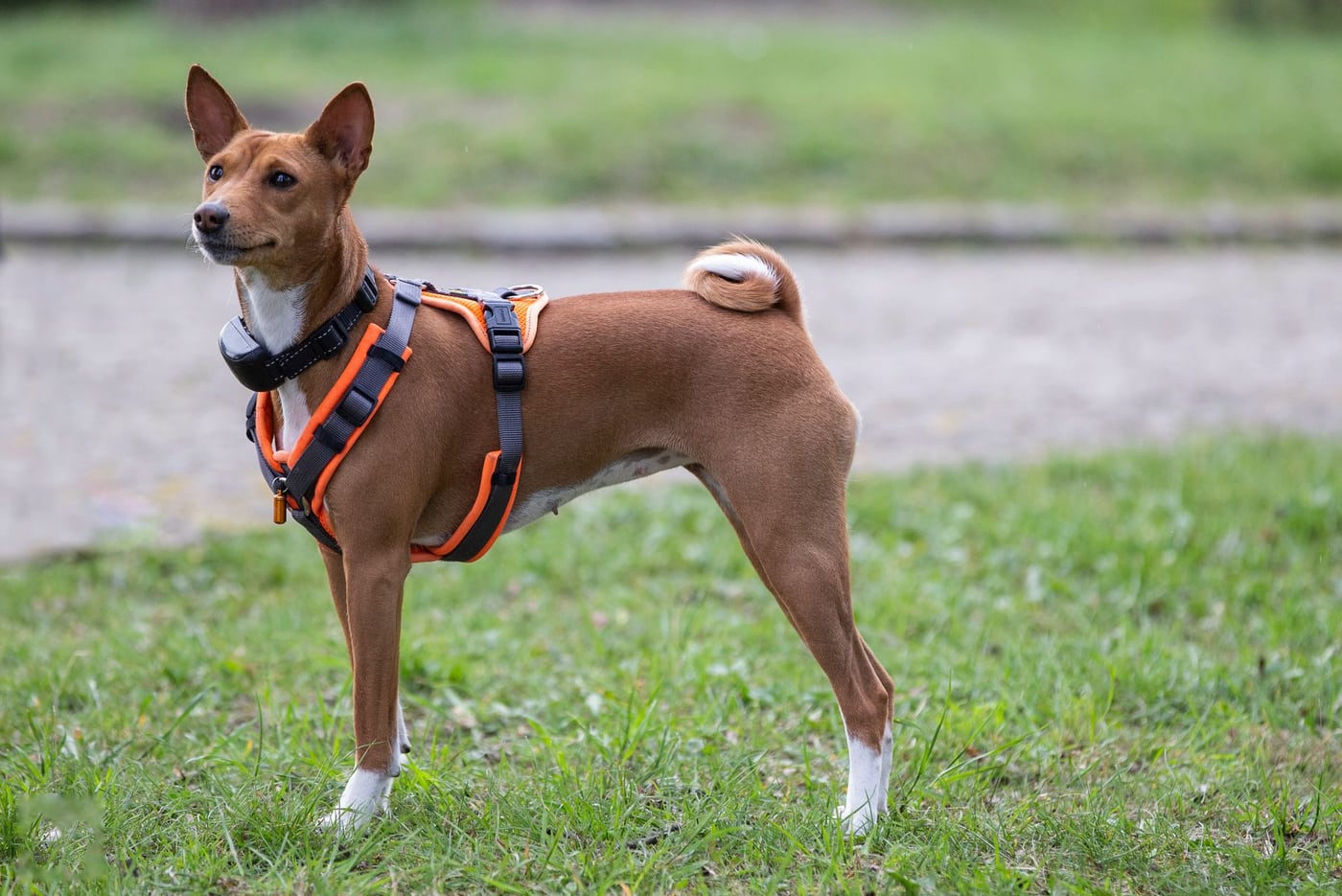
The Basenji is a medium-sized, lightly built breed with an elegant, athletic body reminiscent of an endurance runner. The male dog reaches a height of about 43 cm and weighs about 11 kg, the female is smaller - about 40 cm tall and weighs about 9.5 kg. The difference between the sexes is therefore mainly noticeable in the overall strength and height, not in the type of build.
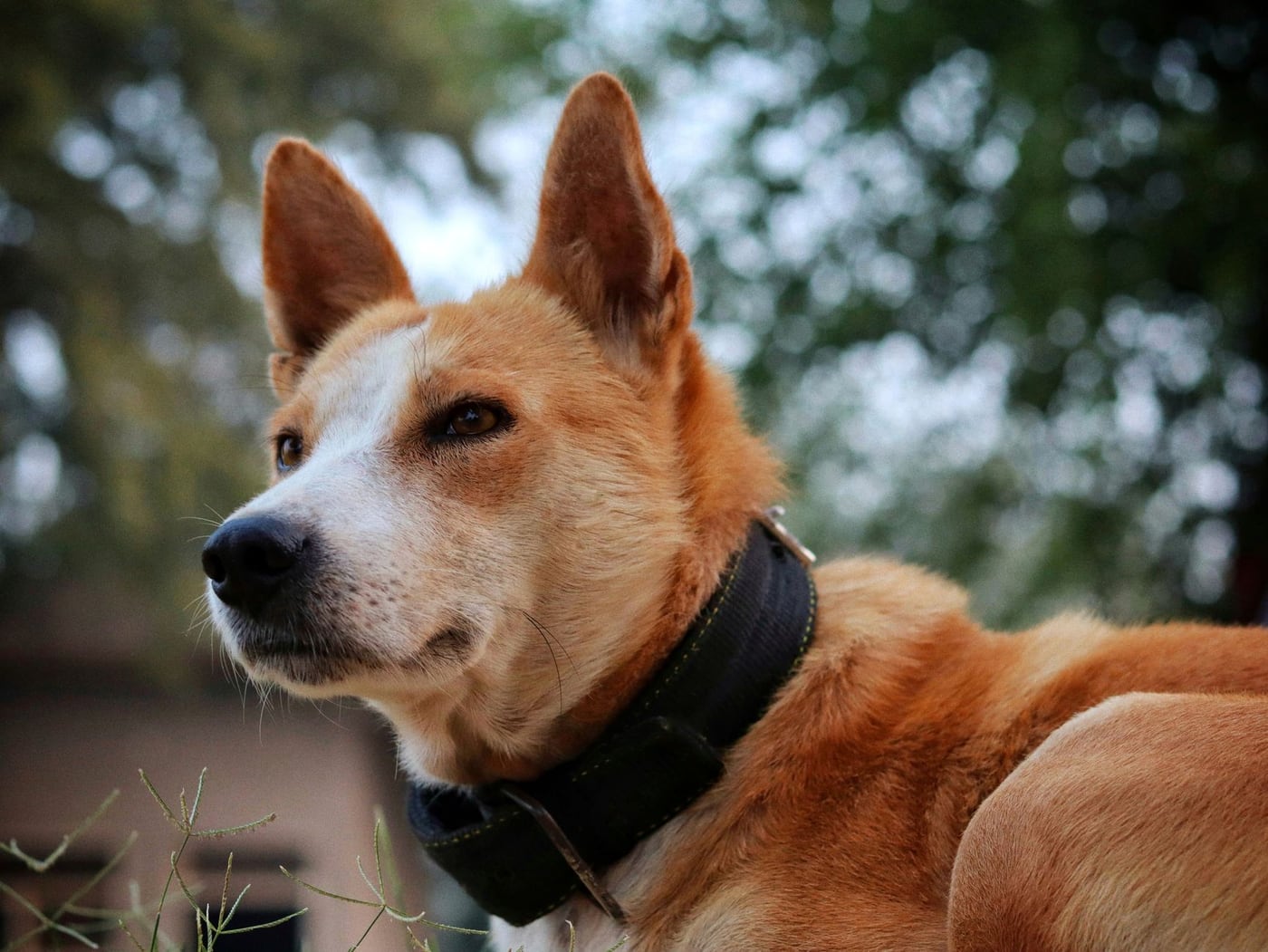
The body is short, roughly square, with a slender but firm chest and a high-set, slightly tucked-up belly, which underlines the impression of speed and agility. The neck is long and elegantly arched, the head flat, with a wedge-shaped shape and a slightly wrinkled forehead, which is most pronounced when alert or excited. The ears are small, erect and pointed, set high on the head, which gives the expression of constant alertness and alertness. The eyes are almond-shaped, dark, with a piercing and intelligent expression.
The coat is short, smooth and very fine, lying close to the body - making it easy to care for and minimal shedding. A typical feature of the breed is the high-set tail, which curls tightly into a single or double spiral and rests on the side of the back.
Coat color variations and their combinations with white are described in detail in a separate section on color.
Basenji Colors
The FCI standard for the Basenji defines the coloration quite strictly, with the basis always being a combination of a rich, pure shade with white markings on the paws, chest and tip of the tail - the white color should not blend into the rest of the coat with blurred transitions, but should form clearly defined areas.
Standard-recognized variants
The basic colors accepted by the standard include pure red, black and tan, black and white combination, or tricolor (black and tan with white) and the so-called brindle pattern, i.e. dark stripes on the base color. In all variants, the white must form sharply defined markings, not flowing transitions.
Non-standard coloring
In addition to the recognized variants, Basenji occasionally exhibits shades that are not described in the standard – typically significantly different combinations without a clear white border or completely atypical color bases. The fact that it is a non-standard color does not automatically mean a health risk; moreover, in the Basenji, there are no specific genetic links between coat color and health complications in the available documents, so we do not list any such connections here.
Basenji's nature
The Basenji is an independent-minded dog with a well-developed sense of self, which is manifested by a combination of high intelligence and a tendency to do things his own way. He tends to be emotionally attached to his owner, but this is expressed more by a quiet presence than by constantly seeking contact - his need for companionship is rather moderate, he is not a dog dependent on constant touch or attention.
Energy is high and so is the demand for mental employment - the Basenji needs regular physical exercise and tasks that engage the mind, otherwise it will find its own entertainment, often to the owner's displeasure. Training requires patience and consistency, because the Basenji is not motivated by obedience for obedience's sake - it responds better to consistent, meaningful training than to mechanical repetition of commands.
Stubbornness is a common trait in this breed and is evident from puppyhood – the Basenji likes to test its boundaries and see what gets away with it. Thanks to its origins in Central Africa, where it was used for hunting, it has developed strong hunting instincts, so small animals moving independently can arouse immediate interest and chase.
It does not resort to barking - this is a breed famous for not barking in the classic sense, instead it makes more of a yodeling or growling and whining noises. Guarding tendencies are not its main feature, it is more likely to alert to an unusual situation with a characteristic expression than to actively defend its territory.
In relation to other dogs, its behavior is variable and depends on socialization and the specific situation. It tends to be rather distrustful and even predatory towards cats and other small animals due to the aforementioned hunting tendencies. It behaves neutrally in contact with children - it is not the type of dog that would actively seek out their company, but it is not a conflict dog if it is used to normal household operations from a puppy.
Basenjis and children
The Basenji is considered a neutral choice for children – it is not a breed that would naturally offer itself to living with them, but under the right conditions it can work well with them. It is a dog with an independent, primitive nature, which keeps its own head and does not automatically seek contact as willingly as breeds bred specifically for working with humans. The noisy expressions of small children, sudden movements or attempts at physical contact can make the Basenji more insecure than happy.
Due to their high need for exercise and mental stimulation, the Basenji appreciates older children who can engage in active games, training or walks rather than toddlers who require calm and caution. The high level of training also means that the dog needs clear rules from puppyhood - without consistent training, it can easily get used to ignoring instructions, which in a family with children can manifest itself in inappropriate behavior such as pulling on clothes or ignoring prohibitions.
The role of socialization and supervision
Early and consistent socialization is key – the Basenji should be accustomed to the presence of children, their sounds and movements from puppyhood, so that it perceives them as a normal part of the household. Adult supervision during every contact is equally important, especially for younger children who are not yet able to assess a dog's signals of non-stress or the need for distance.
- It is advisable to teach children to respect the dog's space and not to disturb the Basenji while it is resting or eating.
- Playing together should be in line with the dog's nature - physical activities are more suitable than close cuddling.
- An adult should remain present as a mediator until the dog and child have built mutual trust.
Basenji and other dogs and pets
The relationship with other dogs is rather neutral in the Basenji - coexistence with another dog in the household is possible, but it is not a breed that would seek pack activities or automatically obey the established rules of dog hierarchy. The Basenji keeps its own head and approaches contacts with foreign dogs more cautiously than outright friendly.
Originally used for hunting in Central Africa, this breed has a strong hunting instinct. Small animals – rodents, birds or wild animals on a walk – easily trigger a chase reaction that is difficult to stop with a command. For this reason, it is not recommended to leave the Basenji off-leash in places where it could encounter potential prey.
The Basenji's relationship with cats is rather problematic, especially if they meet in adulthood. A better chance of peaceful coexistence is provided by raising the dog together from puppyhood, when the dog gets used to the cat as part of the household - but it is still advisable to carefully monitor the first contacts.
With small animals in cages or terrariums (rodents, birds), increased caution is necessary - the hunting instinct can prevail over learned rules, even in a dog that is otherwise calm and obedient in the household.
Is the Basenji suitable for an apartment?
The Basenji does not belong in an apartment, although it is not outright impossible - it depends on how much exercise and mental stress the owner is able to provide daily. This is a dog with a high level of activity and an equally high need for mental exercise, so an apartment may be enough for him only as a place to rest after a sufficiently demanding walk or training, not as his main living space.
The advantage for keeping in an apartment is that the Basenji hardly barks - it is known for making rather different, atypical sounds, and its barking is rated as low. Its short coat is also easy to care for, it sheds little, and its drooling is practically minimal. So there is no problem in terms of cleanliness and noise in the household.
If he is to live in an apartment, he should have at his disposal:
- sufficiently long and frequent walks with space for free movement,
- regular mental stimulation – toys, training, olfactory games,
- a quiet place to relax, where he is not exposed to unnecessary stress,
- an owner who devotes time to him every day, even outside of walking him.
Without these conditions, a Basenji can easily exhibit undesirable behavior in an apartment due to pent-up energy, which is why it is more suitable for more active households than as a classic "apartment" dog.
How much exercise does it need?
The Basenji needs plenty of exercise every day – it is a highly active breed that originated as a hunting dog working in the harsh African terrain and still carries this energy today. A short walk on a leash is definitely not enough, the dog needs space to run and the opportunity to fully utilize its fast, springy movement.
Due to its strong hunting instinct, movement needs to be combined with environmental control - the Basenji can chase game or a moving stimulus regardless of commands, so free movement without a leash only makes sense in fenced or otherwise secured areas.
Suitable activities
- Running and long walks in safe, fenced terrain
- Coursing and chasing artificial bait, where he can use his speed and hunting instincts
- Agility or obedience – suitable for dogs that can work with an experienced, patient handler
- Search and smell games that engage both the nose and the head
Mental stimulation
The Basenji needs mental exercise at least as much as physical exercise. It is an independently thinking dog with its own mind, which quickly gets bored with monotonous repetition - it is therefore worth including search games, varied walking routes and tasks where the dog has to deal with a problem on its own, instead of mechanically following commands.
Thanks to the low demand on the coat and low maintenance, more time is left for exercise and training, which for this breed needs to be reflected in the daily schedule rather than in appearance care.
Training and education
Training a Basenji is one of the more challenging – the breed is highly intelligent, but also very independent and self-thinking. Unlike breeds bred to work closely with humans, the Basenji does not have an innate need to follow commands just because they are given them – they have to find the motivation themselves, and the owner's job is to offer it.
Short, dynamic lessons that end before the dog stops having fun work best. Repeating the same exercise for a long time leads to dullness and ignoring instructions rather than establishing a habit. Positive motivation works best - treats, play, or the opportunity to "do whatever you want" for a while as a reward for cooperation. Harsh methods or pressure are counterproductive for this breed: the Basenji reacts to them by becoming more withdrawn and even less willing to listen.
What to focus on
- Consistency and consistency – the Basenji quickly recognizes inconsistency in requirements and uses it to its advantage.
- Reliable recall – due to its hunting origins and strong interest in its surroundings, it needs to be worked on consistently, ideally throughout its life, and outside of a secure area, the dog prefers to remain on a leash.
- Early and rich socialization – exposure to different people, environments, and situations at an early age helps manage natural alertness to foreign stimuli.
- Mental activity in the form of sniffing games, search games or simple tasks - the basenji does not enjoy an empty, repetitive drill routine.
Thanks to these specifics, the Basenji is more suitable for owners with previous experience who can work patiently and without frustration with a dog that does not just "let itself be controlled", but cooperates if it sees the point in it.
Hair care and hygiene
The Basenji's short coat is one of the least demanding to maintain - an occasional brush with a denser bristle is enough to remove loose hairs and keep the coat shiny. Shedding is low and occurs evenly, so intensive combing throughout the year is not necessary.
Bathing is only necessary occasionally, and the Basenji cleans its own fur - just like a cat, it licks its paws and fur, so it is naturally clean and does not have a distinct doggy odor. Frequent bathing tends to disrupt the natural protective layer of the skin, so it is better to approach it only when really necessary.
Ears, eyes, teeth and claws
- The Basenji's erect ears provide good ventilation, but regular visual inspection and gentle cleaning are still necessary to prevent the accumulation of grease or dirt.
- You just need to check the eyes occasionally and wipe off any small dirt with a damp cloth.
- It is advisable to brush their teeth regularly, as tartar formation is more common in small and medium breeds.
- Due to the dog's high activity and movement, the claws need to be monitored and shortened as needed, especially if the dog moves less on hard surfaces, which naturally wears them down.
Due to its short coat without undercoat, the Basenji does not need trimming or grooming at a groomer - all care can be easily handled at home in a short time.
Feeding
Due to its high activity level and slim, athletic body structure, the Basenji needs a high-quality complete food with sufficient animal protein content to cover the energy requirements of a breed bred for endurance exercise and hunting. The choice of food should correspond to the age, size and current load of the dog - a puppy, an adult and a senior have different nutritional requirements, and the needs of a dog with regular intensive exercise differ from those of an individual with a calmer regime.
Despite the high natural mobility, it is recommended to regularly monitor the body condition of the Basenji - the ribs should be easily palpable, but not visible, and a narrowed waist should be noticeable from above. If the owner reduces the amount of exercise (e.g. due to weather or a change in regime), it is advisable to adjust the amount of food accordingly to avoid gradual weight gain.
What to watch out for
- Choose food appropriate to the current life stage and level of physical activity.
- Regularly check your physical condition by sight and touch, not just by looking at your weight on the scale.
- Adjust the amount of food to the actual activity, not just the recommendations on the package.
- Pay attention to a regular drinking regimen, especially after strenuous exercise.
How long does a Basenji live?
The Basenji lives for approximately 13 to 14 years, which is above average for a medium-sized breed. However, the actual lifespan always depends on a combination of the genetic predispositions of the individual, the quality of care and the conditions in which the dog is raised.
What affects lifespan?
The same rules apply to Basenjis as to most primitive dogs – the closer the breeding is to the natural genetic basis of the breed, the lower the risk of hereditary problems. Therefore, responsible selection of a breeding pair plays a crucial role even before you even get a puppy.
- Genetics and Origin: Despite its long breeding history, the Basenji has maintained a relatively diverse genetic base, which may contribute to its overall vitality.
- Body condition: This is a breed with a dry, muscular body structure without a tendency to be overweight - maintaining a slim figure throughout life supports healthy joints and a healthy heart.
- Exercise: The Basenji has a high level of activity and needs regular exercise and mental stimulation. Enough moderately demanding activities help keep the dog fit both physically and mentally.
- Prevention: regular veterinary check-ups and health monitoring allow you to detect any changes early before they develop into more serious problems.
- Nutrition: a balanced diet appropriate to the dog's age, activity level and weight is one of the basic prerequisites for longevity in any breed.
- Health predisposition: Basenjis may have an increased predisposition to certain hereditary diseases, so it is advisable to be interested in the health history of the puppy's parents and prefer breeders who test breeding individuals.
Who is the Basenji suitable for?
The Basenji is a breed for experienced and active owners looking for a dog with an independent nature, high demands for mental stimulation and a willingness to devote themselves to consistent training. It is not a dog that will easily adapt to anyone - its primitive origins and independent thinking require a patient and consistent approach.
Who is the breed suitable for?
- For owners with previous experience training dogs who can handle a more demanding and consistent approach to training.
- For active people who can offer the Basenji regular exercise and enough mental stress.
- For households where low grooming needs and minimal shedding are valued.
- For those who appreciate that the Basenji does not bark in the classic sense of the word and is an overall quieter breed.
- For owners who are willing to provide their dog with enough stimulation and not leave it without interest for a long time.
Who is the breed not suitable for?
- For complete beginners with no experience with dogs, for whom the independent and more stubborn nature of the Basenji could make training difficult.
- For seniors or people looking for a calm companion with low activity requirements.
- For households with cats, where coexistence may not be problem-free.
- For owners who do not have the time or desire to devote themselves to their dog mentally and physically - without sufficient stimulation, the Basenji will easily find its own, not always desirable, entertainment.
Interesting facts about the breed
The Basenji is classified in FCI group 5 (Spitz and primitive-type breeds), specifically in the "Primitive type" section under standard no. 43 - it ranks alongside breeds such as the Pharaoh Hound, Canaan Dog, or hairless dogs of the Xoloitzcuintle and Peruvian Hairless types, which have also retained many of the characteristics of their ancestors without significant breeding intervention.
The breed originates from Central Africa, which makes it one of the geographically most original dog breeds ever - unlike most European breeds, it did not arise through targeted crossbreeding in recent centuries, but developed in local conditions practically without external influences.
Notable features of the Basenji include a very low rate of shedding and almost no drooling, which, along with low barking, makes this breed a relatively inconspicuous dog in terms of behavior - despite the fact that it is a very active and mentally demanding breed.
Basenji Health
The Basenji is one of the breeds with a longer life expectancy – an average of 13 to 14 years, which makes it a relatively long-lived medium-sized dog. It is one of the oldest and least genetically modified breeds, which, thanks to its origin in Central Africa and minimal intervention by breeders, has retained many of the characteristics of its wild ancestors. The short coat without undercoat means low maintenance, but at the same time lower resistance to cold and the need to adapt to walking conditions in winter. The high need for exercise and mental stimulation is closely related to overall fitness – a Basenji that does not have enough exercise is more prone to restlessness and frustration, which can also affect its overall well-being.
Locomotor system
The Basenji is built as a hardy and agile runner, his body is lean and muscular. Regular, but gradually built-up exercise is more important for maintaining healthy joints and muscles than occasional intense runs - jumping loads without training are not ideal for any breed.
Fur and skin
The short coat of the Basenji almost never sheds and does not require complex care, but it is still worth checking the skin regularly, especially after spending time outdoors in dense vegetation or at higher temperatures, when the breed overheats and cools more easily due to its short coat.
What to look for when choosing a puppy
When choosing a puppy, it is advisable to inquire about the health history of the parents and the breeding line, ask about any examinations that the breeder performs on the parent pair, and monitor the overall vitality and body structure of the puppy. A serious breeder should be able to document the origin of the puppy and provide information about the health status of the parents and previous litters.
Known predispositions
The breed is described to have an increased predisposition to:
- to Fanconi syndrome (a disorder of renal tubule function manifested by the loss of glucose and electrolytes in the urine).
- to progressive retinal atrophy (PRA).
- to persistent pupillary membrane.
- to hemolytic anemia caused by pyruvate kinase deficiency.
- to hypothyroidism.
- to chronic intestinal diseases (so-called Basenji enteropathy).
- to an umbilical hernia.
- to hip dysplasia.
This overview is for informational purposes only and does not replace the examination or recommendations of a veterinarian.
What to buy for a Basenji
Practical basis that is suitable for this breed:
- Car seats for dogs – Car seats and safety equipment for transporting a dog by car.
- Toys – Dog toys – fetching, chewing and interactive.
- Cosmetics – Shampoos, conditioners and hair care products.
- Bowls – Feed and water bowls, anti-swallow bowls and stands.
- Collars – Dog collars – leather, textile and semi-tight.
- Beds – Beds and mattresses for dogs of all sizes.
- Leashes – Leashes, switch leashes and tracking lines.
Useful guides
Practical tips that are useful when caring for a dog:
Frequently asked questions
Why doesn't the basenji bark?
The Basenji doesn't have vocal cords adapted for a classic bark, so instead it makes a growl, whine, or characteristic yodel-like sound. But it's not completely silent - it just uses a different repertoire of sounds than most breeds.
Is the Basenji suitable for beginners?
Probably not. It is an independent and stubborn breed with high training requirements that needs an experienced and consistent owner.
How active is the Basenji and how much exercise does it need?
The Basenji has a high activity level and needs regular, intense exercise and mental stimulation. Without enough exercise, he can become restless and seek his own entertainment, often in undesirable ways.
Do Basenji get along with cats and other animals?
The relationship with cats is not ideal, the Basenji has a strong hunting instinct. It gets along neutrally with dogs, depending on socialization and the specific nature of the individual.
Is the Basenji suitable for children?
The relationship with children is neutral - the Basenji is not a typical family pet that would actively seek contact, but it is not unsuitable for children either. Coexistence depends on the dog's upbringing and on how children respect its boundaries.
How much does a Basenji weigh and how big is it?
The Basenji is a medium-sized breed, the male measures around 43 cm at the withers and weighs approximately 11 kg, the female is smaller – about 40 cm and 9.5 kg.
How difficult is it to care for a Basenji's coat?
Coat care is easy, the Basenji has a short coat with a low shedding rate, so occasional brushing is sufficient. Another advantage is very low drooling.
How long does a Basenji live?
The Basenji lives an average of 13-14 years, which is a longer lifespan for medium-sized breeds.
Why is the Basenji so difficult to train?
The Basenji originated in Africa, where it worked independently as a hunting dog, and has retained this independence to this day. It does not have the natural need to obey commands that breeds bred to work closely with humans have, so training requires patience and consistency.
Is the Basenji suitable for an apartment?
Apartment suitability is neutral – the Basenji can handle apartment living as long as it gets enough exercise and mental stimulation outdoors. Without this, it can become bored and destructive in a small space.
Is the Basenji suitable for seniors?
Rather not, due to their high need for exercise, mental stimulation, and demanding training, the Basenji is a better choice for more active owners.
Resources and further information
- FCI Standard No. 43 - Basenji - Fédération Cynologique Internationale
- Source of body measurements – basenjiforums.com
Professional cooperation
This breed overview was created in cooperation with the Veterinary Clinic VYVET sro and MVDr. Adam Hylák .