
Published 17. 9. 2026
The Mastiff is a large breed originating from Great Britain, classified in FCI Group 2 among the molossoid types of dogs. It is one of the most massive breeds ever - adult males and females measure 70–77 cm at the withers, and dogs can weigh over 100 kg. Despite its impressive size, the Mastiff is calm and balanced, it barks little and does not need to be forced to be active - it can get by with a low level of exercise.
The short coat does not require demanding care, but on the other hand, it is necessary to count on more pronounced drooling, which is inherent to this breed. The Mastiff is friendly to children and is rather sociable, but is neutral towards strangers and other animals. It is not an ideal choice for beginners or seniors - its strength and size require an experienced owner who can handle consistent training.
Professionally consulted
The content was created in cooperation with the veterinary clinic Veterinární klinika VYVET sro and MVDr. Adam Hylák.
Quick overview
What is a Mastiff like?
The Mastiff is a giant breed originating from Great Britain, belonging to the molossoid type of dog. With a weight of 55–104 kg and a height of around 70–77 cm, it is one of the most massive breeds ever, with the male being significantly heavier than the female. Despite its impressive size, it is a dog with low exercise requirements and a rather calm nature – it spends its energy in an economical mode and is not drawn to more significant activity.
The Mastiff is balanced and sociable in nature, it behaves in a balanced manner towards children and is perceived as a rather friendly family dog. It is neutral towards strangers and other animals, including cats, and is gentle when it comes to barking. Training requires patience and consistency, because its size and strength make demands on a more experienced owner.
Thanks to its low activity level and easy care for its short coat, it is more suitable for a house with a garden than an apartment. Due to its weight, space requirements and significant drooling, it is not an ideal choice for beginners or seniors - it is better suited to more experienced breeders of large breeds.
Origin and history of the Mastiff
The Mastiff's roots go back deep into the history of the British Isles, where the massive Molossian dogs probably arrived with Phoenician traders or Roman legions, who encountered local war and hunting dogs bred by the ancient Britons. These ancestors were bred for strength, endurance and the ability to face large game and enemies - they were used as guard and fighting dogs, and later also for hunting large game such as bear and wild boar, and for the grueling chases that were a popular spectacle in England for centuries.
In the Middle Ages, these heavy dogs developed into a type bred primarily on manor houses as reliable property guards and hunters' companions. The English nobility valued mastiffs for their calmness, loyalty, and intimidating appearance, which could deter uninvited visitors without the dog having to be aggressive. Gradually, the characteristic massive type with short hair, broad skull, and powerful body, as we know it today, became established.
More systematic breeding and efforts to unify the type did not come until the 19th century, when dog shows and breed clubs began to be organized in England. The Mastiff was among the first breeds for which a standard was written, and Great Britain is still recognized as its country of origin. The breed was classified among the molossoid types within the International Cynological Federation, which formally confirmed its status as a separate, historically anchored breed.
Appearance and size
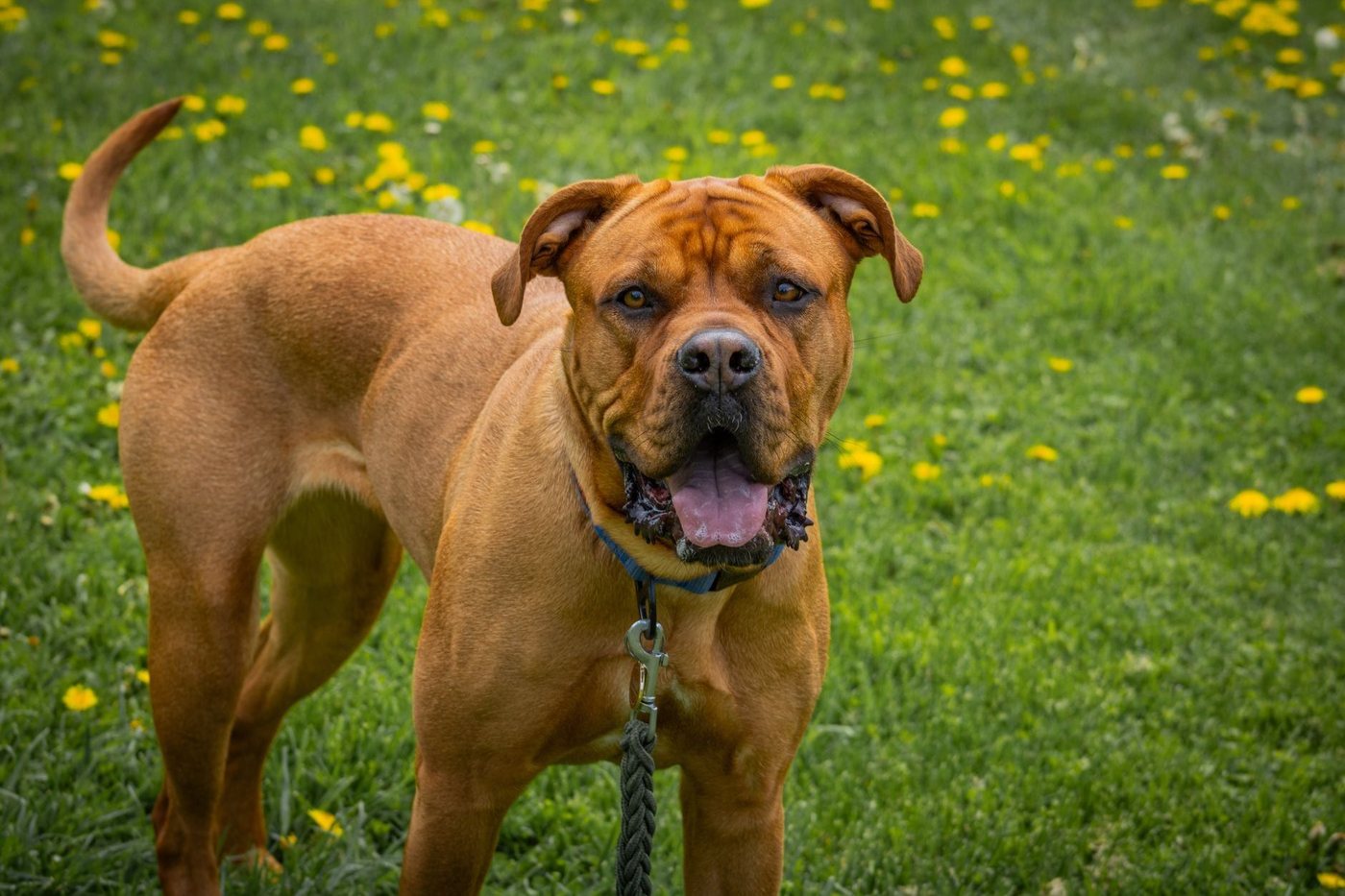
The mastiff reaches 70–77 cm at the withers, without any difference between males and females – the standard states the same range for both sexes. However, the weight differs significantly: the male weighs approximately 72.6–104.3 kg, while the female is lighter, weighing around 54.4–77.1 kg. It is one of the most massive breeds of all, with an exceptionally massive skeleton and a muscular, wide body.
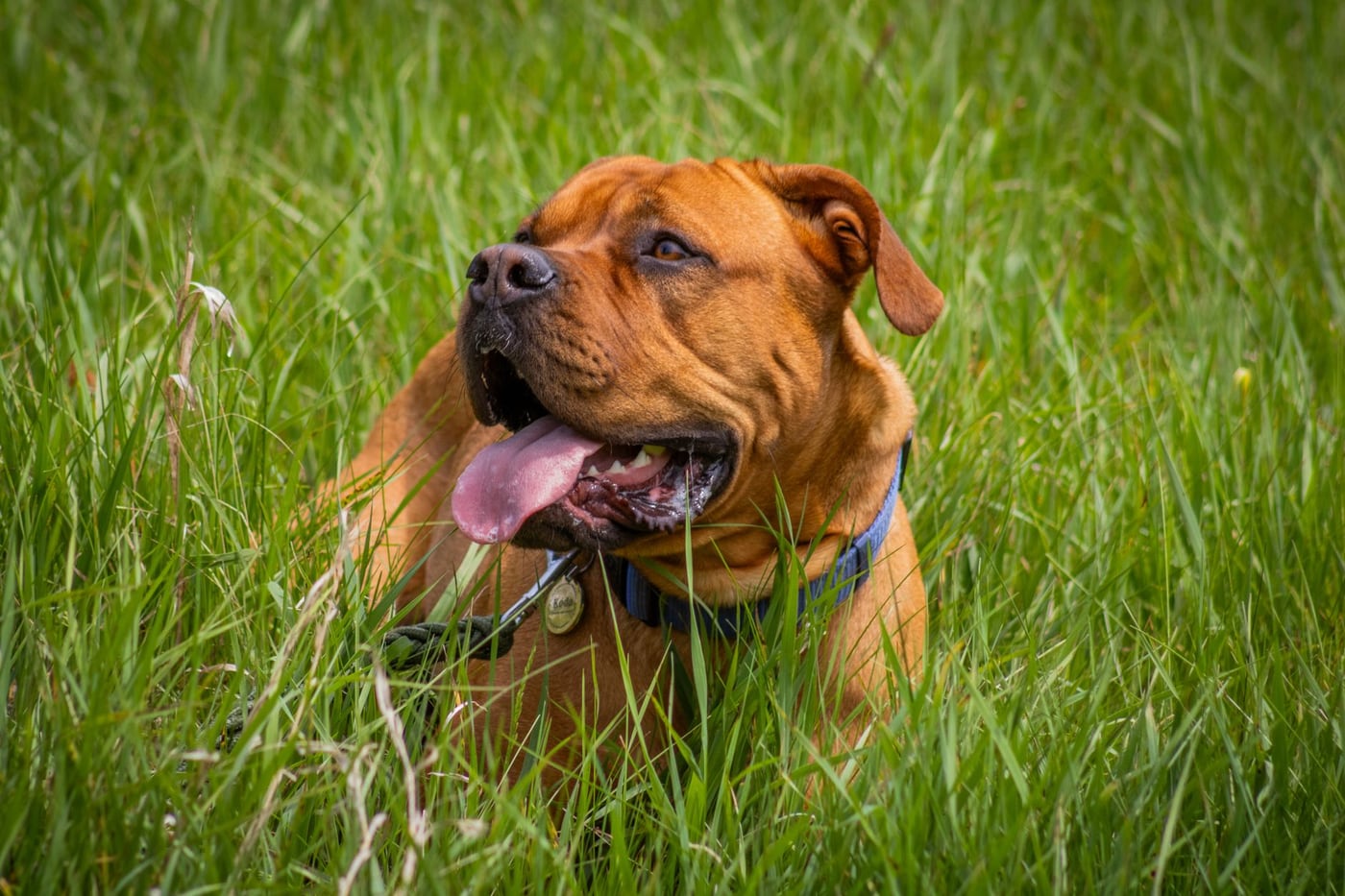
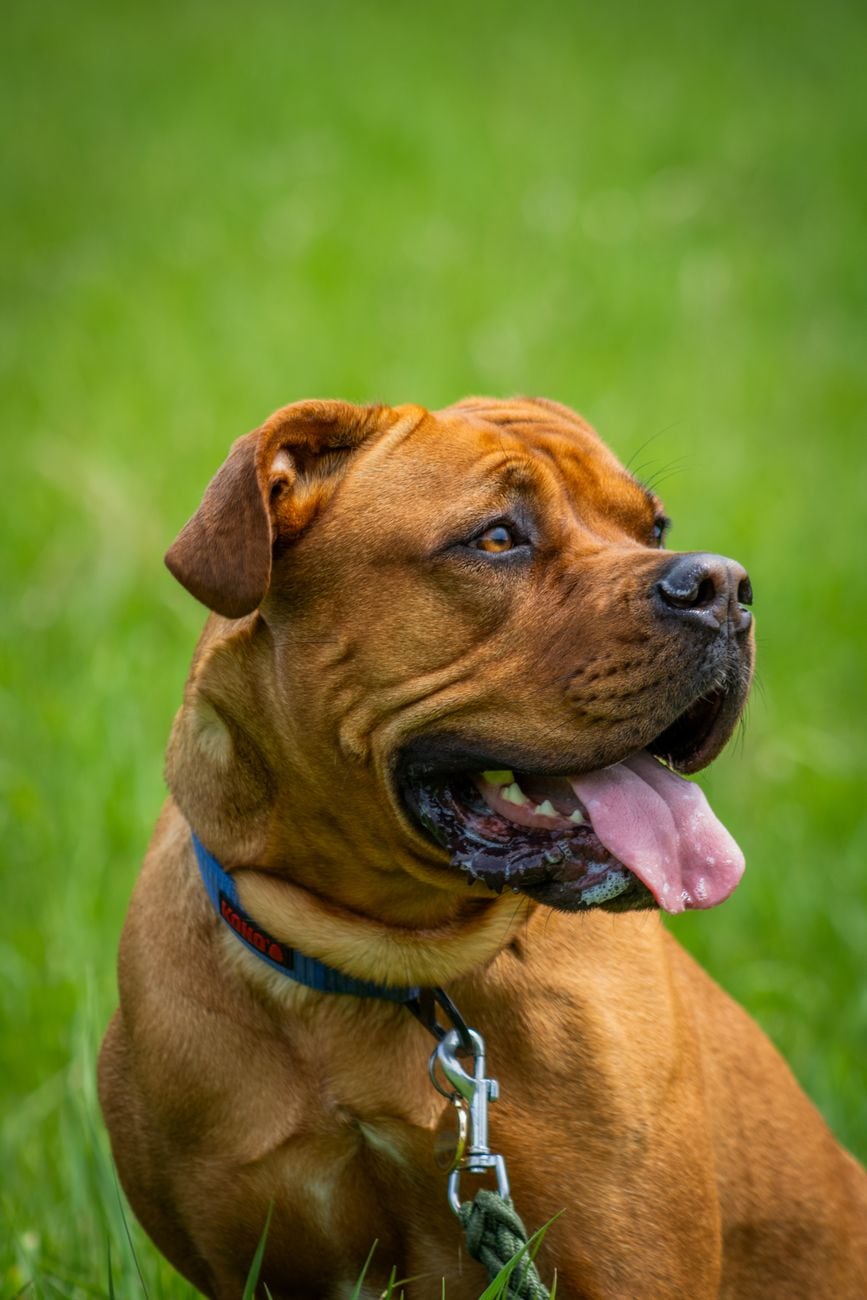
The head is large, square and imposing, with a prominent upper part of the skull and a broad muzzle. The eyes are rather small, dark, set far apart, which gives the expression a calm and serious character. The ears are small to medium in size, thin, close to the cheeks and set high on the head. The muzzle is wide, with pronounced but not excessively loose lips.
The body is compact, the chest deep and spacious, the back broad and strong, which corresponds to the role of the Mastiff as a powerful, calm-looking dog. The tail is set high, strong at the root and tapering towards the end, hanging down when at rest.
The Mastiff's coat is short, dense and close-fitting, and easy to groom. Specific color variations and their standard designs are described in a separate section dedicated to colors.
Mastiff Colors
The Mastiff standard emphasizes that the coat should be short and dense in terms of color - however, the standard specifies a specific list of recognized colors and permitted markings in more detail than the information available in this atlas, and therefore we do not list them here so as not to have to speculate.
What is certain is that this is a short-haired breed with low grooming requirements and moderate shedding - so the color of the coat does not have a significant impact on the amount of grooming required.
Mastiff's nature
The Mastiff is a calm and composed giant whose temperament certainly does not match its impressive size – it has low energy and likes to sleep or spend most of the day relaxing with its family. Nevertheless, it is a dog with a strong relationship with its owner, seeking his presence and acting as a social companion rather than an independent watchdog.
He is devoted to his family and is friendly towards children, making him a suitable companion even in households with children. He remains rather neutral and expectant towards strangers and other animals - this is not a dog that seeks conflict or barks at every stimulus; on the contrary, the barking rate of this breed is low.
The Mastiff's intelligence is evident, but it is combined with a certain amount of independent judgment and a slight stubbornness, so training requires patience and consistency - this is definitely not a breed that will mindlessly follow commands just because its owner wants it to. On the other hand, its need for mental stimulation is not extreme, so moderate but regular training is usually enough to keep the dog from slacking off and from being overworked.
The Mastiff's guarding instinct is based more on its physical presence and ability to respond when the situation requires it, rather than actively seeking out warning cues. A typical expression is a calm observation of the surroundings, accompanied by a certain amount of laziness and drooling, which are inherent to this breed.
Mastiff and children
The Mastiff is usually friendly and calm towards children, its temperament is more phlegmatic than boisterous - it is not one of the dogs that would excessively involve children in play or stress them with its behavior. Due to its size and weight, which in an adult usually exceeds 70 kg, it is necessary to always strictly supervise the coexistence with small children. Even an unintentional movement or leaning on a child can cause a fall or injury, due to the difference in size and strength, without it being a manifestation of aggression.
Low barking and low need for intense exercise make the Mastiff a dog that can function peacefully in a household with children - it does not require hours of active walking or noisy displays of energy. On the other hand, it is a breed with medium training requirements, which means that obedience and respect for rules need to be built consistently and from puppyhood, while the dog is still a manageable size.
Socialization and the role of an adult
The basis for a problem-free relationship between a Mastiff and children is early and consistent socialization of the puppy - introducing it to children's noises, movements and touch during the period when the dog is just learning what is a normal part of family life. An adult member of the household should:
- be present during every contact between the dog and young children, especially in the early years
- teach children how to behave around a large dog – not to pick it up, not to pull its fur, not to disturb it while it is resting or feeding
- Make sure that the dog gets used to handling, touching and the presence of children in various situations from puppyhood.
- respect that even a calm breed can react defensively to pain, fatigue or overexertion
With older children who already understand the rules of living with a large dog, the relationship is usually problem-free. However, for families with very young children, it is important to note that adult supervision remains a necessary part of everyday contact, as long as the child is not able to estimate the strength and size of the dog.
Mastiff and other dogs and pets
The Mastiff is described as neutral towards cats and other household animals - it does not seek out conflicts and, with gradual introduction, can coexist with cats and smaller animals without any problems. However, its size and weight are decisive, so it is always advisable to monitor the first contacts to avoid unintentional injury to the smaller creature.
He behaves calmly towards other dogs and without unnecessary need to dominate, which corresponds to his classification among the powerful guard breeds of the Molossian type - he is more of a dog that observes the situation and reacts with deliberation, rather than the type that would actively seek confrontation. His low barking rate also corresponds to this in his behavior towards strange dogs on a walk.
The Mastiff's need for companionship is medium - it is comfortable being part of the household, but it is not a dog that depends on constant contact with other animals. Thanks to its even temperament and the fact that it is rather friendly towards children, it integrates well into a household with more animals, as long as it has enough space and peace.
Is the Mastiff suitable for an apartment?
Probably not – even though it is a dog with low exercise requirements, its size and weight make a regular apartment an unsuitable environment. The Mastiff needs space where it can stretch out freely and turn around comfortably, which smaller apartments usually do not offer.
Ample indoor space is especially crucial – a dog of this size and weight (72.6–104.3 kg for males, 54.4–77.1 kg for females) will take up a significant portion of the living space just by lying down. A family home with a garden where the mastiff can go freely at any time is ideal.
- Space: a large body requires adequate space to rest and move around the home.
- Calm: this is a balanced and calm dog that does not create a lot of noise in the apartment, but needs somewhere to hide when it wants to be alone.
- Exercise: The mastiff's activity level is low, so long walks are not necessary, but he should still be able to stretch outside regularly.
- Barking: Mastiffs bark little, so they won't cause any noise problems for potential neighbors in an apartment building.
Drooling is a very prominent trait of this breed, which is another argument for a more spacious and easy-to-maintain home rather than a small apartment.
How much exercise does it need?
The Mastiff has a low activity level and its exercise requirements are rather modest - it will do well with short to medium-length walks spread out over the day, leisurely walks and free time in the garden. It is a breed built on a heavy, compact skeleton, so long, exhausting trips are not what it needs or what would benefit it.
Due to their massive build, it is advisable to choose activities with less stress on their joints – walking on softer surfaces, swimming or slower walks without repeated jumps and sudden turns. Classic high-intensity performance dog sports are not suitable for this breed; a calm walk together or easy obedience training is more appropriate.
He likes mental stimulation in smaller doses - short training sessions, sniffing games or practicing basic commands can keep the dog busy without physically taxing him. The training difficulty for the Mastiff is at a medium level, so training requires patience and regularity, but not an extreme time investment.
Due to their robust build and low tolerance for overheating, you should be careful when exercising in hot weather - in the summer it is better to choose walks in the cooler parts of the day and provide the dog with plenty of shade and water. The high rate of drooling is also related to the fact that the dog has a harder time cooling down after exercise, which is another reason to limit intense exercise in the heat.
Training and education
Training a Mastiff requires patience and consistency, although it is not a breed that is difficult to train - it is more a matter of motivation and early setting of boundaries, rather than the dog being unmanageable. Given its size and strength, it is crucial to start basic obedience training at puppy age, when it is much easier to correct unwanted behavior than with an adult, which can weigh over 70 kg.
Positively guided training based on rewards – praise, treats or play – works best. The Mastiff does not usually respond well to harsh methods or pressure, as it is a dog with a calm, rather independent nature that remembers unpleasant experiences well. Short, regular training sessions tend to be more effective than long, demanding lessons – the breed has a lower activity level and loses interest more quickly if training is lengthy or monotonous.
Socialization
Due to its massive body structure, it is important to introduce the Mastiff to different people, animals and everyday situations from puppyhood, so that it can establish a calm and balanced approach to its surroundings. A well-socialized individual is often a suitable companion for families with children, although due to its size it is advisable to teach both children and the dog mutual rules of behavior.
Breed specifics
- The lower need for exercise means that training should not be physically exhausting, but rather focused on obedience and self-control.
- Because of the strength and weight, it is essential to teach the dog not to pull on the leash and not to jump on people.
- The breed appreciates consistent rules and a clearly defined daily routine, which makes it easier for less experienced owners to train.
Hair care and hygiene
The Mastiff's short coat requires minimal grooming - brushing once a week with a rubber brush or glove is enough to remove dead hair and keep the coat in good condition. During the shedding season, the frequency increases to twice a week to prevent excessive hair buildup in the home.
Due to their large body structure and characteristic skin folds on the head and neck, it is necessary to pay attention to their regular inspection and cleaning - moisture and dirt trapped in the folds can lead to skin irritation. It is recommended to wipe the folds with a dry cloth after each walk or feeding.
Specifics of care
- Drooling: Mastiffs are among the breeds with a very strong tendency to drool, so it is advisable to have a cloth on hand and plan on wiping their mouth regularly, especially after drinking water or in warmer weather.
- Ears: Protruding ears should be checked regularly and cleaned to prevent moisture and dirt from accumulating in the ear canal.
- Eyes: Due to the looser skin around the eyes, it is advisable to regularly monitor for excessive tearing or irritation and gently wipe the eyes if necessary.
- Teeth: Brushing their teeth several times a week helps prevent tartar buildup, which is a common problem in large breeds.
- Claws: Due to lower natural activity, the claws do not wear down sufficiently on their own, so they need to be checked and trimmed regularly.
- Bathing: Bathing is only necessary when necessary, frequent washing could disrupt the skin's natural protective layer.
Feeding
Due to its body weight, which in adults ranges in the tens of kilograms, the mastiff needs food adapted to a large breed with slower growth - for a puppy, it is crucial to choose kibble designed specifically for large and giant breeds, because uncontrolled growth and excessive energy intake in the first months of life increase the load on the joints and skeleton.
Due to the low level of physical activity of an adult mastiff, the energy content of the food needs to be continuously adjusted according to the actual output - which is true for a more active dog, it can easily lead to overweight in this breed. Excess weight in such a heavy dog further burdens the joints and musculoskeletal system, so it is worth monitoring the body condition regularly, preferably by looking at and feeling the ribs and waist, and adjusting the amount of food accordingly.
What to watch out for
- Choose food according to the age, size and current weight of the dog, and for puppies, with regard to controlled growth.
- It is better to divide the daily dose into two portions - for large breeds, this is usually easier on digestion.
- Regularly check your physical condition and respond promptly to signs of overweight.
- After eating, give your dog some rest and avoid intense exercise immediately after feeding.
How long does a Mastiff live?
The average lifespan of a Mastiff is between 6 and 10 years. This is typical for such a massive breed – the larger the dog, the shorter its life, and the Mastiff is one of the most robust breeds of all, with dogs weighing over 100 kg.
The specific lifespan varies from individual to individual depending on a number of circumstances:
- Genetics and breeding: The puppy's background and the breeder's responsibility in choosing parents influence the burden a dog will carry into life.
- Physical fitness: Due to their large weight, maintaining a slim figure is key – excess weight puts a strain on the joints and heart and can significantly shorten a dog's active years.
- Exercise: The Mastiff is not a dog with high activity requirements, but regular and appropriate exercise helps maintain muscle mass and promotes joint health without overloading a growing or adult body.
- Preventive care: Regular veterinary check-ups allow for early detection of potential problems that may appear earlier in large breeds than in smaller dogs.
- Nutrition: Food adapted to the large breed and life stage of the dog helps prevent overloading of the musculoskeletal system and digestive problems.
- Health predisposition: Mastiffs may have an increased predisposition to orthopedic problems associated with their large size and weight, so it is advisable to pay attention to the condition of their joints throughout their life.
Who is the Mastiff suitable for?
The Mastiff is suitable for a household with enough space and taking into account that it is a giant dog with a calm nature, not an athlete for daily jogging. Given its low activity level, it is enough to get adequate exercise, but its size, training at the level of a more experienced owner and high drooling are factors that need to be considered in advance.
Who is the breed suitable for?
- For owners with a house and garden where a large dog has enough space to move and rest.
- For families with children – the Mastiff is rather friendly towards children and gets along well with them.
- For those looking for a more social dog that needs a moderate amount of contact with the family, not constant activity.
- For owners who already have experience training larger breeds and can handle medium training difficulty.
- For households where regular wiping of saliva and moderate shedding are not a problem.
Who is the breed not suitable for?
- For beginners with no experience with large and strong dogs – handling a Mastiff requires confidence and consistency.
- For living in an apartment - large dimensions and low suitability for a residential environment clearly speak against it.
- For seniors or people with limited physical strength who might have trouble physically handling a dog.
- For very active owners expecting a partner for sports or long trips - the Mastiff prefers a calmer regime.
- For households where increased drooling is a problem or where emphasis is placed on interior cleanliness.
Interesting facts about the breed
The Mastiff is one of the most massive dog breeds in the world – males weigh between 72.6 and 104.3 kg, females tend to be slightly lighter, weighing between 54.4 and 77.1 kg. Nevertheless, with a regular height at the withers of 70–77 cm for both sexes, it is one of the breeds where the difference between males and females is not as significant in posture as in body weight.
The English name Mastiff is given to the breed under the FCI standard No. 264, classified in the 2nd group among the molossoid types of dogs, specifically in the section of dogs of the dog type. The country of origin, Great Britain, gave this type of powerful guard dog a name that is still used in English today as a general designation for the entire group of large molossians.
Despite its impressive size and strength, the Mastiff is known for its low activity level and low barking rate – a dog that is more of a watchful, calm presence than an active seeker. This contrast between physical strength and calm temperament is one of the breed's most characteristic features.
Mastiff Health
The Mastiff is a large to giant breed, with an average lifespan of 6-10 years, mainly due to the strain on the joints and heart resulting from its body weight. Due to its rapid growth and high weight, this breed is at increased risk of musculoskeletal problems, so it is advisable to pay attention to nutrition and exercise from puppyhood. In addition to orthopedic problems, it is also necessary to take into account its limited physical fitness compared to smaller breeds, which is reflected in the overall daily routine. The following points summarize the areas that are worth considering for the Mastiff.
Joints and musculoskeletal system
Mastiffs may be at increased risk for hip and elbow joint disease due to the combination of their large size, heavy weight, and rapid growth during adolescence. Appropriate, gradual exercise and weight control help reduce stress on the joints throughout the dog's life.
Heart
Large breeds such as mastiffs are generally monitored from a cardiovascular health perspective, so regular veterinary checks of their heart function are recommended as part of preventive checkups.
Thermoregulation and physical exertion
The Mastiff has a low level of natural activity and its body structure does not allow it to withstand long-term intense exercise or high temperatures. Although the short coat makes it easier to care for, the massive body does not dissipate heat as well, so it is advisable to adjust physical activity to the weather and not overexert the dog on hot days.
Saliva and oral cavity
The Mastiff's very high rate of drooling is due to the structure of their mouth and lips. It does not pose a health risk in itself, but it is a good idea to regularly check the condition of the gums and oral cavity as part of routine care.
What to look for when choosing a puppy
- Be interested in the health of your parents, especially from the point of view of joints and heart.
- Ask the breeder about the growth plan and recommended diet for a large breed during the puppy period.
- Monitor the puppy's movement – it should be smooth, with no signs of limping or stiffness.
- Verify whether the breeder carries out regular veterinary checks on the parents.
Known predispositions
The breed is described to have an increased predisposition to:
- to hip dysplasia.
- to heart diseases such as dilated cardiomyopathy.
Discussed risks
- to elbow dysplasia.
- to bone tumors, such as osteosarcoma.
- Due to their deep and narrow chest, this breed is at risk for developing gastric dilatation and volvulus (bloat).
- to hereditary eye defects such as entropion or ectropion of the eyelids.
- to prolapse of the third eyelid gland (so-called cherry eye).
- to degenerative joint diseases due to high body weight and rapid growth.
This overview is for informational purposes only and does not replace the examination or recommendations of a veterinarian.
What to buy for a Mastiff
Practical basis that is suitable for this breed:
- Toys – Dog toys – fetching, chewing and interactive.
- Cosmetics – Shampoos, conditioners and hair care products.
- Bowls – Feed and water bowls, anti-swallow bowls and stands.
- Collars – Dog collars – leather, textile and semi-tight.
- Beds – Beds and mattresses for dogs of all sizes.
- Leashes – Leashes, switch leashes and tracking lines.
Useful guides
Practical tips that are useful when caring for a dog:
Frequently asked questions
How much does a mastiff weigh and how big will it grow?
The male weighs 72.6–104.3 kg and the female 54.4–77.1 kg, and the height at the withers is 70–77 cm for both sexes. This makes it one of the most massive breeds ever.
Is a Mastiff suitable for an apartment?
Probably not – due to its size and weight, the Mastiff needs a more spacious environment where it can move freely and rest. The low activity level partially compensates for this, but space is still important.
How long does a mastiff live?
The average lifespan of a Mastiff is 6-10 years, which is common for large and heavy breeds. The shorter lifespan is related to their large body constitution.
Does a Mastiff drool a lot?
Yes, drooling is very high in Mastiffs and owners should expect it to be a normal part of life with this breed. This is due to the looser skin around the muzzle typical of Molossoid types of dogs.
Is a Mastiff suitable for beginners?
Probably not – its size, strength and moderate training require a more experienced owner who can consistently lead the dog from puppyhood. An untrained adult Mastiff weighing over 70 kg can be difficult to handle.
Can a Mastiff get along with children?
Yes, the Mastiff is rather suitable for children and tends to be very devoted to the family. However, due to its size and weight, supervision is necessary to prevent it from accidentally knocking over or hitting a smaller child.
How difficult is it to care for a Mastiff's coat?
Grooming is low as the Mastiff has a short coat that does not require complex grooming. The shedding rate is only moderate, so regular brushing is sufficient at a normal frequency.
How much exercise does a Mastiff need?
The Mastiff's activity level is low, so he will only need shorter walks and a more relaxed routine. He is not a suitable companion for very active owners looking for a partner for running or long trips.
What health predispositions are particularly important to watch out for in the Mastiff?
The breed may be predisposed to orthopedic problems due to its large body weight and rapid growth during puppyhood. It is therefore recommended to monitor appropriate joint loading, especially at an early age.
Does a Mastiff bark a lot?
No, the Mastiff's barking rate is low and the breed is more likely to calmly observe its surroundings rather than react loudly to stimuli, making it a quiet companion at home.
What was the Mastiff originally bred for?
The Mastiff originates from Great Britain and belongs to the FCI group of molossoid types of dogs, which historically included breeds used as guard and defense dogs due to their strength and robust body structure. Today, it is primarily a companion dog.
Does the Mastiff get along well with cats?
The Mastiff's relationship with cats is neutral, meaning there is no significant aggression, but also no excessive interest. Mutual coexistence usually depends on proper introduction and socialization from puppyhood.
Resources and further information
- FCI Standard No. 264 – Mastiff – Fédération Cynologique Internationale
- Source of body measurements – en.wikipedia.org
- Expert resource – mastiffhealth.org
- Expert resource - web5.lifelearn.com
- Expert source - purina.co.uk
- Expert Resource - vethelpdirect.com
- Expert resource - pdsa.org.uk
Professional cooperation
This breed overview was created in cooperation with the Veterinary Clinic VYVET sro and MVDr. Adam Hylák .