
Published 11. 9. 2026
The St. Bernard is a large breed originating from Switzerland, classified in FCI Group 2 among the molossoid types of dogs. The male dog reaches 70–90 cm at the withers and weighs 70–80 kg, the female is slightly smaller – 65–80 cm and 50–65 kg. Despite its size and strength, it is calm, patient and family-oriented, barks little and will rather report strangers than actively guard them.
Its nature is balanced and sociable, it tolerates children and other dogs in the household well. It needs low activity, but it seeks human company intensely and does not like to be left alone for long. Caring for it involves frequent combing of its fur and putting up with a high level of drooling. It is not an ideal choice for beginners, but is more suitable for owners with spacious housing and experience with large breeds.
Professionally consulted
The content was created in cooperation with the veterinary clinic Veterinární klinika VYVET sro and MVDr. Adam Hylák.

Quick overview
What is a St. Bernard like?
The St. Bernard is one of the largest dog breeds ever – it grows to 65 to 90 cm at the withers and its weight ranges between 50 and 80 kg depending on the sex. It comes from Switzerland and is classified as a molossoid type of dog. Despite its impressive size, it is a calm, balanced dog with low exercise requirements and a gentle nature, which makes it a suitable companion for families with children.
It is characterized by a strong bond with its family - the St. Bernard does not tolerate loneliness well and needs to be part of the household. Training requires patience and consistency, so this breed is not recommended for complete beginners. The coat must be combed regularly, and significant shedding and abundant drooling, which are inherent to the breed, must be taken into account.
Due to its size and need for space, the St. Bernard is not suitable for an apartment - the ideal home for it is a house with a garden. It does not tend to bark, but it reliably warns of incoming visitors, and it usually gets along with other dogs in the household without any problems.
Origin and history of the St. Bernard
The St. Bernard originates from the Swiss Alps, specifically from the area around the Grand St. Bernard Pass, where the monks of the hospice founded by Saint Bernard of Menthon worked since the 17th century. They bred robust mountain dogs as guards and helpers in finding buried or lost pilgrims on the dangerous road between Switzerland and Italy. The breed's ancestors were ancient Tibetan mastiffs brought to the Alps by the Roman legions, who crossed with local shepherd and guard dogs in the mountain areas.
Hospice dogs became famous in the 18th and 19th centuries for their ability to search for lost travelers in deep snow and bring help - this practical use also led to their later reputation as mountain rescuers. Over time, working mountain dogs also evolved into lines bred more for companionship and representation, leading to the more distinctive and massive appearance we know today.
More systematic breeding and efforts to stabilize the type developed in the second half of the 19th century in Switzerland, where the first breed clubs were established and a breed standard was formulated. Switzerland is also recognized as the country of origin of the breed within the international canine organization FCI, under whose leadership the standard was later formally established. Over the course of two centuries, the mountain hospice dogs have developed into today's large, calm and sociable breed, which has retained the confidence and balanced nature of its Alpine ancestors despite the change in its use.
Appearance and size
The St. Bernard is one of the most massive breeds of all – the male reaches 70–90 cm at the withers and weighs 70–80 kg, the female remains slightly smaller, with a height of 65–80 cm and a weight of 50–65 kg. The difference between the sexes is therefore noticeable not only in the skeleton, but also in the overall robustness of the body.
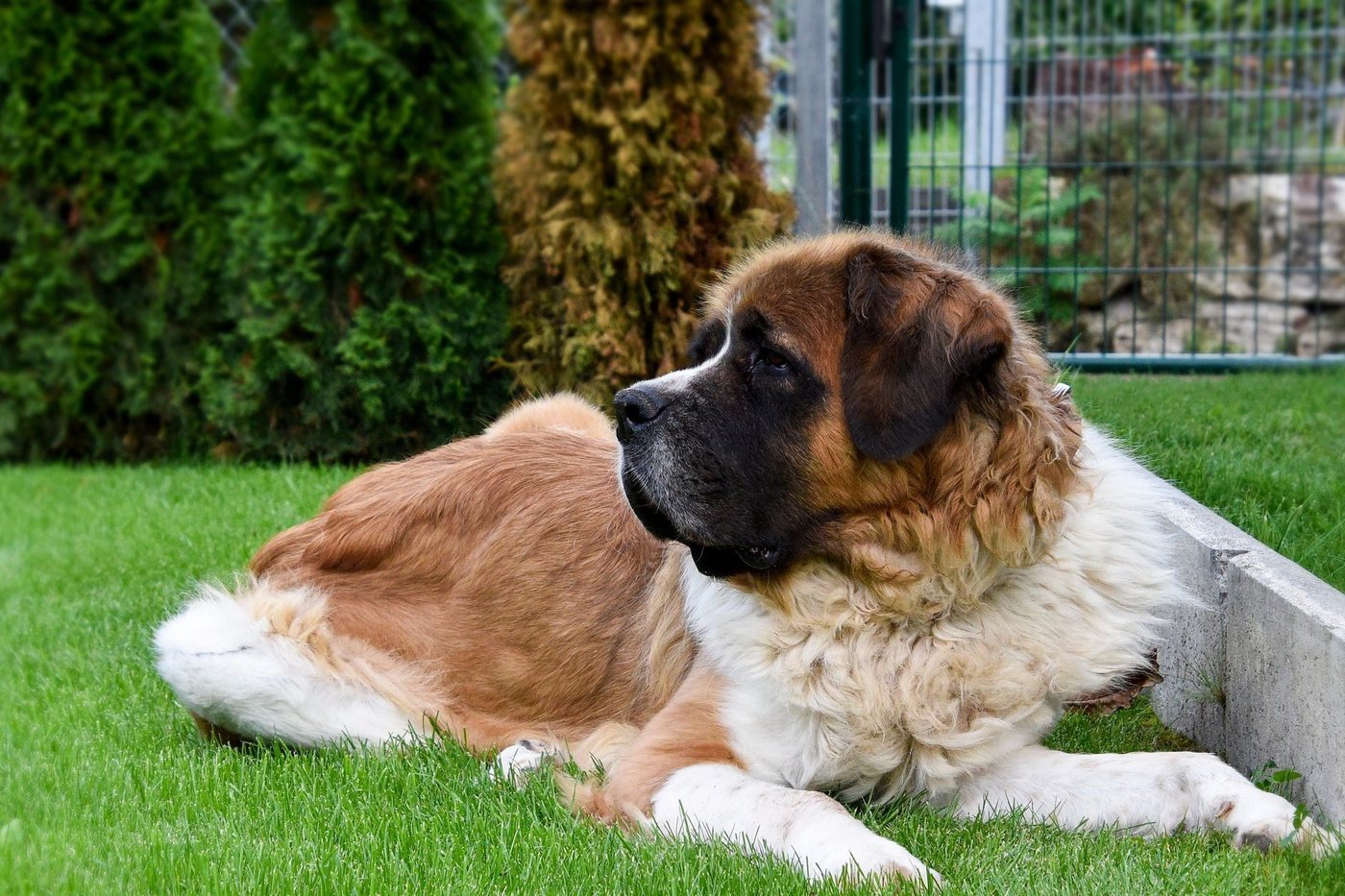
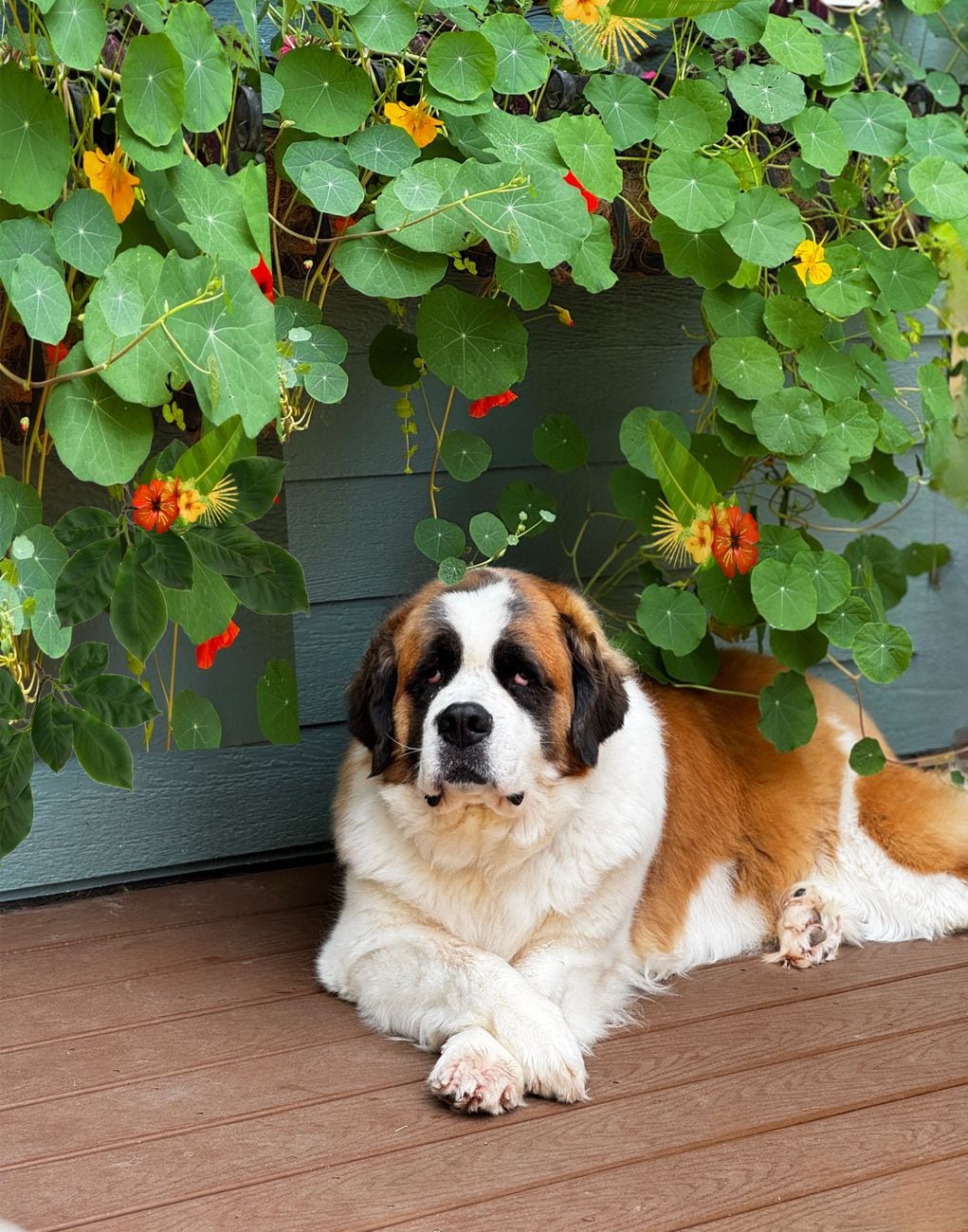
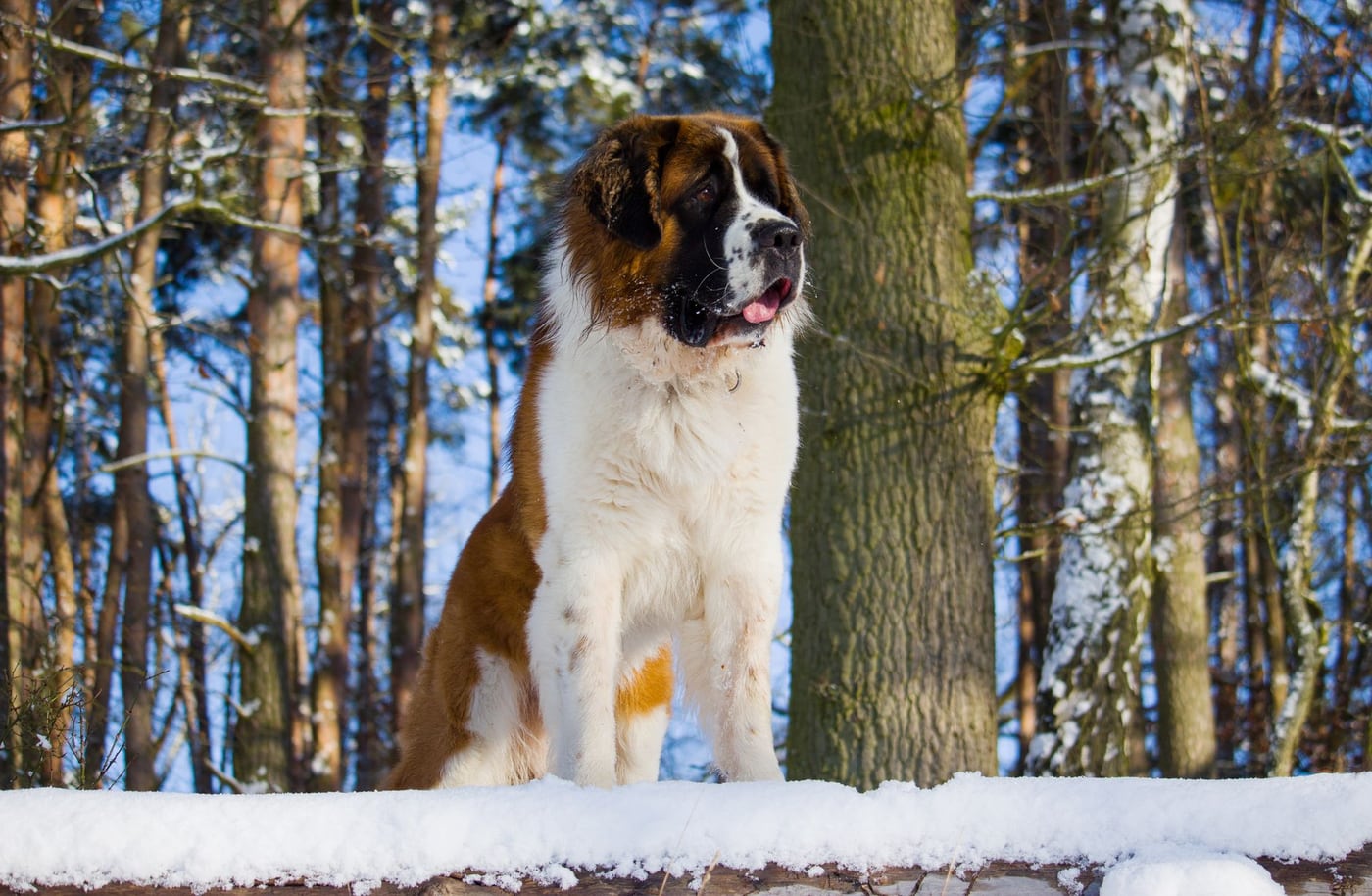
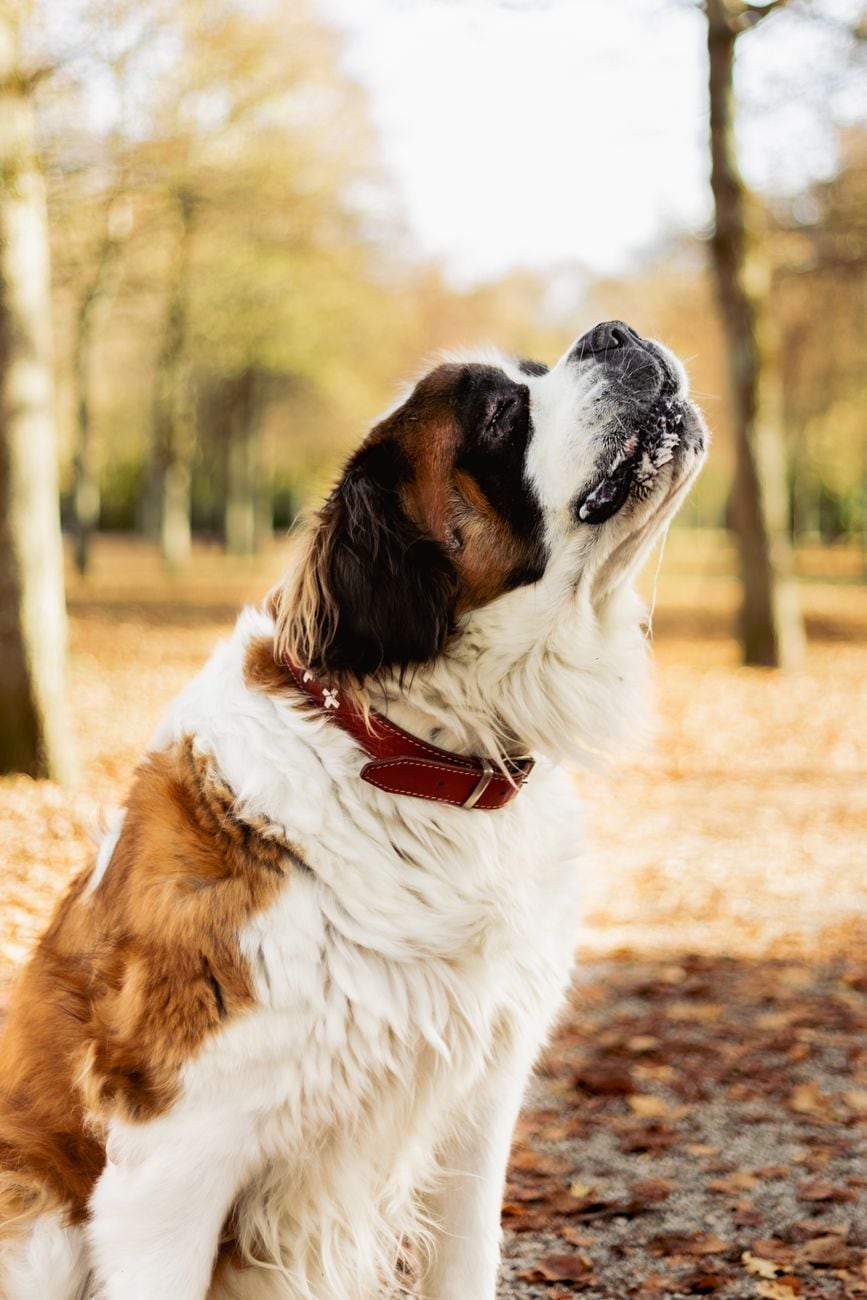
The body is massive and muscular, with a broad chest and strong bones, which is consistent with its origins as a mountain rescue dog. The head is massive, with a pronounced topline and a wide muzzle, the body and the overall impression of strength also include looser skin on the head and neck, which creates characteristic wrinkles. The ears are medium-sized, relatively high-set and hanging loosely on the head, the eyes are dark, with an expression that is often described as kind and calm.
The coat is medium in length and comes in two varieties – short-haired and long-haired, both of which have a dense double coat adapted to the cold mountain environment. This is accompanied by significant shedding, which must be expected throughout the year, and a higher tendency to drool, typical of dogs with looser skin around the muzzle.
The tail is long, strong at the root and carried low when at rest, slightly raised when in motion, but never curled over the back. The color variations of the coat are described in a separate section dedicated to color.
Colors of St. Bernard
The FCI standard for the Saint Bernard does not specify in the sources a specific list of recognized color variants and markings, therefore it is not possible to list here without the risk of inaccuracy a complete list of shades, white markings or mask patterns, as defined by the current standard No. 61.
In general, the St. Bernard is perceived as a breed with a characteristic combination of white and brown-red (or darker) coat color, complemented by typical white markings on the head, neck, chest and limbs - however, the exact distribution and permitted shades must always be verified in the current version of the standard.
Non-standard coloring
Non-standard colors include all variants that deviate from the standard combination of white and brown-red. There is no documented information available for the St. Bernard that a specific non-standard color variant is associated with an increased health risk - therefore, this connection cannot be claimed without a verified source.
The nature of the St. Bernard
The St. Bernard is a calm, balanced giant with a distinctly gentle nature - despite its strength and size, it does not appear dominant or aggressive, but rather a thoughtful companion whose presence is rather calming. It is strongly emotionally attached to its owner and family and needs to spend a lot of time with them - long separation or a life of solitude does not suit it.
This is an intelligent dog, but at the same time calm in its thinking pace - it solves tasks in its own way and without haste, which can seem like a slight stubbornness in training. In fact, it is more about independence and self-confidence, which this breed has already acquired from working in the mountains, where it had to make decisions without constant instructions from a person. Training therefore requires patience, consistency and kind guidance rather than harsh methods - rudeness or pressure does not tolerate St. Bernard well and it will not improve cooperation.
The breed has low energy and a phlegmatic temperament. The St. Bernard prefers rest to play and does not need intense physical activity, but will appreciate regular walks and moderate mental stimulation to keep him from getting bored. He is a sociable dog that gets along well with other dogs in the household, and is rather neutral and non-confrontational towards cats.
He barks sparingly, which does not make him a watchdog in the true sense of the word, but he can still alert you to unusual stimuli or visitors - he acts more like a calm observer than an active guard. He is patient and tolerant with children, which is why he is often considered a family dog, although his size and weight require adult supervision with small children.
St. Bernard and children
The St. Bernard is generally friendly and patient with his family members, including children - his sociable nature and low barking make him a calm domestic companion. Due to his massive body structure and weight, which in dogs reaches 70-80 kg, even a small, unintentional movement or leaning can easily knock a small child down or injure him. Living with children therefore always requires adult supervision, especially in the first years of the dog's life and with children of preschool age.
The key role is played by consistent socialization of the puppy and its gradual introduction to common situations that a family with children brings - noise, rapid movements or physical contact. Given the medium difficulty of training, it is advisable to start with basic obedience early so that the dog acquires calm behavior even around smaller children and learns to control its strength.
What to watch out for
- High weight and massive body build – even a friendly "welcome" can physically endanger a child.
- Very high level of drooling - it is necessary to take into account the need to regularly clean the dog's surroundings and the contact surfaces of children.
- Adult supervision should be a given whenever a dog and small children are allowed to move freely in the same room or in the garden.
- Gradual and patient integration of the dog into family life will also be facilitated by its high need for company - St. Bernard does not tolerate long-term isolation from the family.
The decision to acquire a Saint Bernard for a family with children should take into account not only the breed's temperament, but also the space available in the household and the willingness to give the dog consistent training from puppyhood.
St. Bernard and other dogs and pets
The St. Bernard usually gets along well with other dogs, thanks to its original mission - it was not a dog bred to work alone or to protect its territory against other animals, but a rescuer and companion who had to cooperate with people and other dogs in mountain service. This historical role is also reflected in its current nature: it does not have a pronounced hunting instinct and is usually calm around small animals and has no interest in chasing them.
Relationship with other dogs
The St. Bernard is a social dog that usually tolerates the presence of other dogs in the household or on walks well. It is not a breed with a strong dominance or territorial tendencies towards the pack - it is therefore rather receptive to living with another dog, especially if it is used to its presence since puppyhood.
Relationship with cats and small animals
Since the St. Bernard is not a hunting breed, its relationship with cats or small animals is not problematic - but the reaction varies from dog to dog and depends on how it was used to their presence. Reasonable socialization at an early age is therefore a good basis for peaceful coexistence under one roof.
What to consider when living with other animals
- Due to the St. Bernard's massive body structure, it is advisable to supervise interactions with significantly smaller animals to avoid unintentional injury while playing or moving around the apartment.
- Socialization from puppyhood makes it easier to live peacefully with other dogs and cats in the household.
- The high need for human company means that the Saint Bernard adapts well to living with other animals if it is part of a pack or household that it perceives as its family.
Is Bernardyn suitable for an apartment?
Probably not. The St. Bernard is a large breed with a large need for space, so an apartment is not an ideal environment for him - he feels better in a family house with a garden, where he has enough space to rest and move around freely.
The activity of the St. Bernard is low, so it does not require long walks or intensive exercise - its calm nature and low barking would theoretically allow it to live in an apartment environment. In practice, however, it encounters its dimensions and weight, which require a spacious environment rather than a limited apartment. Added to this is a very high rate of drooling and significant shedding, which in a smaller apartment means significantly higher cleaning requirements.
Due to their high need for companionship, St. Bernards do not tolerate long-term solitude, regardless of the type of housing they live in - they need to be close to their family. If the owner provides enough space, peace and regular, albeit undemanding, exercise, St. Bernards can live happily outside of an apartment in a house with a yard or garden.
How much exercise does it need?
The St. Bernard is a breed with a low need for exercise - it is not a dog that needs to be exhausted with long runs or demanding sports. Regular, rather calm walks adapted to its massive body structure and the slower pace that is natural to it are sufficient.
Due to the large body weight and the strain on the joints, it is better to spread the exercise into several shorter walks a day rather than one exhausting walk. Sharp jumps, long runs on hard surfaces or intense exercise at a young age, when the skeleton is still growing, are not recommended.
Suitable activities
- Quiet walks in nature, ideally in cooler weather
- Basic obedience and easy training that engages both the head and body
- Pulling light loads or sleds – continues the breed's historical use in mountain conditions
- Games and olfactory activities in the garden as a complement to walks
Mental stimulation should be at a moderate level - a Saint Bernard will appreciate simple tasks, finding treats or working with his sense of smell, but he is not the type of dog that needs constant new challenges.
Due to their massive body structure, thick fur, and tendency to overheat, you need to be careful about physical exertion on hot summer days - it is advisable to move walks to the morning or evening hours and significantly limit activity in hot weather.
Training and education
Training a Saint Bernard requires patience and consistency – this is an intelligent, but also slightly independent-minded dog that does not respond well to harsh methods or long, monotonous repetition of exercises. Positive motivation, short and clearly structured lessons, and a calm, consistent approach that respects its slower pace and low need for constant exercise are proven.
Due to the robust body structure, it is essential to start basic obedience training – recall, walk and put down – at an early age when the puppy is easy to physically correct. An adult St. Bernard weighing over 70 kg is practically unmanageable when it comes to disobedience on a leash, so pulling and leading on a leash should be mastered before he is fully grown.
Socialization
Thanks to their high need for human company and rather friendly nature, the Saint Bernard usually handles socialization without major complications. However, it is advisable to gradually expose them to different people, sounds, other dogs and common situations from puppyhood - this will help maintain their calm, non-conflict nature even in adulthood and will support their natural ability to alert to unfamiliar situations without unnecessary barking.
Breed specifics
- The low activity level means that training sessions should be short and gentle, without excessive physical demands.
- The moderate need for mental stimulation is well met with simple obedience exercises and sniffing games.
- For beginners, the size and strength of an adult dog can be difficult to handle, so more experienced guidance or consultation with a dog trainer is recommended.
Hair care and hygiene
The St. Bernard has a medium-long coat, but caring for it is definitely no small matter - the owner's main task is to manage the high shedding and abundant drooling that are inherent to this breed.
Coat and shedding
The coat requires regular brushing, ideally several times a week, and daily during shedding periods. Otherwise, dead hairs get stuck in the undercoat and the coat tends to mat, especially behind the ears, on the neck and on the back thighs. Given the dog's size, it is good to expect that combing the entire coat will take a long time - it is worth getting the dog used to being calm when brushing from a puppy.
Drooling and facial wrinkles
Very high drooling is a typical feature of the St. Bernard, which is related to looser lips and a large muzzle. The area around the muzzle and any skin folds on the head should be wiped regularly with a damp cloth to prevent moisture from accumulating in the folds and irritating the skin.
Bathing
Frequent bathing is not necessary - just wash your dog only when necessary, for example after the coat is dirty, as excessive bathing can disrupt the natural protective layer of the skin and coat.
Ears, eyes, teeth and claws
- It is advisable to check and clean the ears regularly, as moisture and dirt accumulate more easily in overhanging auricles.
- It is a good idea to monitor the eyes and, if necessary, gently wipe away any eye discharge.
- Teeth are cleaned regularly to prevent tartar buildup.
- Claws should be trimmed as needed, especially if they are not naturally worn down by sufficient movement on harder surfaces.
Feeding
Given the size and low level of physical activity, it is essential for the St. Bernard to choose a complete food designed for large and giant breeds, ideally with regard to age - a puppy, an adult and a senior have different requirements for energy value and nutrient ratio. In a growing dog of this size, it is advisable to pay attention to slower and more even skeletal growth, because rapid weight gain can put a strain on the joints.
Because the Saint Bernard is a less active breed, it is easy to inadvertently increase the amount of food given to your dog in proportion to its actual energy expenditure. Regular body condition checks – such as feeling the ribs and monitoring the waistline – should therefore be a natural part of your care, as should adjusting the amount of food according to the dog's current weight and physical activity.
Risk of being overweight
In such a heavy breed, any excess weight has a more significant impact on the joints, spine and overall vitality than in smaller dogs. Maintaining an optimal weight throughout life is therefore one of the easiest ways to support the physical health and comfort of a Saint Bernard in his later years.
- Choose food according to the dog's age, size and current physical activity.
- In puppies, ensure controlled growth without unnecessarily rapid weight gain.
- Regularly evaluate body condition and adjust the amount of feed accordingly.
- Avoid excessive feeding outside of main meals.
How long does a Saint Bernard live?
The St. Bernard lives on average 8 to 10 years, which is quite typical for such a large and powerful breed with a weight of over 70 kg for males and around 50–65 kg for females. The lifespan of giant breeds is generally shorter than that of smaller dogs, because their organism and skeletal and joint apparatus are burdened by a significantly higher body weight.
What affects the lifespan of a Saint Bernard?
- Genetics and origin of the puppy: The health of the parents and proven breeding significantly affect how long a dog will live and in what condition it will experience old age.
- Physical fitness: Maintaining a lean, not overly heavy physique reduces stress on the joints and heart, which is key for such a large breed.
- Exercise: The St. Bernard has a low need for activity, yet regular but gentle exercise helps maintain muscle mass and promotes joint health without unnecessarily overloading the growing or aging skeleton.
- Prevention: Regular veterinary check-ups allow for early detection of any problems associated with the size and weight of the breed.
- Nutrition: Food adapted to the large breed and life stage of the dog helps prevent overweight, which puts a strain on the St. Bernard's joints and heart.
- Health predisposition: The breed may have an increased predisposition to problems with joints and the musculoskeletal system, which is common in large and heavy breeds and should be taken into account when planning exercise and nutrition.
Who is Saint Bernard suitable for?
The St. Bernard is more suitable for owners with a spacious house and garden, who can count on significant drooling, high shedding and the need for regular, although not extremely demanding, coat care. It is a dog with a low level of activity, which will appreciate a quiet family life and the proximity of people, but it is definitely not suitable for an apartment or for people who leave the dog alone for a long time during the day.
Who is the breed suitable for?
- For families with children, because the Saint Bernard is rather friendly towards children and behaves calmly and sociably in the household.
- For homeowners with a garden, where they have enough space and do not have to handle high physical activity.
- For people who are willing to dedicate time to regular combing and cleaning after shedding and drooling.
- For households where the dog is a welcome part of everyday life - the St. Bernard needs a lot of contact with people and does not tolerate isolation well.
- For owners of other dogs with whom the Saint Bernard usually gets along well.
Who is the breed not suitable for?
- For residents of apartments or smaller households without outdoor space.
- For first-time dog owners with no previous experience – training requires patience and consistency, even though this is not an extremely stubborn breed.
- For people who cannot tolerate drooling and significant shedding in the home.
- For very active owners looking for a dog for long sporting performances - the St. Bernard prefers a calmer pace.
- For households where the dog would spend long hours a day alone, without human company.
Interesting facts about the breed
The St. Bernard is one of the largest recognized breeds - dogs can reach up to 90 cm at the withers and weigh around 80 kg, which makes them among the most massive dogs ever.
The Swiss name of the breed St. Bernhardshund refers to the Great Saint Bernard Hospice in Switzerland, from which the breed also got its name in the international designation St. Bernard.
Although this is a breed bred primarily as a companion dog, the preserved historical connection to the hospice indicates its original use in demanding mountain conditions - this is reflected in the massive body structure and thick, medium-length coat.
Bernard's health
The St. Bernard is a giant breed, weighing up to 80 kg and with an average lifespan of 8–10 years, which is a common range for dogs of this size. A body of this size and weight places significant demands on the skeletal and muscular apparatus, circulatory system and thermoregulation during growth and adulthood. Health care should therefore take into account in particular the puppy's growth rate, the weight load on the joints and limited tolerance to heat. Due to the thick coat and massive body structure, it is advisable to pay attention to regular care of the coat and skin.
Musculoskeletal system and growth
In large and giant breeds, rapid weight gain in the first months of life generally places increased strain on joints, ligaments and growing bones. For a Saint Bernard, who weighs tens of kilograms in adulthood, it is therefore advisable to ensure that the puppy is not exposed to excessive physical exertion or excess energy in the food ration during the growth period, and to allow it to gradually, controlled loading of the musculoskeletal system.
Heart and circulatory system
Large body size and high weight generally mean higher demands on the heart and circulatory system. For giant breeds, it is recommended to monitor their fitness level and not overexert the dog during periods of high temperatures or after meals.
Thermoregulation and drooling
The St. Bernard has a very high rate of drooling and a thick, medium coat with high shedding, which is related to its limited tolerance to higher temperatures. Its massive body makes it harder to get rid of heat, so it is advisable to limit physical exertion in the warm months and provide plenty of shade and water.
Hair and skin care
The medium length coat and high shedding rate require regular brushing to help keep the skin in good condition and prevent matting of the undercoat. Grooming should also include checking the skin folds on the head and neck, where moisture can accumulate.
What to look for when choosing a puppy
- Be interested in the health and fitness of your parents, as well as their age and lifestyle.
- Ask the breeder about the method of raising and feeding puppies during the growth period, given the rapid weight gain in this breed.
- Observe whether the puppy moves freely and without signs of pain or stiffness.
- Find out how the breeder addresses environmental conditions (access to shade, cold, space) in relation to the breed's thermoregulation requirements.
- Request available documentation about the health status of the parents, if the breeder has it available.
Known predispositions
The breed is described to have an increased predisposition to:
- to hip dysplasia.
- to elbow dysplasia.
- to the development of osteosarcoma (bone tumor).
- to dilated cardiomyopathy.
- to entropion (inversion of the eyelid).
- to acute gastric dilatation and torsion (gastric dilatation-volvulus) in association with deep chest pain.
- to entropion/ectropion caused by a loose skin fold in the facial area.
- to epilepsy.
This overview is for informational purposes only and does not replace the examination or recommendations of a veterinarian.
What to buy for a Saint Bernard
Practical basis that is suitable for this breed:
- Toys – Dog toys – fetching, chewing and interactive.
- Cosmetics – Shampoos, conditioners and hair care products.
- Bowls – Feed and water bowls, anti-swallow bowls and stands.
- Collars – Dog collars – leather, textile and semi-tight.
- Beds – Beds and mattresses for dogs of all sizes.
- Leashes – Leashes, switch leashes and tracking lines.
Useful guides
Practical tips that are useful when caring for a dog:
Frequently asked questions
Is St. Bernard suitable for an apartment?
No, a Saint Bernard is not suitable for an apartment. Its size, need for space, and high rate of shedding and drooling make it better suited to a house with a garden.
How much does a Saint Bernard weigh?
A male dog weighs 70–80 kg, a female dog is lighter, usually 50–65 kg. This makes it one of the significantly heavier breeds, which needs to be taken into account when choosing a bed and a car for transportation.
How long does a Saint Bernard live?
The average lifespan of a Saint Bernard is 8-10 years. This is the usual lifespan for large breeds, shorter than for smaller dogs.
Is a Saint Bernard suitable for beginners?
Probably not, the Saint Bernard is not an ideal choice for a first dog. Its size and weight require the owner to be confident in leading and controlling the dog, although the training itself is only moderately demanding.
Is a Saint Bernard good with children?
Rather, yes, the Saint Bernard is usually calm and tolerant with children. However, due to its size and weight, supervision is advisable during play so that the child is not accidentally knocked over.
Why does a Saint Bernard drool so much?
Drooling is related to the looser skin structure of the muzzle, typical of molossoid breeds. In the St. Bernard, drooling is very high and must be expected as a permanent part of life with this dog.
How much exercise does a Saint Bernard need?
The activity level of the Saint Bernard is low, it is not a dog that requires long sports performances. However, adequate regular exercise is still important, especially to maintain a healthy weight and joints.
How much does a Saint Bernard shed?
The shedding rate of the Saint Bernard is high, and due to the medium length of the coat and the undercoat, regular grooming is required in the home. Grooming is manageable, but requires regularity.
Where does St. Bernard come from and what was it originally used for?
The St. Bernard originates from Switzerland, where it is known as the St. Bernhardshund - Bernhardiner. It belongs to FCI group 2 among the molossoid types of dogs, section Molossian type.
Is a Saint Bernard a good watchdog?
The St. Bernard will alert you to unusual situations, but it is not an aggressive guard. Its barking is low, so it does not bark without reason, but rather calmly observes its surroundings.
Does a Saint Bernard get along with other dogs and cats?
It gets along well with other dogs, but its relationship with cats is neutral and depends on the specific socialization and nature of the individual dog. In general, the St. Bernard is considered a social breed that seeks contact with people.
Is a Saint Bernard suitable for seniors?
The St. Bernard's relationship with seniors is neutral, the main limiting factor is its size and strength when walking on a leash. It is definitely necessary to consider the owner's physical capabilities to handle such a large and heavy dog.
Resources and further information
- FCI standard No. 61 – St. Bernard – Fédération Cynologique Internationale
- Source of body measurements – fci.be
Professional cooperation
This breed overview was created in cooperation with the Veterinary Clinic VYVET sro and MVDr. Adam Hylák .