
Published 31. 8. 2026 · Updated 1. 9. 2026
The Miniature Bull Terrier is a small breed originating from Great Britain, classified in FCI Group 3 among bulldog-type terriers (standard no. 359). It is essentially a smaller version of the Bull Terrier - both males and females measure 35.5 cm at the withers and usually live to be 11 to 13 years old. The short coat requires minimal care, but training is all the more demanding: the Miniature Bull Terrier is energetic, tenacious and headstrong, so without consistent and patient guidance it can easily assert itself of its own accord. Thanks to its small size, it is also suitable for an apartment, but it needs plenty of exercise and mental exertion, otherwise it seeks entertainment on its own and may not be liked by its owner. It is rather friendly towards children and generally very attached to people, but it tolerates loneliness less well. It can be distrustful and even conflictive towards cats and sometimes other dogs, which needs to be addressed from puppyhood. This breed is usually not recommended for a first dog - it will be appreciated more by an active owner with experience in training.
Professionally consulted
The content was created in cooperation with the veterinary clinic Veterinární klinika VYVET sro and MVDr. Adam Hylák.
Quick overview
What is the Miniature Bull Terrier like?
The Miniature Bull Terrier is a small breed from Great Britain that carries the temperament of its large ancestor, the Bull Terrier, in a compact body. It reaches around 35.5 cm at the withers, regardless of gender, and usually lives for 11–13 years. Its muscular build, short coat, and typical egg-shaped head are its distinguishing features.
By nature, it is a tenacious, energetic and very sociable dog with a high need for exercise and mental exertion. Without enough stimuli, it easily becomes bored and seeks its own entertainment, which causes worries for the owner. Training requires patience and consistency, because the breed has a mind of its own and likes to test boundaries.
He is best suited to active people with previous experience with terriers who can offer him plenty of exercise and mental stimulation. With introduction and socialization from puppyhood, he can live with children, but he tends to be rather reserved with cats and strange dogs.
Origin and history
The Miniature Bull Terrier originated in Great Britain as a smaller version of the classic Bull Terrier, with which it shares its ancestors and typical appearance - an egg-shaped head and a solid, muscular body. The breed was based on dogs created by crossing bulldogs with various terriers in the 19th century, with the aim of breeders at the time being to obtain a courageous, tenacious dog used for hunting small game, killing rodents and in some cases for organized fights, which were widespread in England at that time.
While the standard Bull Terrier gradually established itself as a larger, more robust dog, breeders also maintained smaller lines – these were practical for burrowing and rat-hunting work, where agility and lower body weight were valued rather than bulk. These smaller individuals were gradually crossed and selectively bred by breeders to retain the characteristic head profile and temperament of the large Bull Terrier, but in a more compact frame.
The independent recognition of the smaller variant as a distinct breed came only after the establishment of the Bull Terrier standard - the miniature form was bred rather marginally for a long time and its type uniformity became established later. After the formal definition of the standard and its inclusion in the international cynological nomenclature under the FCI, the Miniature Bull Terrier spread beyond the British Isles, but remained a less common breed in terms of numbers than its larger predecessor, with which it is still closely related both in origin and in character traits.
Appearance and size
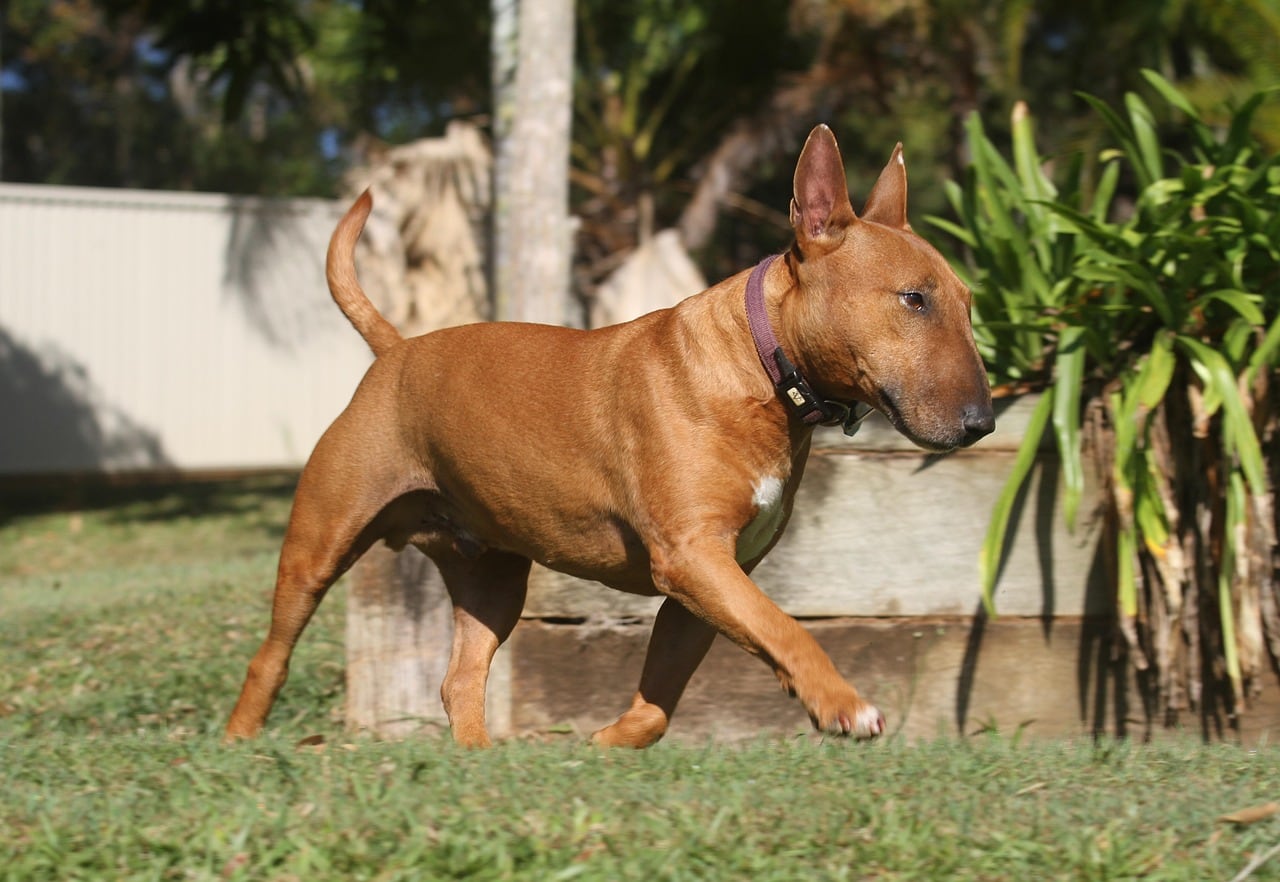
The Miniature Bull Terrier is a small, compactly built breed with a height at the withers of 35.5 cm, while the standard does not distinguish between males and females - both sexes reach the same height and their build follows the same proportions. The body is muscular and solid, with an impression of strength that can be surprising at first glance for such a small dog.
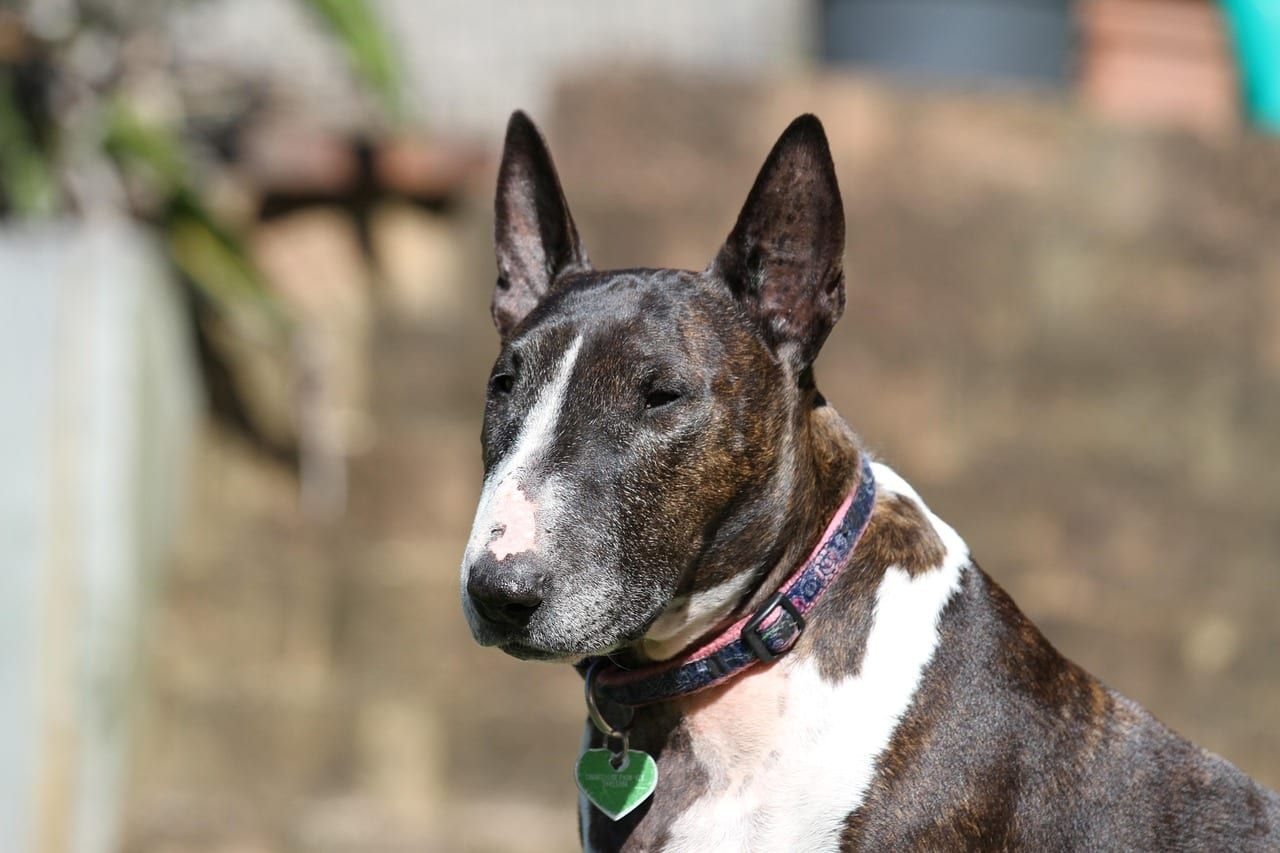
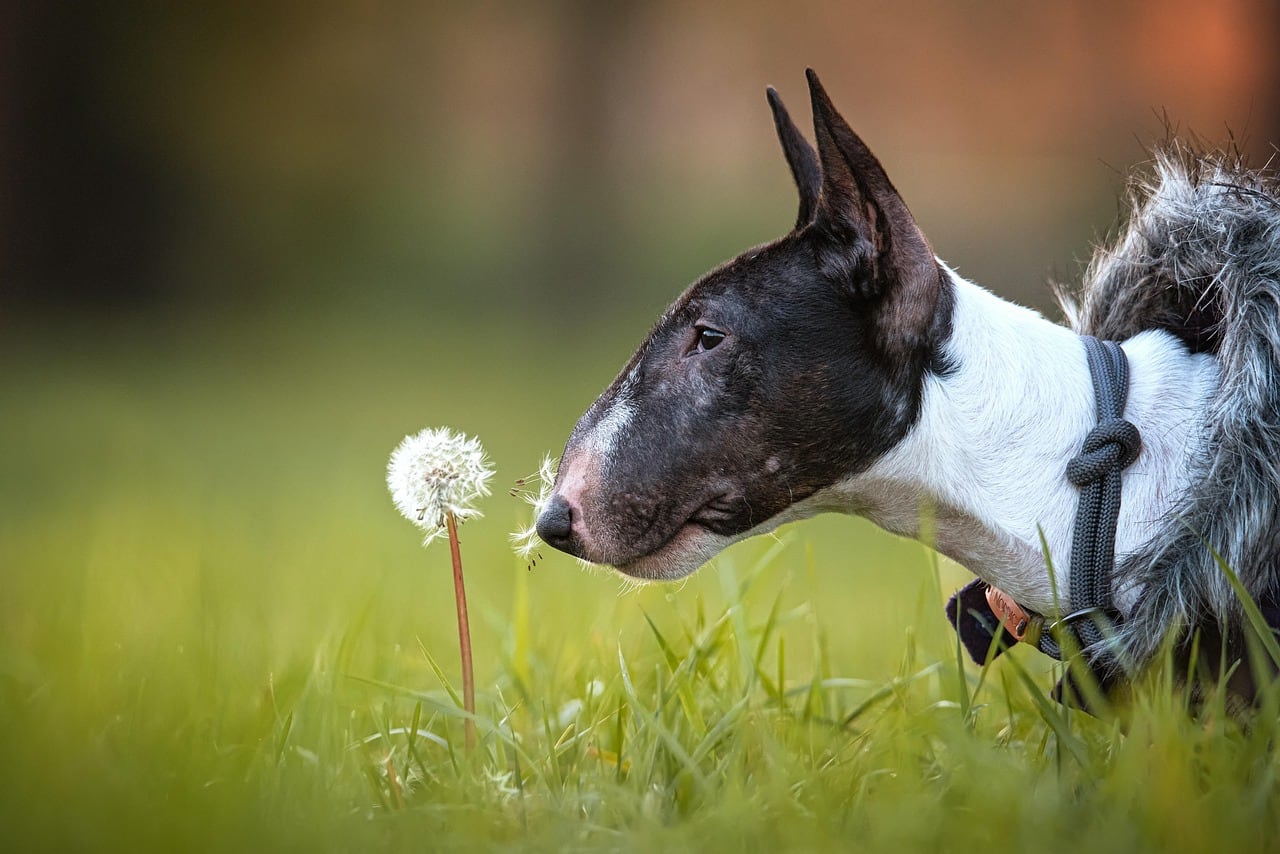
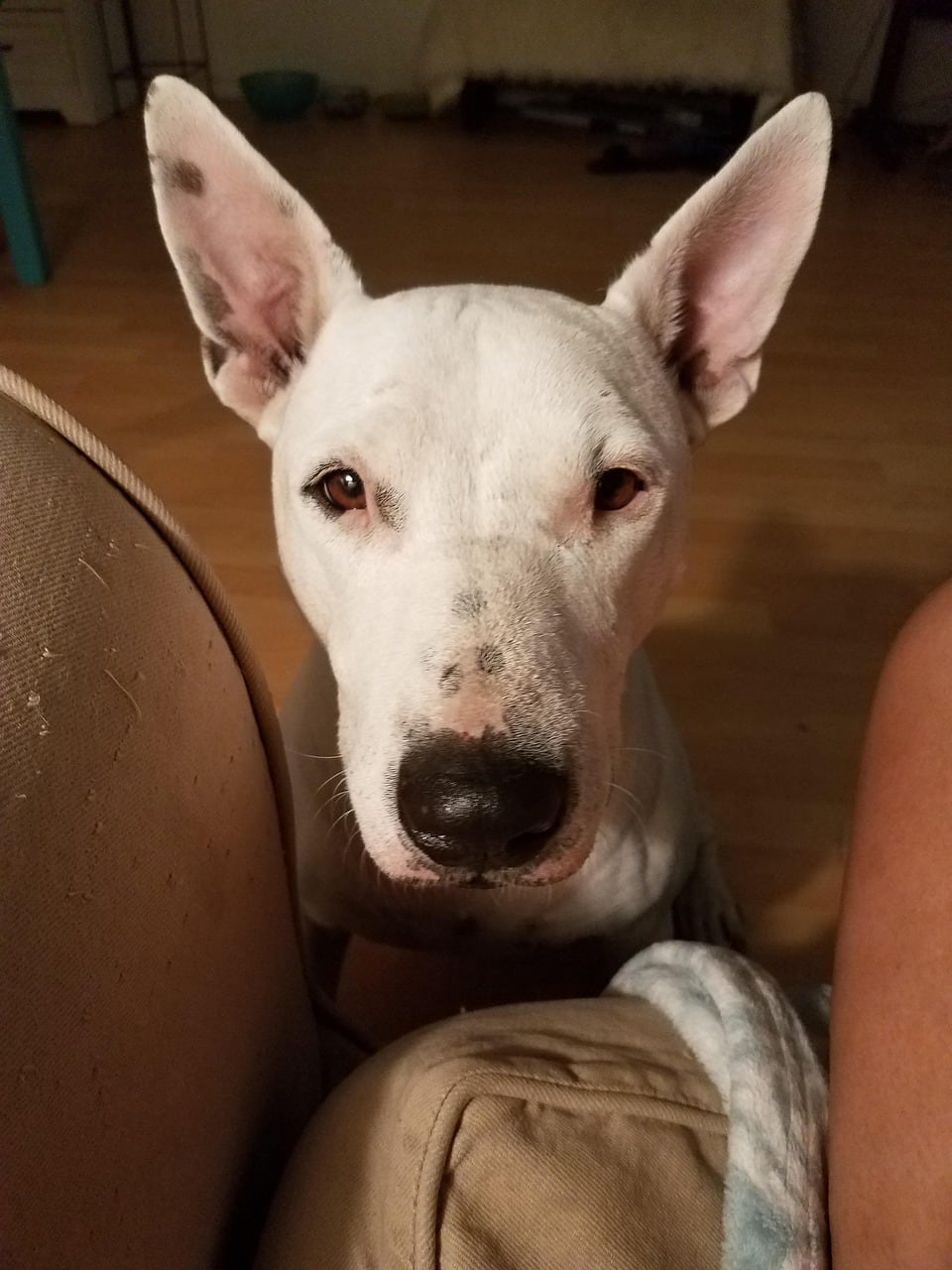
The most distinctive feature of the breed is the egg-shaped head - when viewed from above and from the front, it resembles a slightly curved oval, the profile is smoothly arched from the crown to the bridge of the nose without a pronounced break (trace). The ears are small, set close together, erect and carried with the tips upwards. The eyes are narrow, triangular and set obliquely, which gives the breed's expression a characteristic piercing attention.
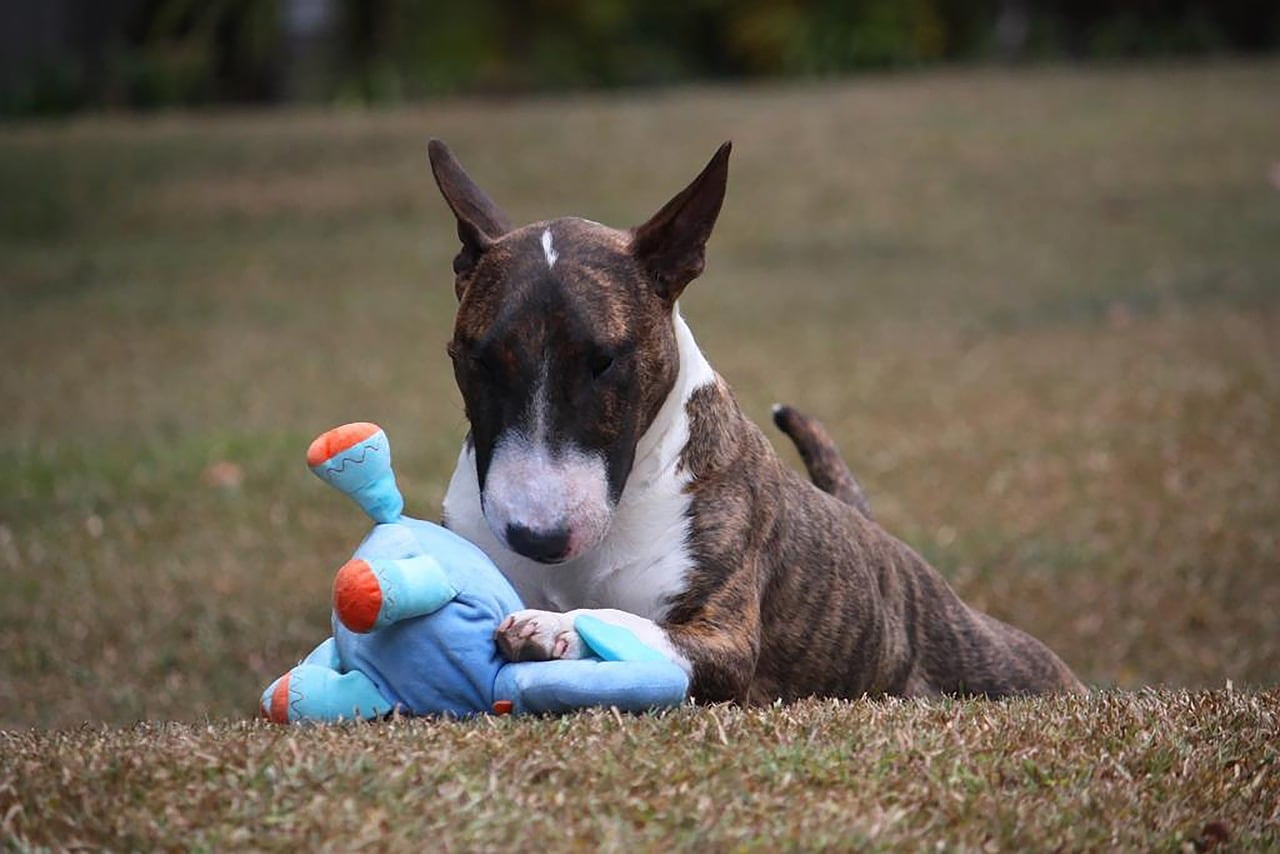
The coat is short, dense and close-fitting, rather rough to the touch, with a glossy surface. This type of coat does not require complex grooming, but the breed sheds to a reasonable extent. Specific color variants and their standardization are described in a separate section on colors.
The tail is set low, tapering towards the tip and carried horizontally, never carried high over the back. Overall, the breed gives the impression of a small but extremely compact and muscular dog, whose body structure corresponds to a smaller version of the classic Bull Terrier.
Miniature Bull Terrier Colors
The FCI standard for this type of terrier distinguishes two basic color varieties, in which the assessment of color is part of the overall exterior evaluation, not just an additional feature. However, the standard specifies a specific list of recognized color shades and permissible features in more detail than the data available in this atlas, and therefore we do not provide an exact list here to avoid distortion.
We recommend that those interested in a Miniature Bull Terrier consult the current version of the standard with the breed club or directly with a verified breeder regarding the exact color range and its deviations - they can also provide information from a specific breeding line for individual color varieties.
Miniature Bull Terrier temperament
The Miniature Bull Terrier is a spirited, tenacious dog with a very high energy level, which remains true to its terrier character – it is courageous, self-confident and strongly emotionally attached to its owner. It requires a lot of time to spend with it, as it has a high need for company and does not like solitude.
It is an intelligent but also independent dog – it likes to make its own decisions, which in practice manifests itself as a certain stubbornness. The combination of a sharp mind and its own head places high demands on training: the Miniature Bull Terrier learns quickly if the training is fun and conducted consistently, but the mechanical repetition of commands quickly tires it. It does not tolerate boredom and lack of mental stimulation well and without sufficient exercise, it seeks entertainment on its own, often in a way that may not suit the owner.
Relationship with family and surroundings
The Miniature Bull Terrier is devoted to its own family and seeks physical contact, it behaves generally friendly towards household members and is rather suitable for households with children. Its attitude towards strangers and strange dogs is usually neutral to reserved - it is not an overly cordial breed towards strangers, but it is not an outright aggressive type either. It barks appropriately, more in response to a stimulus than without reason, and it has a natural vigilant tendency towards the house and owner, so it can warn of unusual situations.
It behaves evenly towards other dogs, but without a particular need for pack contact, and coexistence with cats or small animals is usually not without problems due to its strong predatory instinct. It also has a high appetite for movement and an interest in play and activity - it needs to discharge its energy regularly and meaningfully, otherwise it can easily become restless and impulsive.
Miniature Bull Terrier and children
The Miniature Bull Terrier is considered to be rather suitable for children, although living with the smallest members of the family requires consistent training and constant adult supervision. It is a temperamental, tenacious and energetic breed with a high need for exercise and mental stimulation, which requires clearly guided training - without it, its strong will and lively nature can be difficult for an inexperienced family to handle.
When playing with children, its tenacity and desire for movement are evident, so it is more suitable for families with older school-age children who can respect the rules of contact with the dog and will not irritate it unnecessarily. With small children, it is necessary to monitor the intensity of the game and ensure that the dog has the opportunity to calmly withdraw if the interaction no longer wants to continue.
The role of socialization and upbringing
The key factor is early and systematic socialization of the puppy to common situations in a household with children - noise, sudden movements, playing with toys and sharing space. Given that this is a breed with high training requirements, it is advisable to work on obedience and impulse control from the beginning, ideally under the guidance of an experienced dog trainer or within the framework of organized training.
- Adult supervision should be a given whenever a dog comes into contact with children, especially in the puppy's early years.
- It is advisable to teach children basic rules of behavior towards dogs - not to disturb them while they are eating and resting, and not to touch toys and bowls without permission.
- Regular exercise and mental activity help keep the dog balanced, which also has a positive effect on its behavior towards children.
Due to the high training requirements and strong nature of the breed, the Miniature Bull Terrier is generally not recommended as a first dog for families without previous experience with terriers or similarly temperamental breeds.
Miniature Bull Terrier and other dogs and pets
Cohabitation with other animals should be carefully considered for this breed. The relationship with other dogs is assessed in the documents as neutral, and with cats rather negative - both attitudes are closely related to what the Miniature Bull Terrier was originally bred for. It was created as a smaller version of the Bull Terrier for fighting rodents and as a fighting dog, which is still reflected in its nature today with a strongly developed hunting instinct and low tolerance for competition.
Relationship with other dogs
Friendly behavior towards other dogs cannot be automatically predicted - the reaction depends on socialization, the specific situation and the temperament of both animals. Individuals of this breed may have a tendency to resolve conflicts with another dog directly, so it is not recommended to rely on the dog to "somehow settle down on its own" in a group of dogs. Gradual and thoughtful introductions from puppyhood are essential.
Relationship with cats and small animals
The combination with a cat or other small domestic animal (rodents, rabbits) is among the risky coexistence. A strong hunting instinct, inherited from ancestors bred to hunt rats, can lead to the dog perceiving a fast-moving small animal as prey, not as a member of the household. The situation may develop more favorably in a puppy growing up with a particular cat from a young age, but it is always an individual assessment, not a rule valid for the entire breed.
- Introduce new coexistence with another animal gradually, under control and never leave it unattended.
- It is better to plan meetings with strange dogs and avoid unexpected encounters without a leash.
- In households with small animals (hamster, guinea pig, rabbit), consider the constant risk of hunting behavior.
Is the Miniature Bull Terrier suitable for an apartment?
Rather yes - the Miniature Bull Terrier is suitable for an apartment if the owner can meet its high demands for exercise and mental exertion. It is a compact dog with short hair and only moderate shedding, so even a smaller apartment is not a problem in terms of space and cleaning.
The key is to provide him with enough physical and mental exercise outside the home. This is a temperamental breed with a high level of activity that needs regular long walks, active games and tasks that will keep him busy - without this, restlessness or destructive behavior will quickly appear in the apartment. Barking is rated as moderate, which usually does not bother the neighbors in a panel house, but the dog deserves peace in the apartment as well as regular going outside.
Since the Miniature Bull Terrier requires a high level of companionship, it is not advisable to leave him alone in a small space for long hours - this applies regardless of the size of the apartment. Apartment behavior is better managed by a more experienced owner who can set clear rules and provide enough stimuli, because training this breed is also one of the more demanding.
How much exercise does it need?
The Miniature Bull Terrier needs at least an hour or two of active exercise per day, divided into several walks - this is an energetic breed with a high level of activity, which is not satisfied with a short walk around the block. In addition to physical exercise, mental work is equally important, because the need for mental stimulation is high for him and a bored dog will often find activity on his own, usually in an undesirable way.
Suitable activities
- Longer walks and runs in a safe environment
- Fetching and chasing games to burn off energy
- Obedience training elements that engage both the head and body
- Olfactory games and search games as a form of mental stress
- Obedience or agility for dogs with basic obedience skills
Given that the training requirements for this breed are high, it is advisable to combine physical exercise with regular training - running alone without training work may not be enough to keep the dog balanced. Short hair does not mean resistance to extreme weather, so it is wise to adjust the intensity and duration of activities on hot days to avoid overheating.
Training and education
Training a Miniature Bull Terrier is one of the more demanding disciplines and requires patience, consistency and, most importantly, experience with managing terriers from the owner - this breed is not an ideal choice for a complete beginner. The strong will and stubbornness that are typical of Bull Terriers are just as pronounced in the miniature variant as in their larger relatives, only in a more compact package.
The key to success is positive motivation - treats, toys and praise work much better than any pressure or harsh methods, to which this dog reacts more with resistance than willingness to cooperate. Training sessions should be short, dynamic and frequent, as the Miniature Bull Terrier gets bored easily and long repetition of the same exercise will reliably discourage him. The high need for mental stimulation means that obedience exercises alone are often not enough - it is advisable to include sniffing games, tracking or simple task activities that will also keep the dog mentally busy.
Socialization and specifics
Since the dog is rather neutral with other dogs and does not have a naturally positive relationship with cats, early and consistent socialization is essential. The puppy should get to know different situations, people and other animals from an early age, so that conflict situations do not escalate unnecessarily in adulthood. Due to the strong bond with the family and the high need for company, it is not recommended to leave the Miniature Bull Terrier alone for a long time - boredom and loneliness easily translate into undesirable behavior, such as destructiveness or excessive barking.
Due to its temperament and determination, it is recommended to entrust training to a more experienced owner, or seek the help of a cynologist specializing in terriers. Consistency in rules and clearly set boundaries work much better with this breed than an occasional or inconsistent approach by the whole family.
Hair care and hygiene
The short, close-fitting coat does not require complex grooming – a weekly brushing with a rubber brush or glove is enough to remove dead hair and keep the coat shiny. Shedding occurs at a regular rate, without significant seasonal peaks, so it does not burden the household with excessive amounts of hair.
Bathing should only be done when absolutely necessary, for example after getting dirty while walking - frequent washing could damage the natural protective layer of the skin. Thanks to the short coat, the dog dries quickly after a bath.
Ears, eyes and teeth
Ears should be checked regularly and cleaned gently if necessary to prevent dirt buildup and irritation. Eyes should be checked occasionally for signs of redness or excessive tearing. Teeth benefit from regular care, such as brushing or using appropriate chewing aids, which helps reduce tartar buildup.
Claws
Claws need to be trimmed regularly, especially if the dog moves less on hard surfaces where they would naturally wear out - long claws can negatively affect the correct position of the paws.
Feeding
Due to their high activity level, the Miniature Bull Terrier needs a high-quality complete food that will cover their energy needs and support muscle mass – this breed has a compact, muscular body structure and the nutritional composition of the food should correspond to this. The choice of food should be adapted to the age, weight and physical activity of the individual.
Food by life stage
A puppy needs a food designed for the growth of small to medium breeds, which supports the gradual and even development of the skeleton and joints. An adult should receive food appropriate to its activity - for dogs involved in sports or work, a more energy-rich food is suitable, for less active dogs, on the contrary, a maintenance option is more suitable. As the dog ages, it is appropriate to re-evaluate the composition of the food and adapt it to lower energy consumption and possible joint problems.
Physical fitness check
It is advisable to regularly check the body condition of the Miniature Bull Terrier by sight and touch - the ribs should be easily palpable, but not visible. Given that this is a breed with a muscular, compact body and an appetite, which is usually good in this group of dogs, there is a risk of overweight if the feeding regimen is set incorrectly. Excess weight unnecessarily burdens the joints and musculoskeletal system, so it is reasonable to continuously adjust the amount of food according to the dog's actual physical load, not according to a blanket recommendation.
- Choose food according to the dog's age, size and level of physical activity.
- Regularly monitor your physical condition and adjust your diet as needed.
- Reserve more energy-rich food for physically active individuals.
- Transitions between feeds should be made gradually to avoid digestive problems.
How long does a Miniature Bull Terrier live?
The Miniature Bull Terrier lives an average of 11 to 13 years, which is within the normal range for dogs of its size and build.
The specific lifespan of each individual depends on a combination of multiple factors that the owner can largely influence.
What influences life expectancy the most?
- Genetics and origin of the puppy: the health of the parents and the responsible approach of the breeder are among the key prerequisites for longevity.
- Physical fitness: maintaining a slim, muscular figure without being overweight reduces the strain on joints and internal organs.
- Exercise: Due to its high activity level, it needs regular and sufficiently demanding exercise, which also serves as a prevention of problems associated with a lack of exercise.
- Preventive veterinary care: regular check-ups, vaccinations and early detection of potential health problems extend quality years of life.
- Nutrition: quality food appropriate to the dog's age, weight and activity contributes to good condition and immunity.
- Health predisposition: the breed may have an increased predisposition to certain hereditary diseases, so it is advisable to monitor the dog's health over the long term and consult a veterinarian about any deviations.
Who is the Miniature Bull Terrier suitable for?
The Miniature Bull Terrier is best suited to experienced owners who can provide him with plenty of physical and mental exercise, as well as consistent but sensitive guidance. He is a dog with a high level of activity and an equally high need for mental stimulation, and can handle more demanding training - but only in the hands of someone who is prepared for it and will not be discouraged by his stubborn nature.
Who is the breed suitable for?
- For active owners who provide him with enough exercise and mental activity every day.
- For experienced breeders who can handle consistent training.
- For families with children, where the dog is trained to live together in the household from puppyhood.
- For apartment and house owners, because space requirements are not a major obstacle.
- For people who appreciate a dog that craves close contact with its family.
Who is the breed not suitable for?
- For complete beginners with no experience in raising dogs with strong personalities.
- For households with cats or other small animals where coexistence could be problematic.
- For owners who don't have time for regular activity and mental stimulation.
- For people looking for a dog suitable for a pack without an individual approach, because the relationship with other dogs tends to be rather neutral.
Interesting facts about the breed
The Miniature Bull Terrier is a smaller version of the Bull Terrier that developed as a separate variety under the same standard – both breeds share the same egg-shaped head and characteristic profile, but differ in height at the withers. While the Bull Terrier is not limited by the standard, the Miniature variant is set at 35.5 cm, making it a breed that retains the temperament and build of its older relative in a more compact package.
Within the FCI, it is included in the Bull type Terriers section along with the Staffordshire Bull Terrier and the Bull Terrier, with which it shares not only its origin in Great Britain, but also its typical tenacity and strong bond with its family.
Miniature Bull Terrier Health
The Miniature Bull Terrier is one of the breeds with a relatively long lifespan of 11–13 years, which corresponds to its medium size and compact, muscular body structure. There is no sufficiently substantiated data available in open breeding sources regarding specific health risks that could be stated without the risk of distortion. In general, for active, muscular breeds with a significant need for exercise, it is important to provide adequate stress on the joints and spine from puppyhood to adulthood. The breed's short coat means minimal grooming requirements, but at the same time, it provides less natural protection against cold and sunlight.
Fur and skin
The short, smooth coat does not require complex care - regular brushing is enough to help remove dead hair and keep the skin in good condition. Due to the absence of an undercoat, the dog is more sensitive to cold weather, which is worth considering when walking in the winter months.
Locomotor system
The high level of activity and need for physical exercise mean that the dog should be gradually built up in fitness and given adequate exercise appropriate to its age and body type from puppyhood onwards. Sudden jumps and excessive joint strain at an early age are not desirable for any breed of this constitution.
What to look for when choosing a puppy
When choosing a puppy, it is advisable to visit the breeding station in person, get to know the parents and the conditions of breeding, and ask the breeder about the health history of the line. It is also useful to monitor the puppy's overall vitality, movement, and reactions to common stimuli in its environment.
Known predispositions
- to primary lens luxation (PLL) – a hereditary eye defect in which the lens becomes loose from its natural position and which can lead to sudden and painful vision loss.
- to hereditary nephritis, a disorder in which dogs can show signs of kidney failure without visible warning signs until the advanced stage.
- to polycystic kidney disease (PKD), in which cysts form in the kidneys and the disease often goes without obvious symptoms for a long time.
- to patellar luxation (dislocation of the kneecap), which can cause pain when the dog walks.
- to congenital heart valve defects, which, if left undetected and untreated, can lead to heart failure.
- Individuals with white or partially white coats may have an increased predisposition to congenital deafness, either unilateral or bilateral, although deafness can also occur in colored individuals.
- White individuals of the breed may have an increased predisposition to lethal acrodermatitis (LAD), a rare hereditary disorder affecting the skin and immune system.
- A scientific study has identified a mutation in the ADAMTS17 gene in the breed associated with the development of primary lens luxation, with the complex inheritance of the disease suggesting that other genetic loci may also contribute to the risk.
Discussed risks
- According to the British Veterinary Association, hip testing is recommended for the breed due to a possible predisposition to hip dysplasia, although widespread testing is not yet common.
This overview is for informational purposes only and does not replace the examination or recommendations of a veterinarian.
What to buy for a Miniature Bull Terrier
Practical basis that is suitable for this breed:
- Car seats for dogs – Car seats and safety equipment for transporting a dog by car.
- Toys – Dog toys – fetching, chewing and interactive.
- Cosmetics – Shampoos, conditioners and hair care products.
- Bowls – Feed and water bowls, anti-swallow bowls and stands.
- Collars – Dog collars – leather, textile and semi-tight.
- Beds – Beds and mattresses for dogs of all sizes.
- Leashes – Leashes, switch leashes and tracking lines.
Useful instructions
Practical tips that are useful when caring for a dog:
Frequently asked questions
Is the Miniature Bull Terrier suitable for beginners?
Rather not – it is a breed with high training requirements and a strong, confident nature that requires an experienced and consistent owner. Without clear leadership, it can be stubborn and difficult to handle.
How big is a miniature bull terrier?
It is classified as a medium breed, despite the word "miniature" in its name - both males and females measure around 35.5 cm at the withers. It is therefore a smaller version of the classic bull terrier, not a small dog in the true sense of the word.
How long does a miniature bull terrier live?
The average lifespan is between 11 and 13 years. The specific lifespan depends on the genetics, care, and lifestyle of the individual.
Is the Miniature Bull Terrier suitable for children?
Rather, yes, thanks to his playful and energetic nature, he gets along well with children. However, due to his strength and temperament, it is advisable to always supervise interactions with smaller children.
Does the Miniature Bull Terrier get along with other dogs and cats?
The relationship with other dogs is neutral and requires careful socialization from the puppy. It does not get along well with cats and smaller animals, which is related to its terrier origin and hunting instincts.
How much exercise does a miniature bull terrier need?
This is a high-activity breed that needs regular daily exercise and plenty of mental stimulation. A bored, under-exerted individual can become destructive or noisy.
Is it difficult to care for the Miniature Bull Terrier's coat?
Grooming is easy – the short coat only requires occasional brushing. Shedding is moderate, so regular brushing helps keep your home cleaner.
Is a miniature bull terrier suitable for an apartment?
Rather, yes, if the owner provides enough outdoor exercise and mental stimulation. Thanks to its short coat and low drooling, it is also undemanding in terms of cleaning in the apartment.
Why does the miniature bull terrier have a typical head shape?
The characteristic egg-shaped, slightly domed head is one of the distinguishing features of the entire Bull Terrier breed, to which the miniature variant adheres by standard. This shape distinguishes Bull Terriers from most other terrier and bulldog breeds.
Is the Miniature Bull Terrier a noisy breed?
Barking is rated as medium, so it is not a typically noisy dog, but not a quiet guard either. On the other hand, drooling is very low, which will be appreciated by owners who prefer cleanliness in the home.
What was the Miniature Bull Terrier originally bred for?
It originated in Great Britain as a smaller version of the Bull Terrier, bred within the FCI group of bull type terriers. Its temperament corresponds to this - courage, tenacity and strong attachment to humans are typical of the breed to this day.
Can a miniature bull terrier tolerate solitude at home?
This breed has a high need for companionship, so being left alone for long periods of time is not a good fit for them. Without enough human presence and stimulation, they may develop unwanted behaviors out of boredom or frustration.
Resources and further information
- FCI Standard No. 359 – Miniature Bull Terrier – Fédération Cynologique Internationale
- Source of body measurements – fci.be
- Expert resource – mbtca.net
- Expert resource - en.wikipedia.org
- Expert resource - pets4homes.co.uk
- Expert resource - pubmed.ncbi.nlm.nih.gov
Professional cooperation
This breed overview was created in cooperation with the Veterinary Clinic VYVET sro and MVDr. Adam Hylák .