
Published 11. 9. 2026
The Staffordshire Bull Terrier is a medium-sized breed originating from Great Britain, classified in FCI Group 3 among bull terriers (Bull type Terriers section, standard no. 76). It measures 35.5–40.5 cm at the withers, males weigh 12.7–17 kg and females 11–15.4 kg. The short, smooth coat does not require high maintenance and shedding is only moderate.
Despite its strong, athletic build, the Staffordshire Bull Terrier is a breed with a strong need for human company and mental exertion - it does not tolerate long periods of solitude and can become restless without enough stimulation. It is rather good with children, but its relationship with other dogs and cats must be assessed individually. Even a less experienced owner can handle the training if he is willing to devote regular time and an active program - it will be appreciated especially by people who want an energetic dog for both the apartment and outside.
Professionally consulted
The content was created in cooperation with the veterinary clinic Veterinární klinika VYVET sro and MVDr. Adam Hylák.
Quick overview
What is the Staffordshire Bull Terrier like?
The Staffordshire Bull Terrier is a medium-sized, muscular dog of British origin, classified in FCI Group 3 among bull terriers. It measures 35.5–40.5 cm at the withers, weighs between 11 and 17 kg depending on the sex, and lives an average of 12 to 14 years, which is among the higher values for dogs of its size.
This is a breed with a high need for exercise and mental activity - just a walk is not enough for him, he will appreciate games, training and solving tasks. He is strongly attached to his people and requires company to a large extent, so he does not tolerate loneliness well. He is temperamental, confident and courageous, while usually very devoted to his family.
The short coat requires minimal care and shedding remains at a moderate level. It is friendly towards children, but its behavior towards other dogs and cats varies from one dog to another, so consistent socialization from puppyhood is recommended. It is more suitable for active owners who can offer it enough exercise and clear guidance - it is not an automatic choice for complete beginners or seniors.
Origin and history of the Staffordshire Bull Terrier
The Staffordshire Bull Terrier originated in the second half of the 19th century in the industrial areas of England around Birmingham and Staffordshire, the region after which the breed takes its name. Its ancestors were old bulldogs and various terriers, combining them to create a type of dog that combines the strong jaws and courage of the bulldog with the agility and temperament of the terrier.
These dogs were originally bred for blood sports – especially dog fighting against each other and other animals, which was a popular, albeit brutal, pastime in the working-class neighborhoods of England at the time. After dog fighting was banned in the mid-19th century, fighting dogs gradually became companions and watchmen in working-class households, where their devotion to people and courage earned them a reputation as reliable family dogs despite their fighting origins.
Formal recognition of the breed did not come until the 20th century, when breeders sought to separate this type of dog from the related Bull Terriers and Staffordshire Terriers bred in America. The breed standard was established by the British Kennel Club and subsequently adopted by the international organization FCI, which classified the breed in Group 3 among bull-type terriers.
From Great Britain, the Staffordshire Bull Terrier gradually spread to other European countries and overseas, where, thanks to its nature and compact size, it found a place as a popular family dog, although its reputation is still influenced by its historical connection with fighting use.
Appearance and size
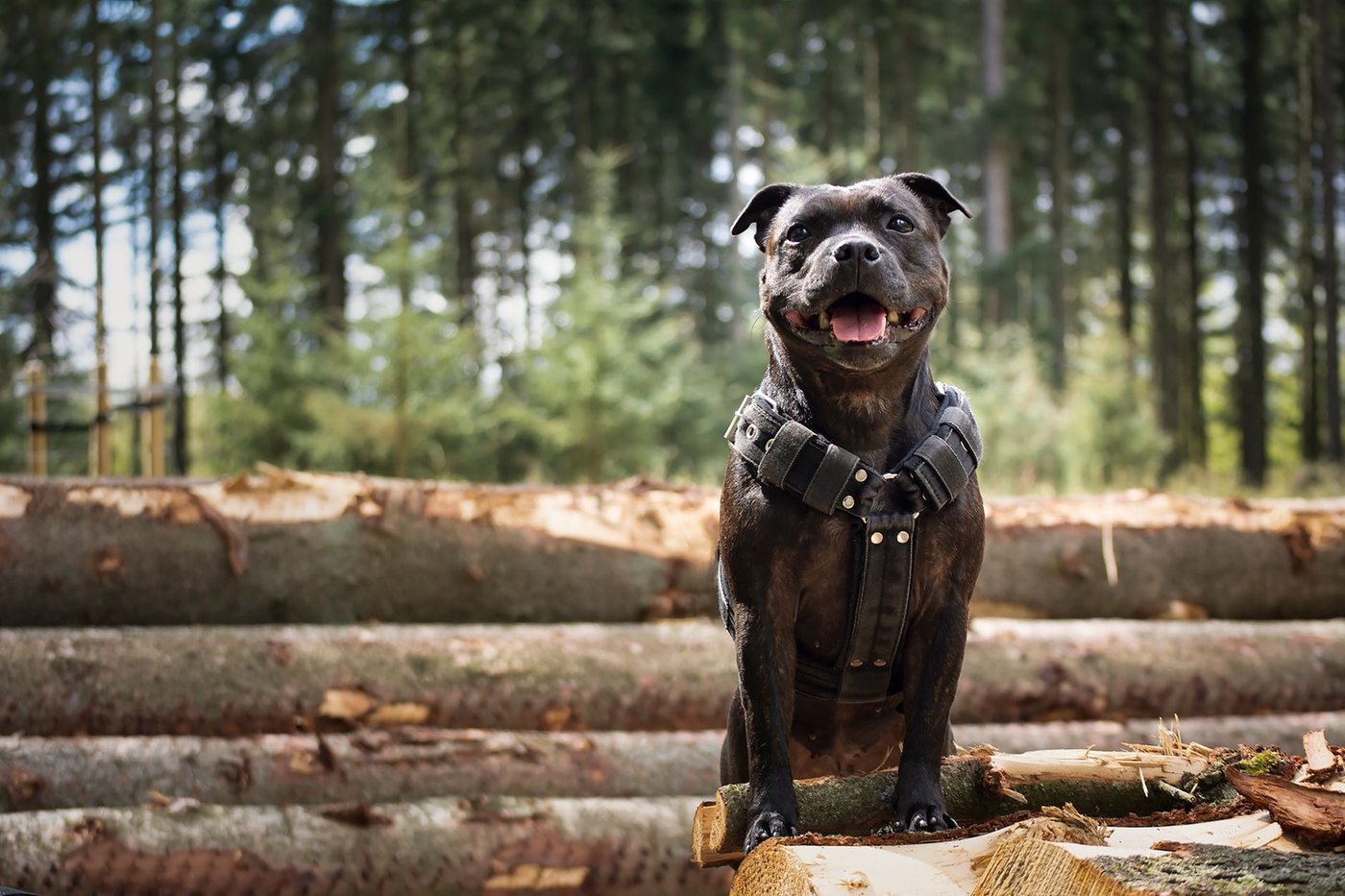
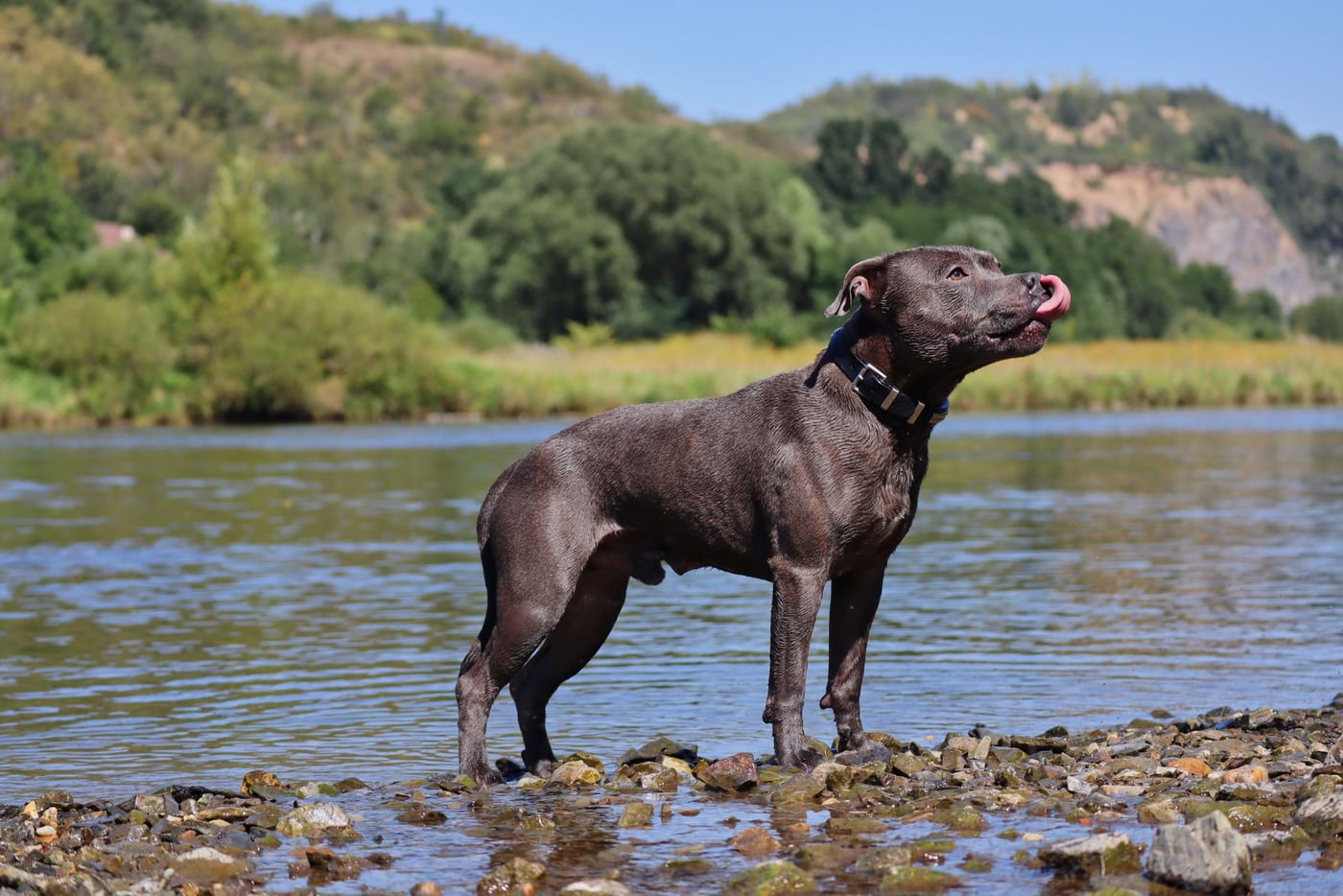
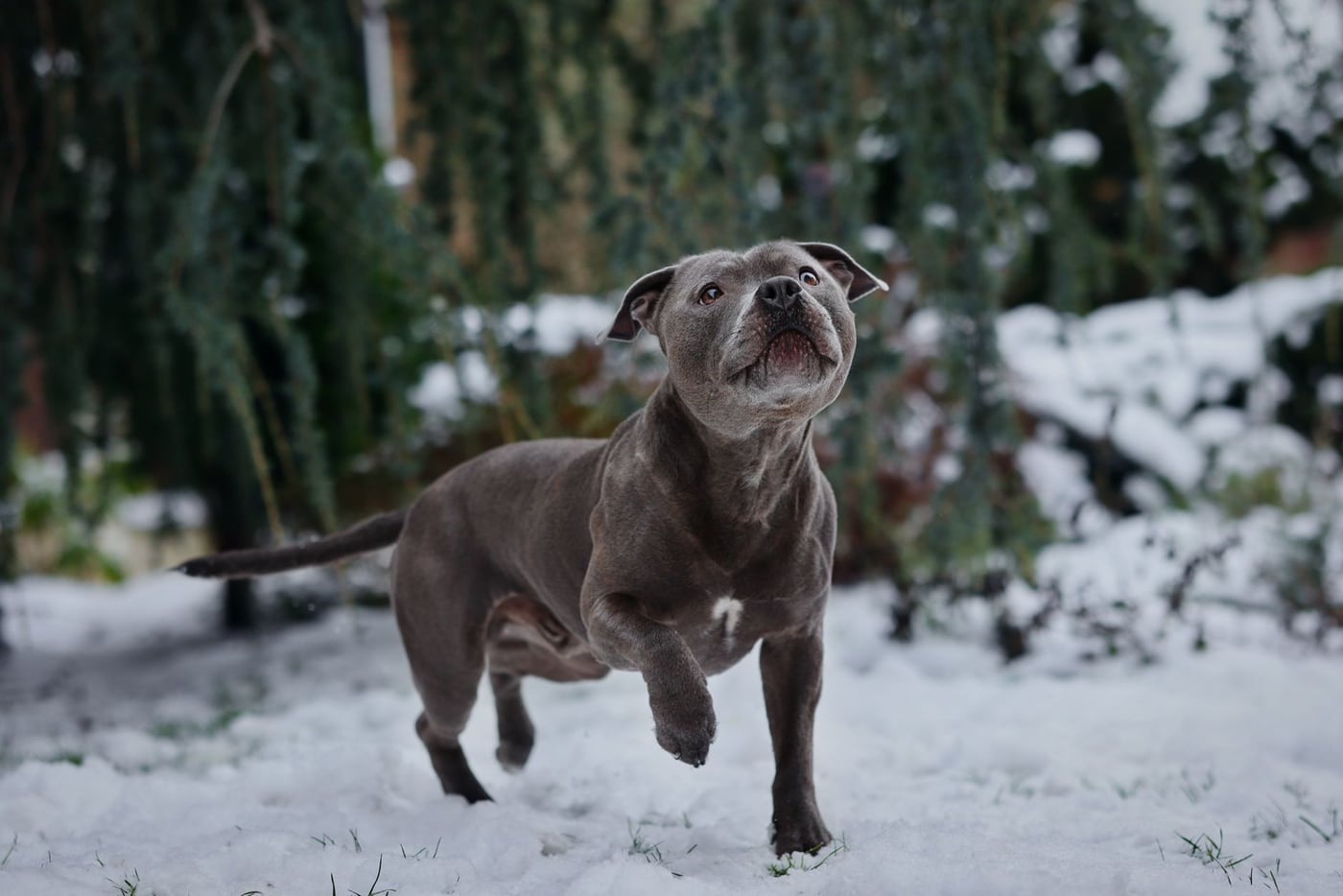
The Staffordshire Bull Terrier is a compact, muscular, medium-sized dog with a prominent head and a broad stance that gives the impression of strength without being heavy. It stands at 35.5–40.5 cm at the withers, both in males and females, with the difference between the sexes being more in weight and overall robustness. Males weigh 12.7–17 kg, while females are slightly lighter, 11–15.4 kg, and tend to be slightly finer-boned.
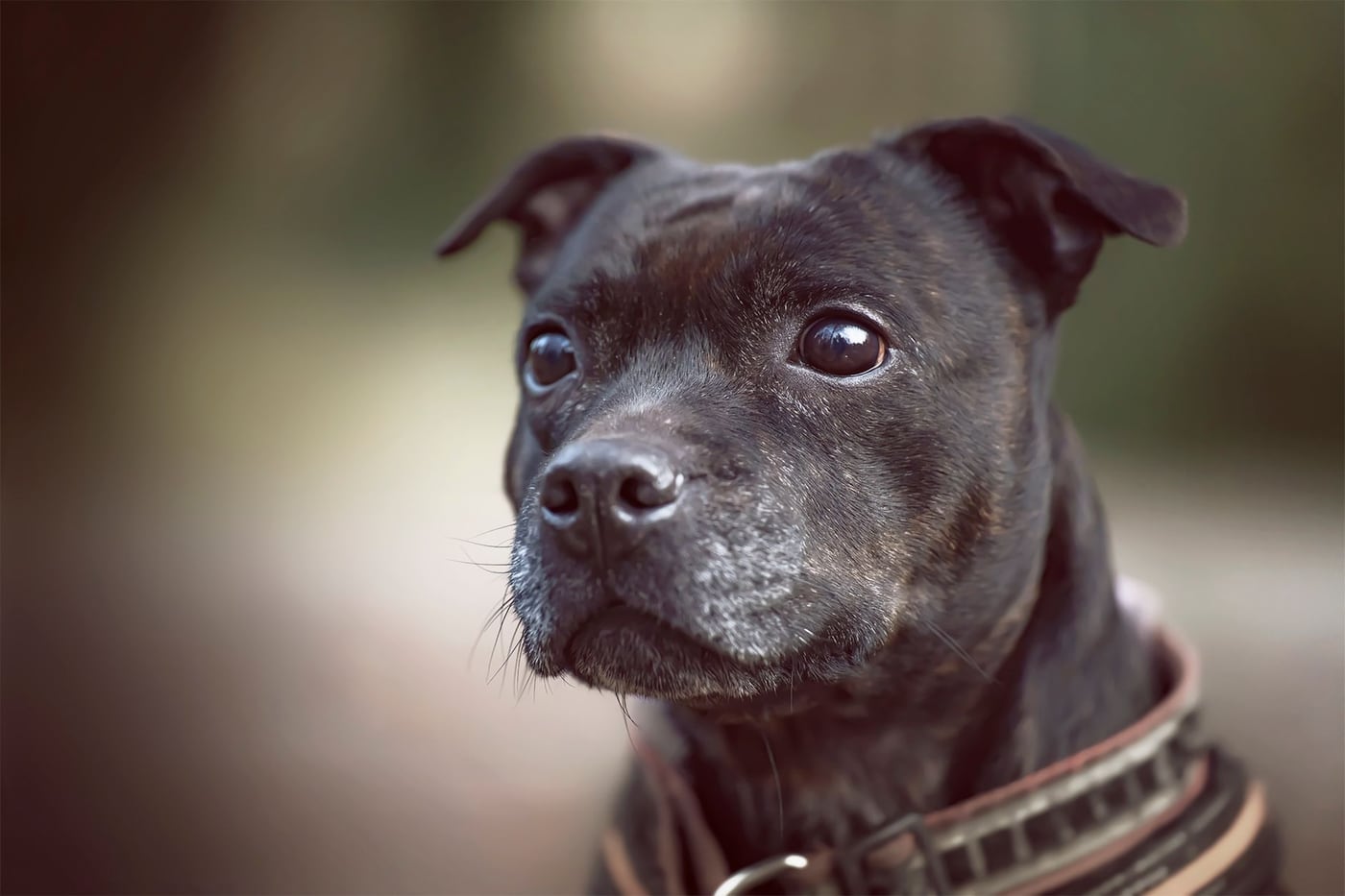
The body is short and compact, with a deep chest and well sprung ribs, the back is short and strong. The head is typically very pronounced - broad, with prominent cheek muscles and a short muzzle, which gives this breed a characteristic, "square" expression. The ears are set high, either rose-shaped or half-round, never fully drooping or erect. The eyes are round, dark and set rather low and straight, thus underlining a concentrated expression.
The coat is short, smooth and close to the body, without an undercoat, which makes it easy to care for and visually inspect the skin. The tail is set low, tapering towards the tip and carried not too high above the back line.
We describe color variants and their standard combinations in a separate section dedicated to coloring.
Colors of the Staffordshire Bull Terrier
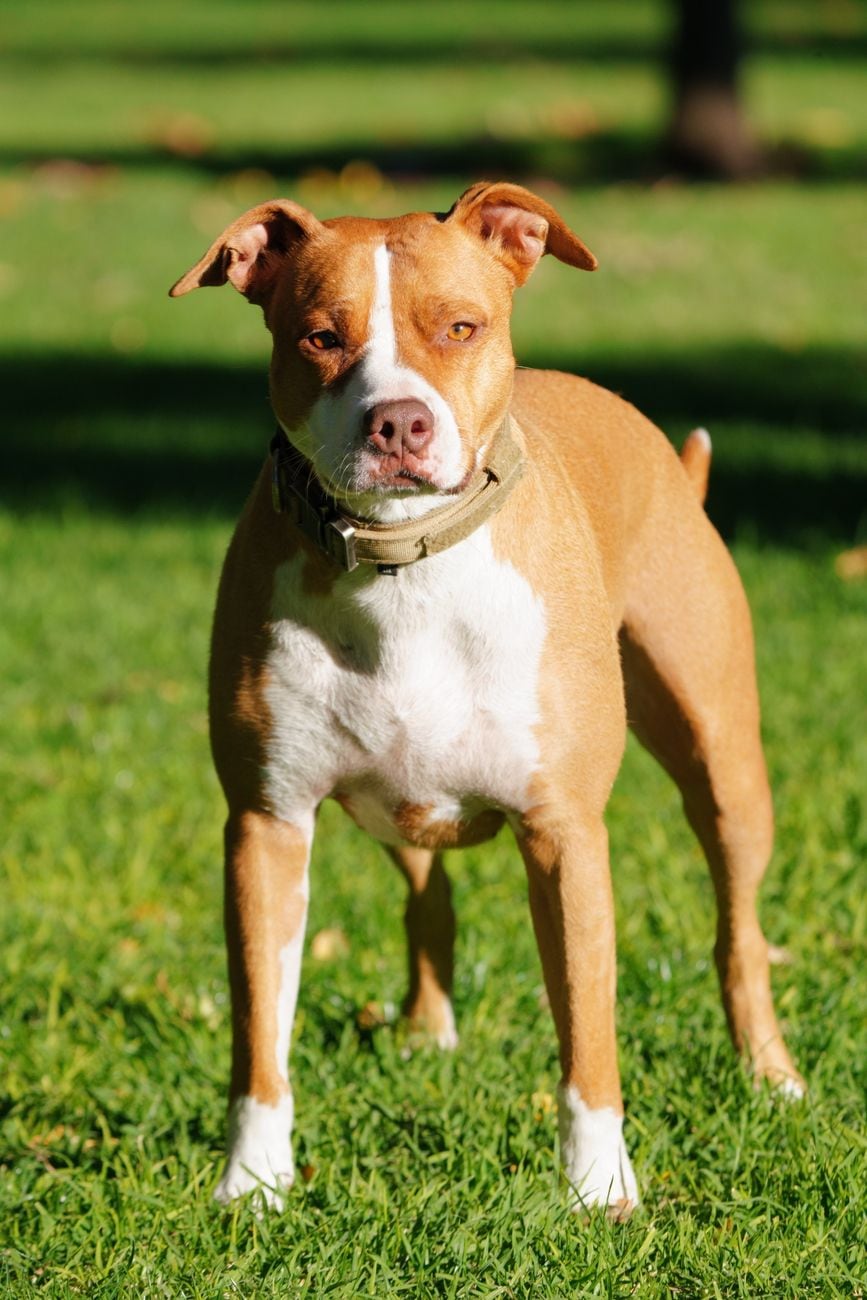
The FCI standard for the Staffordshire Bull Terrier allows a wide range of coat colors, but a specific list of individual shades and permitted characteristics (e.g. white spots on the chest or paws) is not available in this overview - when choosing a puppy, it is therefore advisable to check the current version of the standard with the breed club or directly with the FCI.
As for non-standard coloring, this breed occasionally has color variants that are not recognized by the official standard. The mere deviation from the standard color does not in itself mean a health risk - a connection between a specific color mutation and a health problem can only be asserted where it is confirmed by relevant studies, and such a documented relationship is not available for this breed.
The nature of the Staffordshire Bull Terrier
The Staffordshire Bull Terrier is a dog with a strongly developed relationship with its family – it is intensely attached to the people it lives with and seeks their closeness. The breed has a high need for company, so long-term isolation or living alone is not suitable for it. It is a dog that wants to be part of the everyday life in the household, not just an observer.
By temperament, this is an energetic and lively dog with a high level of activity, who will appreciate regular exercise and games. Mental stimulation is equally important for him - he suffers from boredom and without enough stimuli, he can redirect his energy in undesirable ways, for example, through destructive behavior in the household.
He is intelligent and a quick learner, but his training is in the medium range - he shows a certain degree of independence and will, so without consistent guidance he can be stubborn at times. He appreciates clear rules and a motivating approach more than hard drill.
He is rather open and sociable towards strangers, which does not make him a typical guard dog in the true sense of the word - his guarding tendencies are mild, he will rather warn of a visitor than actively chase them away. He uses barking to an appropriate extent, not excessively.
In relation to other dogs and cats, its tolerance is variable and depends a lot on socialization and the specific nature of the individual, so it is recommended to approach introductions to other animals gradually and with reason.
Staffordshire Bull Terrier and children
The Staffordshire Bull Terrier is considered a breed that gets along well with children if raised close to them and properly socialized from puppyhood. It is a dog with a great need for contact with people and a strong bond with its family, which in practice often manifests itself as a lively interest in what is happening around children and a willingness to join in the game with them. However, this closeness does not mean that coexistence should take place without adult supervision - a strong, muscular body structure and high energy level mean that even in the context of playful contact, the dog can unintentionally pull down or knock over a small child.
The breed's temperament is energetic and prone to intense experiences - the Staffordshire Bull Terrier needs plenty of exercise and mental exertion, otherwise it may direct its energy in inappropriate ways, for example through overly exuberant behavior in the household. Regular energy expenditure and mental stimulation are therefore not only a matter of the dog's satisfaction, but also of a calmer and more predictable coexistence with children.
Socialization and education as the foundation
Training this breed is considered moderately difficult – the dog is docile, but needs clear and consistent rules from the start. In the context of children, this means that they should have learned the basics of obedience and controlling impulsiveness from a puppy, including limiting jumping and excessive emotional retrieval during play. It is equally important for children to learn how to handle the dog – not to tease it at the bowl, not to disturb it when it is resting, and to respect its signals of discomfort.
- Never leave a small child and a dog unattended, even if they are well-behaved.
- Involve children in daily care and play, but under adult guidance to create mutual respect.
- Make sure your dog gets enough exercise and mental stress - fatigue will prevent excess energy from being directed in the wrong direction.
- Start socialization with children and other stimuli as soon as possible after the puppy arrives in the family.
The relationship with dogs of other breeds and cats is rated neutral in this breed, which is worth keeping in mind when planning trips or visits with children where contact with other animals is expected.
Staffordshire Bull Terrier and other dogs and pets
In relation to other dogs and cats, the Staffordshire Bull Terrier is rated as neutral – that is, neither outright conflictual nor reliably tolerant without reservations. Practice varies from individual to individual and depends a lot on the upbringing, socialization and specific experience of the dog.
Due to its classification as a bull terrier type (FCI section Bull type Terriers), caution is recommended when meeting strange dogs, especially of the same sex - although aggression towards people is not expected, inter-dog relationships can be variable and it is advisable not to underestimate them.
Living with cats and small animals
If a Staffordshire Bull Terrier grows up with a cat from a puppy, it will usually get used to it and learn to live with it in the same household. However, for an adult dog that has not known cats, the introduction needs to be approached gradually and with caution - a neutral assessment means that the result is not predetermined and depends on the individual nature and experience of the particular dog.
Caution is advised with small animals such as rodents or poultry, as the rapid movement of a small creature can easily trigger a chase reaction in this type of dog. It is safer to keep these animals out of reach or under constant supervision, rather than relying on the dog to get used to them on its own.
Recommendations for multiple dogs in the household
- Always introduce a new dog gradually, preferably on neutral ground.
- Watch the body language of both dogs and do not leave them unattended until you are sure of their relationship.
- Kittens and puppies that grow up together from a young age tend to live together more easily than adult animals that are introduced later.
- Due to the high need for human company and mental stimulation, it is advisable to direct the dog's energy into joint activities, which reduces the risk of undesirable behavior towards other animals in the household.
Is the Staffordshire bull terrier suitable for an apartment?
Rather yes - thanks to its medium size and low coat care requirements, it can adapt to a smaller apartment, but it needs plenty of exercise and mental stimulation outside the home.
This is a dog with a high need for activity and an equally high need for mental stimulation, so the space of the apartment itself is not what determines its contentment - regular longer walks, games and tasks that keep it occupied are key. Without sufficient exercise, it can manifest itself in restlessness or destructive behavior even in spacious housing.
Barking is usually at a moderate level, which is usually not a problem for apartment living and neighbors, as long as the dog receives enough attention and is not bored. Due to its high need for company, it does not tolerate long-term loneliness - an apartment suits it better in a household where someone spends most of the day with it, rather than as a place where it has to spend time alone.
- Small to medium-sized apartment: suitable if sufficient outdoor exercise is ensured
- Quiet in the apartment: moderate barking, usually doesn't bother the neighbors
- Activity requirement: long walks and games are essential, not a supplement
- Society: needs to be with family, not suited to a household where he stays alone for long hours
How much exercise does it need?
The Staffordshire Bull Terrier is a highly active dog and needs regular, energetic exercise every day – a short walk to the toilet is definitely not enough. This is a muscular, powerful dog that can expend a lot of energy, and if it has nowhere to direct it, this can manifest itself in undesirable behavior in the household.
Suitable activities
Thanks to its compact body and short coat, it is suitable for a wide range of physical activities. It appreciates a combination of free movement and controlled activities, where it will use both its body and head.
- Longer errands and faster walks, ideally with room to move freely
- Fetching and games with tug toys that match his strong nature
- Basic obedience and agility at a reasonable level
- Nosework and olfactory games as a supplement to physical activity
Due to their high need for mental stimulation, it is not enough for them to just run around – they also need tasks that keep them thinking. A bored individual without enough stimulation tends to be restless and difficult to control, so it is worth combining physical activity with training and puzzles.
A short coat without an undercoat means that on hot summer days it is advisable to move intense exercise to cooler parts of the day and to be careful about overheating, especially during higher loads in the sun.
Training and education
Even a less experienced owner can handle training a Staffordshire Bull Terrier if they follow a few principles - consistency and positive motivation are key; rough treatment or pressure will cause them to become stubborn and lose interest in cooperation. Thanks to their high intelligence and desire to be close to their owner, they learn well if lessons are short, understandable and the reward comes immediately after correct behavior.
Motivation works best with a treat, toy, or vocal praise – this dog needs to feel that training is a shared game, not an obligation. Long and monotonous repetition will quickly bore him, so it pays to alternate exercises and include short breaks for exercise or play.
Socialization
Early and consistent socialization is essential for this breed, especially when it comes to contact with other dogs and animals - the breed can be rather reserved towards unfamiliar individuals, both with its own kind and with cats, so it pays to gradually and sensitively accustom the puppy to different environments, people and animals. On the contrary, it tends to be friendly and approachable towards people, including children, which makes socialization easier in this regard.
Specifics of education
- High need for mental stimulation – a bored individual seeks their own entertainment, often unwanted.
- A strong bond with the family requires that training be carried out calmly and without tension, to which it is sensitive.
- Given its strength and temperament, it is worth training your puppy to walk on a leash and basic commands for calmly handling situations outdoors.
- Regular exercise combined with training helps keep the dog balanced and happy.
Hair care and hygiene
The short, smooth, close-fitting coat makes grooming the Staffordshire Bull Terrier one of the least demanding parts of his breed. A weekly brushing with a rubber brush or smooth glove is enough to remove loose hair and keep the coat shiny. During the shedding season, which tends to be more pronounced in the spring and fall, brushing is a good idea to do a little more frequently to prevent hair from ending up on furniture and clothing.
Bathing should only be done when absolutely necessary – after getting very dirty or after rolling around in something unscented. Frequent washing would dry out the coat and skin. Since this is a breed without undercoat and without skin folds, there is no need to worry about the depressions around the muzzle or neck, which other breeds need to be cleaned and dried regularly.
Ears, eyes, teeth and claws
The erect ears of the Staffordshire Bull Terrier are well ventilated, but it is still worth taking a peek inside once a week and wiping away any visible dirt with a damp cloth or cotton swab. The eyes should be checked occasionally and any morning haze in the corners should be gently wiped away. It is advisable to brush the teeth several times a week with a special dog toothpaste or offer chewing aids that help reduce tartar formation. The claws should be trimmed regularly, as they can overgrow if not exercised enough on hard surfaces and cause walking difficulties.
Feeding
A high-quality complete food is the foundation for this muscular, energetic dog - given the high level of activity, the diet should contain enough full-fledged animal proteins that support the maintenance of muscle mass, and an adequate amount of energy to cover daily exercise. The choice of food should be adapted to the age, weight and level of stress of a particular individual - a growing puppy, an active adult dog and a less mobile senior have different nutritional requirements.
Physical fitness check
Thanks to the compact and muscular body structure, overweight may not be as noticeable at first glance as in thinner breeds, so it is useful to regularly check the ribs by palpation and observe the dog's silhouette from above and from the side. Due to the lower energy expenditure in less active individuals, there is a risk of weight gain if the feeding regimen is set inappropriately, which unnecessarily burdens the joints and overall mobility.
- Adjust the amount of feed to the current physical activity, not to a fixed dose.
- Monitor your physical condition and respond promptly to signs of weight gain.
- When transitioning between life stages (puppy - adulthood - senior), gradually adjust the composition of the diet.
- Treats used during training should be included in the total daily energy intake.
How long does a Staffordshire Bull Terrier live?
The average lifespan of a Staffordshire Bull Terrier is 12 to 14 years, which is a solid value for a breed of this size. However, the specific lifespan of each individual depends on a combination of genetics, living conditions and the care provided by the owner.
What affects lifespan?
- Genetics and origin: dogs from kennels where health examinations of parents are taken into account generally have better chances of a long and problem-free life.
- Physical condition: the Staffordshire Bull Terrier is a muscular, compact breed and being overweight puts a strain on the joints and heart - maintaining an optimal weight is one of the essential factors for longevity.
- Exercise: this is a breed with a high need for activity, so plenty of regular exercise contributes not only to fitness, but also to psychological well-being.
- Prevention: regular veterinary check-ups, vaccinations and deworming help detect potential problems early.
- Nutrition: a high-quality, age-appropriate diet supports the health of muscles, coat, and internal organs throughout the dog's life.
- Health predisposition: the breed may have an increased predisposition to certain hereditary diseases, so it is advisable to monitor the dog's health throughout its life and address any problems with a veterinarian in a timely manner.
Who is the Staffordshire Bull Terrier suitable for?
The Staffordshire Bull Terrier is best suited to people who can offer it enough exercise and mental stimulation and who want to spend a lot of time with it - it is a breed strongly attached to its family, which does not tolerate loneliness and lack of contact well.
Who is the breed suitable for?
- For active owners who provide their dog with regular exercise and plenty of stimulation
- For families with children, where the breed is popular for its even-tempered nature
- For people living in an apartment, if they are able to compensate for the smaller space with longer walks
- For owners who want to have their dog close at all times and don't mind their dog's high need for company
- For those interested in consistent, but not overly complicated training
Who is the breed not suitable for?
- For people who are away from home for long periods of time during the day and cannot pay attention to their dog
- For owners looking for an undemanding, independent dog without the need for constant contact
- For households where the dog would spend most of its time alone in the garden without human company
- For those interested who do not want to devote time to regular exercise and mental stimulation
Interesting facts about the breed
The Staffordshire Bull Terrier originates from the English county of Staffordshire, after which it is named, and its English name Staffordshire Bull Terrier refers to the region of its origin in Great Britain.
The breed is listed under standard number 76 within the FCI, it falls into group 3 (terriers) and specifically into the bull terrier section, which also includes related bull terriers.
Although it is a breed with a strong and compact body, with its height of 35.5–40.5 cm and weight, it falls into the category of medium-sized dogs - the difference between a male and a female is more in weight, there is practically no difference in height.
Staffordshire bull terrier health
The Staffordshire Bull Terrier is a breed with a relatively good constitution and lives on average 12 to 14 years, which is above average for a dog of its size. The short, smooth coat does not require any special care and does not pose a health risk in itself. As with any breed, it has certain predispositions due to its genetic basis, so it is worth taking an interest in the health of the puppy's parents and what examinations the breeder performs on his breeding pair. Specific diagnoses should always be assessed by a veterinarian, so the atlas only provides general recommendations for selection and care.
Joints and musculoskeletal system
Due to the robust body structure and high activity level, it is advisable to pay attention to adequate exercise, especially during the growth period, when the puppy's musculoskeletal system is more sensitive. Regular, but gradually built-up exercise helps keep the joints and muscles in good condition throughout the dog's life.
What to look for when choosing a puppy
- Choose a breeder who is dedicated to breeding and is willing to document the origin and health status of the parents.
- Ask about the results of health examinations of breeding animals, if the breed club requires or recommends them.
- Monitor the overall vitality, movement, and body structure of the puppy and its parents during a personal visit to the breeder.
- Verify that the puppy has been adequately socialized and is accustomed to the normal stimuli of the home environment.
Known predispositions
The breed is described to have an increased predisposition to:
- to the neurometabolic disease L-2-hydroxyglutaric aciduria (L-2-HGA), which mainly affects young individuals and is associated with neurological symptoms.
- to hereditary juvenile cataract (HC), for which there is a genetic test.
- to persistent hyperplastic primary vitreous (PHPV), an eye defect monitored as part of breeding ophthalmological examinations.
- to patellar luxation.
- to hip dysplasia.
- to the development of mast cell tumors (mastocytomas) of the skin.
- to allergic skin diseases and atopic dermatitis.
- to distichiasis (eyelash growth in the wrong place on the eyelid).
This overview is for informational purposes only and does not replace the examination or recommendations of a veterinarian.
What to buy for a Staffordshire Bull Terrier
Practical basis that is suitable for this breed:
- Car seats for dogs – Car seats and safety equipment for transporting a dog by car.
- Toys – Dog toys – fetching, chewing and interactive.
- Cosmetics – Shampoos, conditioners and hair care products.
- Bowls – Feed and water bowls, anti-swallow bowls and stands.
- Collars – Dog collars – leather, textile and semi-tight.
- Beds – Beds and mattresses for dogs of all sizes.
- Leashes – Leashes, switch leashes and tracking lines.
Useful instructions
Practical tips that are useful when caring for a dog:
Frequently asked questions
Is the Staffordshire Bull Terrier suitable for an apartment?
Yes, they are quite suitable for an apartment, although they are a very active dog. However, they need plenty of daily exercise and mental stimulation, otherwise they can get bored even in a smaller space.
Is the Staffordshire Bull Terrier good with children?
Rather yes, he tends to be friendly with children and has a high need to be with his family. Even so, adult supervision is appropriate for any strong breed when playing with small children.
Is the Staffordshire Bull Terrier an aggressive dog?
The breed itself is not automatically aggressive, its reputation often stems from historical use and strong build, not from the nature of individual individuals. It is mainly determined by upbringing, socialization and the specific line from which the dog comes.
How much does a Staffordshire Bull Terrier weigh?
The male weighs 12.7–17 kg, the female is slightly lighter, 11–15.4 kg. The height at the withers is similar in both sexes, 35.5–40.5 cm.
How long does a Staffordshire Bull Terrier live?
The average lifespan is between 12-14 years. It is a relatively long-lived breed of medium size.
How much exercise does a Staffordshire Bull Terrier need?
He needs a high level of physical activity and mental stimulation every day. A short walk is not enough for him, he will appreciate longer walks, games and various activities that keep him mentally busy.
Does the Staffordshire Bull Terrier shed a lot?
Shedding is moderate, the coat is short and smooth, making it easy to care for. Regular brushing will help remove loose hair and keep the coat in good condition.
Is the Staffordshire Bull Terrier suitable for beginners?
The suitability for beginners is rather neutral - this is a strong, temperamental dog with medium training requirements, which will appreciate a more experienced or consistent owner. Without sufficient socialization and guidance, it can be more difficult to handle.
Does the Staffordshire Bull Terrier get along with other dogs and cats?
The relationship with other dogs and cats is rather neutral and depends a lot on socialization from puppyhood and the specific nature of the individual. Adult dogs of the same sex can sometimes show higher dominance, so gradual and controlled introduction is recommended.
How difficult is training a Staffordshire Bull Terrier?
The training difficulty is medium – he is intelligent and docile, but at the same time stubborn and needs a consistent leader. Thanks to his high need for mental stimulation, he does well in obedience and various dog sports.
What is the difference between a Staffordshire Bull Terrier and an American Staffordshire Terrier?
The Staffordshire Bull Terrier is a smaller and lighter breed, standing 35.5–40.5 cm tall and weighing up to 17 kg, while the American Staffordshire Terrier is typically more massive and taller. Both breeds share a common origin in the Bull Terrier type, but developed independently and have different standards.
Does the Staffordshire Bull Terrier have any health predispositions?
As with many purebred breeds, there may be certain hereditary predispositions, but specific diagnoses should always be discussed with a breeder or veterinarian. It is recommended to ask about the health examinations of the parents before purchasing a puppy.
Resources and further information
- The Staffordshire Bull Terrier Club
- American Staffordshire Bull Terrier Club (US) - Staffordshire Bull Terrier Club of America
- Staffordshire Bull Terrier – Czech-Moravian Cynological Union (CMKU) breed page
- FCI Standard No. 76 - Staffordshire Bull Terrier - Fédération Cynologique Internationale
- Source of body measurements – fci.be
- FCI Standard No. 76 – Staffordshire Bull Terrier – Fédération Cynologique Internationale (FCI)
- Staffordshire Bull Terrier - Wikipedia (English)
- Canine inherited disorders database - Staffordshire Bull Terrier - University of Cambridge, Department of Veterinary Medicine
Professional cooperation
This breed overview was created in cooperation with the Veterinary Clinic VYVET sro and MVDr. Adam Hylák .