
Published 30. 8. 2026
The Dachshund is a small breed originating from Germany, classified in FCI group 4 as the only representative of the Dachshund section under standard no. 148. Due to its elongated body and short legs, it is at first glance unmistakable with any other breed. It comes in three coat types – short-haired, long-haired and wire-haired – and in two sizes, the standard Dachshund and the miniature Dachshund, popularly shortened to "dachshund". The male stands 20–27 cm tall and weighs 4–9 kg, the female is slightly smaller with a height of 17–25 cm and a weight of 3.5–9 kg.
It is a hunting dog with a strongly developed instinct, which is also reflected in high barking and the need for mental stimulation. The nature of the dachshund is neutral towards children and other animals, training requires a moderately demanding approach and patience. Care for the coat is undemanding, shedding is medium. Due to its smaller size and rather medium activity, it is well suited to an apartment and for seniors, but is less suitable as a first dog for complete beginners.
Professionally consulted
The content was created in cooperation with the veterinary clinic Veterinární klinika VYVET sro and MVDr. Adam Hylák.
Quick overview
What is a Dachshund like?
The Dachshund (German: Dachshund, Czech: dakl) is a small German breed from FCI group 4, which consists only of dachshunds in three coat types – short-haired, long-haired and wire-haired. It is characterized by an elongated body on short legs, a structure adapted to its original use for hunting in burrows. According to size, there is a distinction between the standard dachshund and the miniature dachshund, both of which are small breeds with a height at the withers of 17–27 cm and a weight of 3.5–9 kg.
In terms of temperament, it is a dog with a strongly developed hunting instinct, which is manifested by independent thinking and a certain amount of stubbornness - training therefore requires patience and consistency, rather than a harsh approach. The dachshund is loud, barking is one of its distinctive features and apartment owners should take this into account. It is usually attached to its family and requires a moderate amount of company, it behaves neutrally in relation to children and other animals, so it depends on socialization and the specific nature of the individual.
The coat care is undemanding, the activity and need for mental stimulation are in the medium range. Thanks to its small size and adaptability, it is also suitable for an apartment, and will be appreciated by seniors who are looking for a smaller but distinctive companion.
Origin and history
The Dachshund originates from Germany and is the only breed that the FCI classifies in a separate section 1 – Dachshunds within the 4th group (standard no. 148). The name itself, as well as the German and English names Dachshund (“badger dog”), refers to its original purpose – hunting badgers and other burrowing animals.
The dachshund is built to crawl through narrow underground passages and work independently, tracking, chasing or pulling game out. This is where its typical elongated body and short legs come from, thanks to which it is still classified as a hunting breed.
The breed has developed two size variants – the standard dachshund and the miniature dachshund – and three coat types (short, long and rough), which historically adapted to different types of terrain and game hunted.
Appearance and size
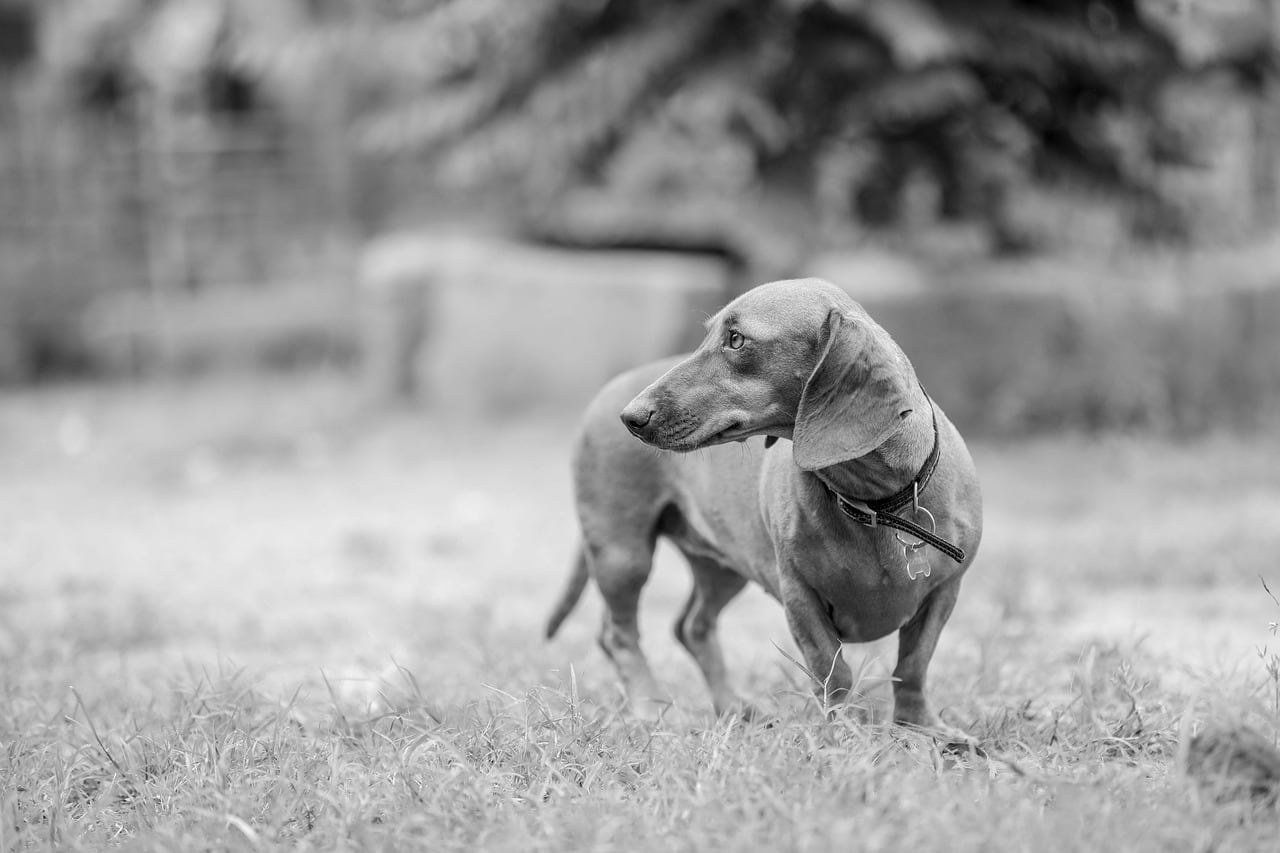
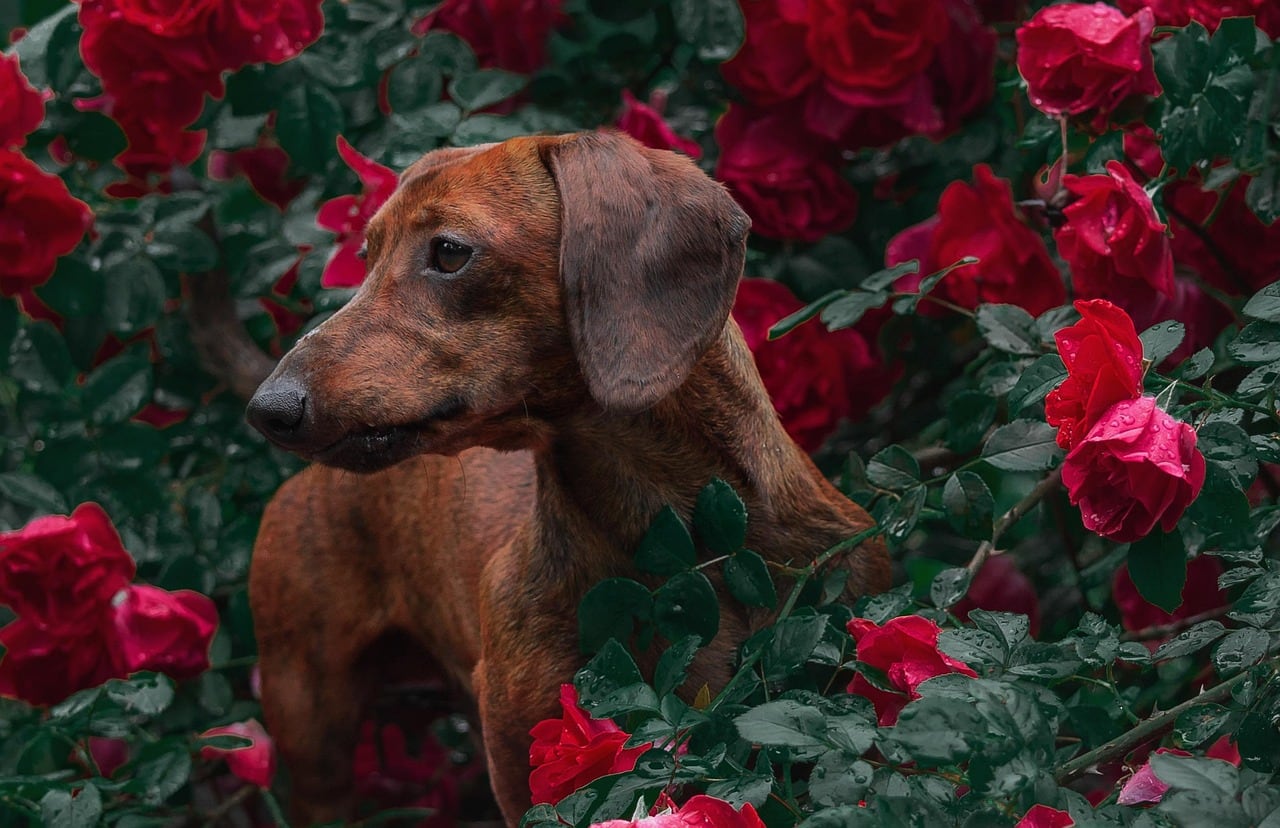
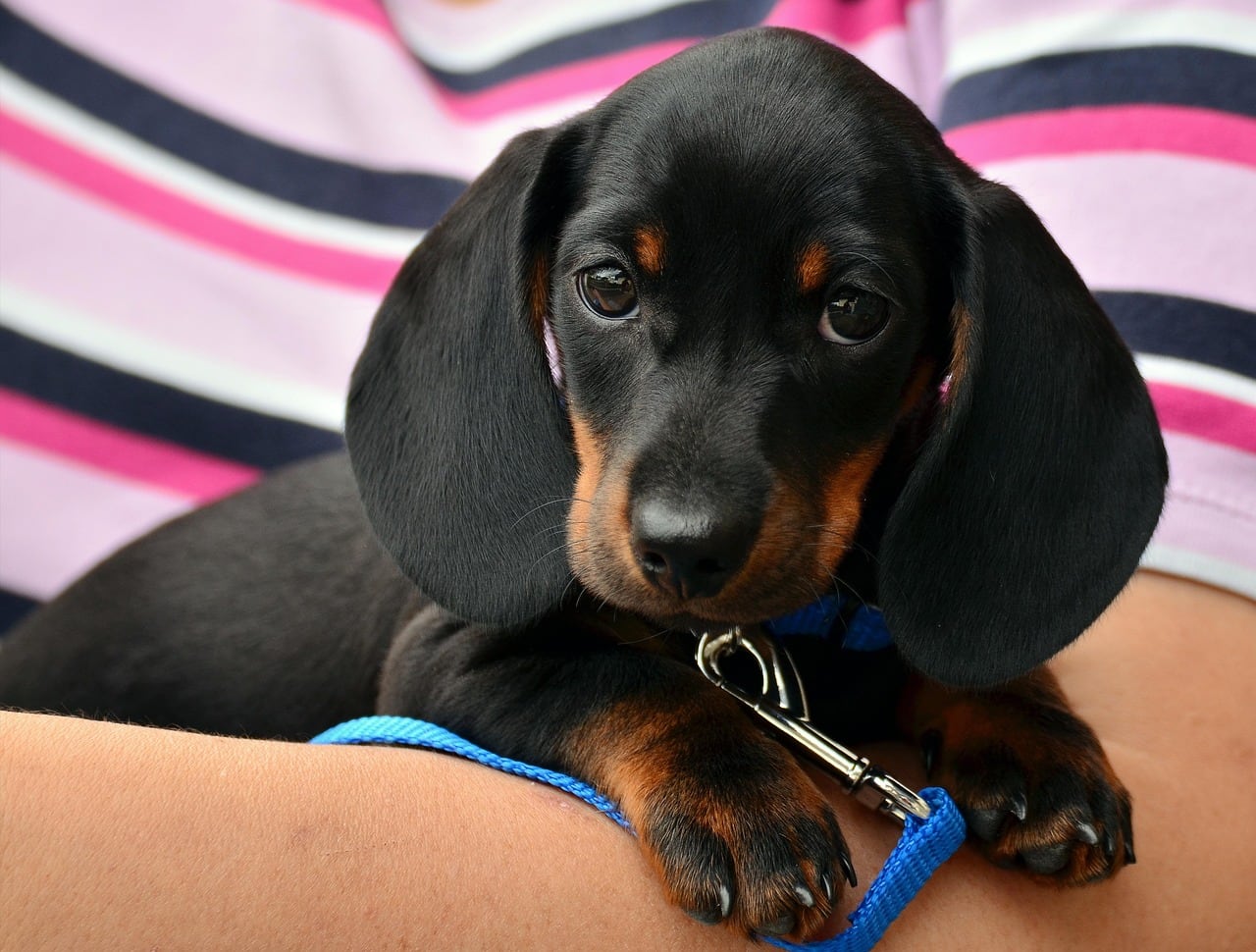
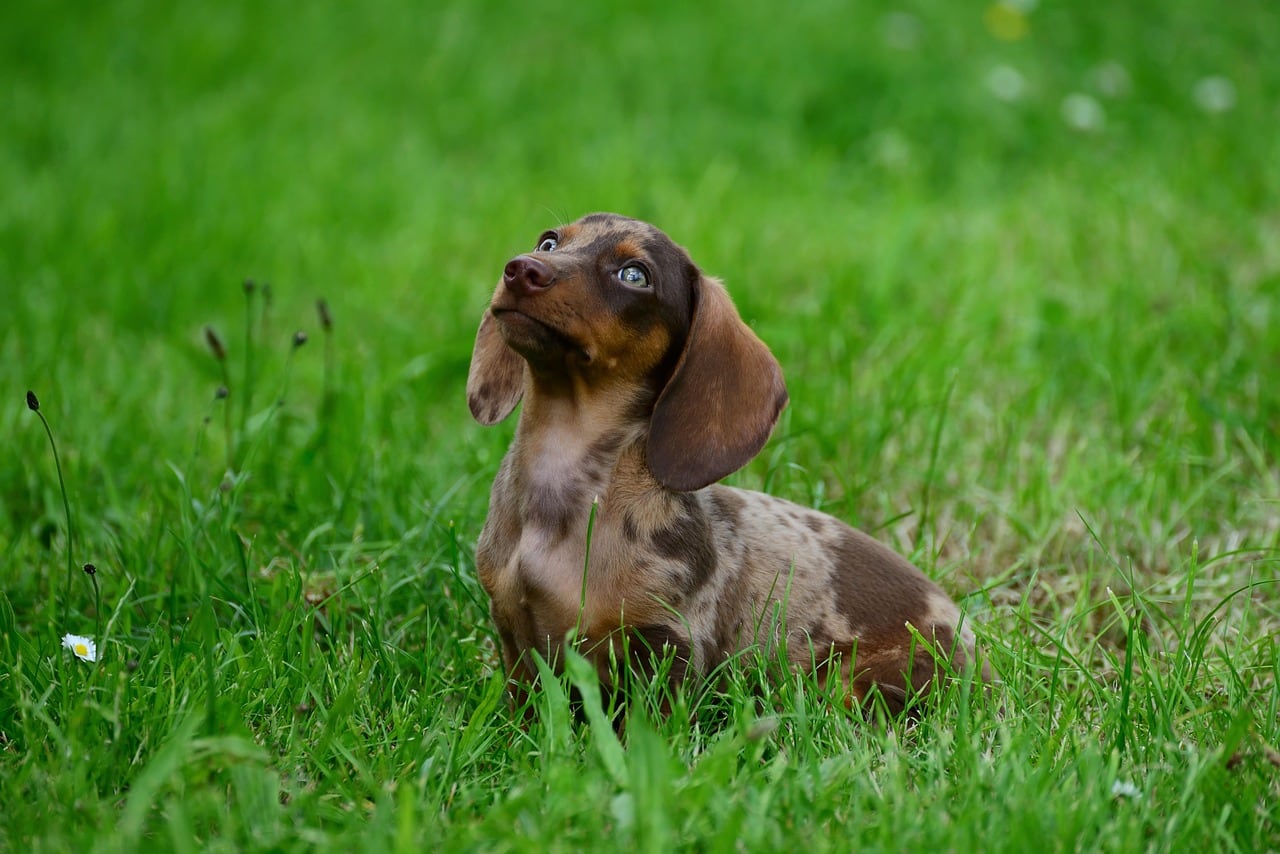
The Dachshund is a small breed with an unmistakable body structure - a long, muscular torso on significantly short legs is a feature that makes it recognizable to almost everyone. The body is elongated, the chest is deep and spacious, which, as hunters, allowed it to penetrate even narrow burrows. The head is wedge-shaped, with a pronounced muzzle and long, low-set ears that flow freely along the sides of the head.
According to the standard, the dachshund comes in two sizes – standard and dwarf – with the male reaching 20–27 cm at the withers and weighing 4–9 kg, the female being slightly smaller, 17–25 cm and 3.5–9 kg. The smaller dwarf is particularly popular for apartment living, where it can easily adapt to its size.
The Dachshund's coat comes in three variations - short, long and wire - which give the breed a different overall appearance, although the basic body structure remains the same. The short-haired type has a smooth, shiny and close-fitting coat without an undercoat, which is easy to maintain. The long-haired Dachshund has a finer, slightly wavy coat with longer sections on the ears, chest and tail, while the wire-haired type is covered in a harsh, shaggy coat with prominent eyebrows and whiskers, giving it a characteristic "stern" appearance.
Dachshund Colors
The color of the dachshund is regulated by FCI standard No. 148 and within it there is a precisely defined list of recognized colors and drawing characters for individual coat types. The specific list of colors must always be verified in the current version of the standard at the ČMKU or the relevant breeders' club, as they vary depending on the coat type and breeding rules may be specified.
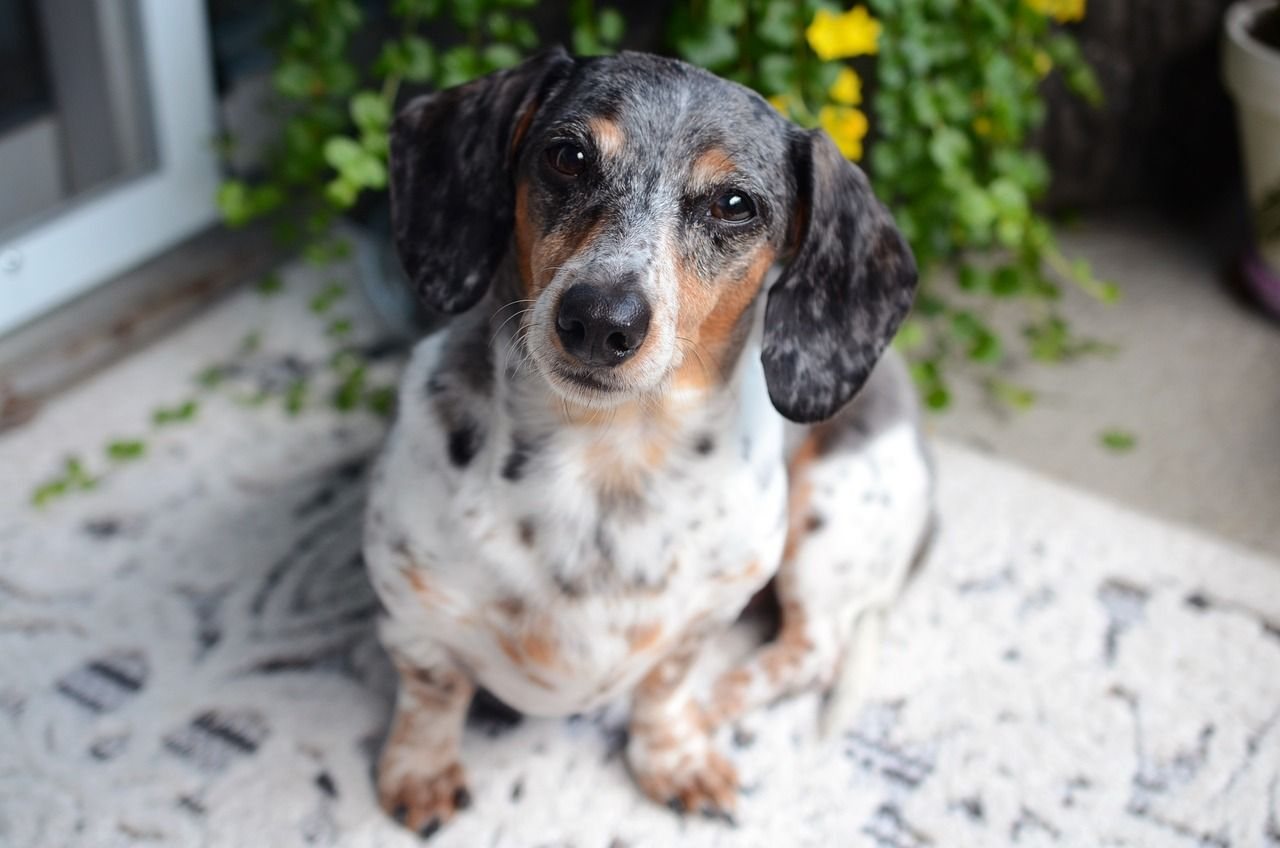
In recent years, there have been colors appearing on the market that are not allowed by the FCI standard or that are the result of targeted crossing of carriers of atypical genes - typically shades referred to as blue, chocolate or merle patterns. Such dogs do not meet the breed standard and often cannot be entered into standard breeding programs.
Furthermore, breeding for these fashionable colors is associated with an increased risk of unwanted gene combinations that can be linked to vision, hearing or skin problems. Therefore, when choosing a puppy, it is wise to choose a breeder who adheres to standard colors and has health-tested parents rather than chasing an unusual coat shade.
Dachshund personality
The dachshund is a dog with a strong temperament that does not deny its hunting origins - it was bred to work independently underground, and this is reflected in its nature. It is an animal with its own head, which likes to defend its opinion, and therefore training is considered to be moderately demanding. It is affectionate towards its family and seeks contact with people, its need for company is moderately high - long solitary stays are not good for it.
They are neutral towards children and other animals – no enthusiastic rushing into contact, rather a sober assessment of the situation. A typical manifestation is a high barking rate, which the dachshund often uses as a mouthpiece for anything unusual around the house. Thanks to their hunting instincts, they like to sniff, follow scent trails and can be stubborn when following a trail or playing with a toy.
Mental stimulation is as important to him as exercise - a bored dachshund can find his own, not always desirable, entertainment. As a social dog, he integrates well into the household, but he appreciates being worked with and not left without stimulation for long.
Dachshund and children
We rate the Dachshund's relationship with children as neutral - it is not a breed that would automatically be suitable for a family with small children, but with the right approach it can work with them without any problems. Due to its small size and low weight, it is important that children know how to handle the dog, as rough handling or careless lifting can hurt it.
The dachshund is also a hunting dog with strong instincts and a high barking rate, which can also be manifested in the home environment - it reacts to external stimuli and makes it clear loudly. It is a good idea to discuss this with children in advance so that their behavior is not surprising.
We recommend:
- Always supervise small children playing with the dog.
- teach children how to properly pick up and pet a dachshund
- Involve the dog in family life gradually and with consideration for its nature
Coexistence with school-age children who respect the rules for treating dogs is usually problem-free.
Dachshund and other dogs and pets
The coexistence of the dachshund with other dogs and pets is assessed as neutral, i.e. strongly dependent on the specific nature of the individual, socialization and the way of introduction. The dachshund was bred as a hunting dog for small game and badgers, which is reflected in its instincts to this day - small animals in the household (rodents, small birds) can therefore arouse its hunting attention rather than calmness.
In relation to other dogs, it mainly depends on how used the dachshund is - with sufficient socialization from puppyhood, it will get used to canine friends well, without it it can be territorial or try to assert itself despite its size. It is similar with cats: if they grow up together or the introduction is gradual and controlled, coexistence usually works without problems.
Given the Dachshund's strong barking, it is advisable to expect that he will react loudly to new animals or visitors to the household - however, this is more related to his alert nature than to aggression. It is wise to introduce new animals gradually and under supervision, especially in the first weeks of living together.
Is the Dachshund suitable for an apartment?
Due to its small size and low to medium activity level, the Dachshund is more suitable for an apartment. It does not need a large plot of land or a lot of space to move around - regular walks and enough stimuli in the form of sniffing games or short training sessions are enough to satisfy its moderate need for mental stimulation.
However, what needs to be considered is its high barking rate. In a smaller apartment, especially in a house with thin walls or a panel house, this trait can manifest itself as a problem in relations with neighbors. The dachshund tends to react loudly to sounds behind the door, footsteps in the hallway or movement outside the window, which is also related to its hunting origin and natural alertness.
Due to their medium need for company, they do not appreciate long periods of solitary stay at home - however, they feel good in an apartment where the owner is present most of the day or regularly spends time with the dog. The low demand for coat care is another plus for apartment breeding, as it does not burden the household with excessive hair cleaning.
How much exercise does it need?
The Dachshund has a moderate need for exercise, which does not mean hours of running - rather regularity. Short walks divided into two or three walks per day are enough for him, supplemented by the opportunity to sniff and explore the surroundings. As a hunting dog, he has a coded need to follow tracks, so he benefits from movement in the field, where he can use his sense of smell, not just mechanically "trampling" kilometers on a leash.
Due to the elongated spine and short legs, excessive exercise such as jumping from heights, long jumps or excessive stair climbing is not recommended for the Dachshund – especially in younger and older ages. On the contrary, a reasonable amount of exercise helps keep the muscles around the spine in shape.
In addition to physical exercise, mental stimulation is also important, which the dachshund requires in a moderate amount. Suitable are sniffing games, finding treats or mantrailing, where he can fully apply his hunting origins. Due to his nature and body structure, he is not a typical candidate for endurance sports such as agility in high jumps, but he can easily handle undemanding disciplines adapted to his body.
Training and education
The Dachshund is a hunting dog bred to work independently underground, and this hereditary independence is also reflected in training. The training requirement is medium - this is not a breed that mindlessly follows commands just to please, but rather evaluates for itself whether a given activity is worthwhile for it.
Consistency combined with patience is the key to training. Short, regular training blocks work better than long lessons, as the dachshund gets bored quickly and his attention span then decreases. Motivation with treats and praise brings better results than harsher methods, to which he reacts more stubbornly.
Due to its strong barking, it is advisable to work on the quiet command and on managing stimuli from the environment from puppyhood, otherwise it tends to react loudly to anything unfamiliar. Socialization should be ongoing, because the dachshund behaves rather neutrally towards dogs and people and without sufficient contact with the environment can be insecure in stressful situations.
The need for mental stimulation is moderate, so a combination of obedience training and scent games that utilize his innate interest in scent trails will suffice.
Hair care and hygiene
Dachshund coat care varies depending on the breed – they come in short-haired, long-haired and wire-haired varieties. The short-haired breed is the least demanding to maintain, requiring only occasional brushing with a rubber brush to remove dead hair. The long-haired dachshund needs more regular brushing to prevent matting behind the ears and on the limbs. The wire-haired breed requires professional trimming, usually twice a year, as the dead hair does not shed on its own.
Bathing is only necessary when really necessary, frequent washing unnecessarily disrupts the natural protective layer of the skin. Due to the long, hanging ears, it is advisable to check them regularly and, if dirty, clean them gently to prevent moisture from accumulating in them and causing irritation. The claws should be trimmed regularly, especially if the dachshund moves less on hard surfaces, where they would naturally wear down. Dental care should include regular cleaning or at least chewing aids that help reduce tartar formation.
Feeding
The dachshund is a small breed weighing between 3.5 and 9 kg, so the amount of food needs to be adjusted to the specific weight category - the miniature dachshund needs significantly less than the standard breed. Given the medium level of activity, this is not a dog with high energy requirements, so it is advisable to use a rather conservative dosage and regularly check the body condition by palpating the ribs.
The food should correspond to the size of the breed and age - puppies, adults and seniors have different requirements for energy, protein and mineral content. For dachshunds, it is recommended to divide the daily dose into two smaller portions instead of one large meal, which saves digestion and prevents overeating.
Due to the type of body structure, it is desirable to maintain a slim weight for the Dachshund - excess weight is more noticeable in this breed than in dogs with more classic proportions. Treats should only form a supplementary part of the diet and be counted towards the total daily energy intake. Fresh water must be available throughout the day.
How long does a Dachshund live?
The average lifespan of a dachshund is 12-16 years, making it one of the breeds with a longer lifespan compared to larger dogs. This fact is also related to its small size - smaller breeds generally live longer than large dogs.
Life expectancy is influenced by a number of factors that the owner has to a large extent under his control. Given the typical body structure with an elongated back, it is advisable to maintain an appropriate weight - excess weight unnecessarily burdens the spine and joints. Regular but adequate exercise without sudden jumps and long stairs helps to keep the dachshund in good shape throughout its life.
A quality diet appropriate to the dog's age and activity level, regular veterinary care including preventive check-ups and timely resolution of any health problems also play a role. Genetic predispositions may vary between lines, so it makes sense to be interested in the health history of the puppy's parents when purchasing it.
Overall, this is a breed that, with responsible care, can enjoy many years of active life alongside its family.
Who is the Dachshund suitable for?
The Dachshund is a small dog with a strong personality that fits into many different types of households, but it is definitely not a breed "for everyone". Its hunting origins and strong will predispose it to a specific approach in education and coexistence.
This breed may be right for you if…
- you live in an apartment and you don't mind that the dachshund is a relatively loud dog
- you are looking for a medium-sized companion with low grooming requirements
- you are a senior and want a dog that can handle a calmer pace of life
- you are interested in a breed with a strong personality and are not afraid of consistent training
- you will appreciate a dog with a moderate need for exercise and mental stimulation
Consider another breed if…
- you are looking for a dog that will automatically be problem-free with small children or other animals – the dachshund is rather neutral in this regard and depends on socialization
- You are bothered by frequent barking because the dachshund tends to report what is happening around him.
- you are a complete beginner and do not want to deal with more demanding training - a dachshund requires a patient and consistent approach
- you prefer a breed that unconditionally obeys the first command - the dachshund's independence due to its hunting nature complicates this
Interesting facts about the breed
The Dachshund is classified in FCI Group 4, which bears its name - it is the only section directly called "Dachshunds", which indicates how specific and unmistakable its body structure is within the entire breed classification.
The FCI standard No. 148 recognizes three coat variants – short, long and wire – and also distinguishes several size types, including the standard dachshund and the miniature dachshund. Thus, one breed exists side by side in several forms, which differ both in appearance and partly in temperament.
Despite its small size, the Dachshund is considered a hunting dog, which is reflected in its temperament and the amount of barking that tends to be higher than in purely companion breeds. This hunting instinct is still evident today, although many individuals live purely as companion dogs in apartment conditions.
Another interesting feature is the range of weight and height for females and males, which partially overlaps for both sexes - the differences between the sexes are smaller in the dachshund than in many other breeds of similar size.
Dachshund Health
The Dachshund lives an average of 12 to 16 years, which makes it one of the breeds with a relatively long life expectancy. Its elongated body structure with short legs is a typical feature of the entire Dachshund section and the owner should pay attention to it when caring for the dog - with a suitable lifestyle, many problems associated with this structure can be minimized or at least delayed.
Prevention is key with Dachshunds. It is recommended to keep the dog in reasonable condition, as being overweight puts a lot more strain on the spine and joints than in breeds with more normal proportions. It is also advisable to avoid sudden jumps from heights, such as from the couch or the car, and instead make it easier for the dog to move around using steps or a ramp.
Regular veterinary check-ups should be a given even for seemingly healthy individuals - early detection of possible changes in the musculoskeletal system or other health problems significantly increases the chance of a successful solution. The suitability of a particular individual for breeding or more demanding activities should always be consulted with a veterinarian, ideally based on a professional examination.
Known predispositions
- Dachshunds may have an increased predisposition to intervertebral disc disease (IVDD) due to the breed's chondrodystrophic spine structure.
- to progressive retinal atrophy (PRA).
- to patellar luxation.
- to epilepsy, including forms associated with Lafora disease.
- to cystinuria and the formation of cystine urinary stones.
- to obesity, which can further strain the spine.
- to Cushing's syndrome (hyperadrenocorticism).
- to diabetes mellitus.
This overview is for informational purposes only and does not replace the examination or recommendations of a veterinarian.
What to buy for a Dachshund
Practical basis that is suitable for this breed:
- Car seats for dogs – Car seats and safety equipment for transporting a dog by car.
- Toys – Dog toys – fetching, chewing and interactive.
- Cosmetics – Shampoos, conditioners and hair care products.
- Bowls – Feed and water bowls, anti-swallow bowls and stands.
- Collars – Dog collars – leather, textile and semi-tight.
- Beds – Beds and mattresses for dogs of all sizes.
- Leashes – Leashes, switch leashes and tracking lines.
Useful guides
Practical tips that are useful when caring for a dog:
Frequently asked questions
Is a dachshund suitable for an apartment?
Yes, the dachshund is more suitable for an apartment due to its small size. However, it needs regular walks and mental exercise to avoid boredom.
How long does a dachshund live?
The average lifespan of a dachshund is between 12 and 16 years, which makes it one of the long-lived small breeds.
How much does a standard and miniature dachshund weigh?
The weight of males ranges between 4 and 9 kg, females weigh 3.5–9 kg. The difference between the standard and dwarf breeds is mainly reflected in the height and overall body structure.
Is a Dachshund suitable for beginners?
The dachshund's suitability for beginners is neutral - training requires patience and consistency, as it is an independently thinking hunting dog.
Is a dachshund good with children?</p>
The relationship with children is neutral in the Dachshund, so coexistence always depends on the specific nature of the dog and the upbringing of both parties.
How much does a dachshund bark?
The Dachshund is one of the breeds that bark a lot, which is related to its hunting and guarding instincts.
How much exercise does a dachshund need?
The dachshund's activity level is medium, so regular walks supplemented with olfactory and mental games are sufficient.
Line dachshund a lot?
Dachshunds shed moderately and care for their short coat is easy, with occasional brushing sufficient.
Is a Dachshund suitable for seniors?
Yes, thanks to its small size and low maintenance requirements, the dachshund is also suitable for seniors.
Does a dachshund get along with other dogs and cats?
Coexistence with other dogs and cats is neutral for dachshunds and depends on socialization and the specific nature of the individual.
Resources and further information
- FCI Standard No. 148 – Dachshund – Fédération Cynologique Internationale
Professional cooperation
This breed overview was created in cooperation with the Veterinary Clinic VYVET sro and MVDr. Adam Hylák .