
Published 9. 9. 2026
The Rottweiler is a large German breed classified in FCI group 2 among the molossoid types of dogs (standard no. 147). The male dog measures 61–68 cm at the withers and weighs around 50 kg, the female is shorter and lighter – 56–63 cm and approximately 42 kg. The coat is short, coarse and close-fitting, its care is undemanding, shedding is moderate. Its calm, confident expression and strong bond with the family are characteristic – its need for company is high and it does not tolerate long-term isolation.
This is a dog with high demands for exercise and mental stimulation, it can handle training at a medium level of difficulty, but requires consistency and more experienced leadership. It is rather suitable for children, and is neutral to cautious towards unfamiliar people and other animals. It is less suitable for an apartment and is not an ideal choice for a first dog experience - it will be appreciated by active owners who can offer it enough exercise and clear rules.
Professionally consulted
The content was created in cooperation with the veterinary clinic Veterinární klinika VYVET sro and MVDr. Adam Hylák.
Quick overview
What is a Rottweiler like?
The Rottweiler is a large molossoid breed originating from Germany, belonging to FCI group 2. Males reach a height of 61–68 cm, females are slightly smaller, 56–63 cm, with an adult male weighing around 50 kg and a female around 42 kg. It is a strong, compactly built dog with a short, coarse coat, which appears confident and calm, but at the same time needs plenty of exercise and mental exertion.
It has a balanced, alert and family-oriented temperament – it has a high need for company, so it does not tolerate loneliness well. It is considered rather suitable for children, but due to its strength and size it requires consistent guidance from puppyhood. It can be trained at a medium level, it is a docile dog, but it will appreciate clear rules and more experienced guidance.
The Rottweiler is more suitable for active owners with a house and garden than for an apartment, and not for complete beginners or seniors. It is neutral towards cats, barks and sheds at a moderate level, and its short coat makes it easy to care for.
Origin and history of the Rottweiler
The Rottweiler originates from the southern German town of Rottweil in Swabia and its roots go back to the Roman Empire. It is believed that the breed evolved from the powerful cattle dogs that the Roman legions took with them on their campaigns across the Alps - these animals were used to guard the herds and protect provisions. After settling in the area of today's Rottweil, these dogs were crossed with local cattle breeds and gradually a strong, hardy dog was created, adapted to work with cattle.
In the Middle Ages and early modern times, the Rottweiler was an indispensable assistant to local butchers and cattle traders - he drove the herds to market and on the way back he wore a money pouch hung from his collar, because it was considered a reliable protection against robbers. This is where the nickname "Rottweiler Metzgerhund" comes from, i.e. the butcher's dog from Rottweil. With the development of railway transport in the second half of the 19th century, cattle driving gradually disappeared and with it the practical use of the breed, which found itself on the verge of extinction at the turn of the century.
The turning point came at the beginning of the 20th century, when enthusiasts appreciated its strength, intelligence and obedience for the purposes of service and guard cynology. Germany gradually formed the first breed clubs for the breed and established a standard, on the basis of which the Rottweiler is now also listed in the international cynological organization FCI as a German breed classified among the molossoid types of dogs. The original cattle dog thus became a versatile working breed used as a service, defense and companion dog.
Appearance and size
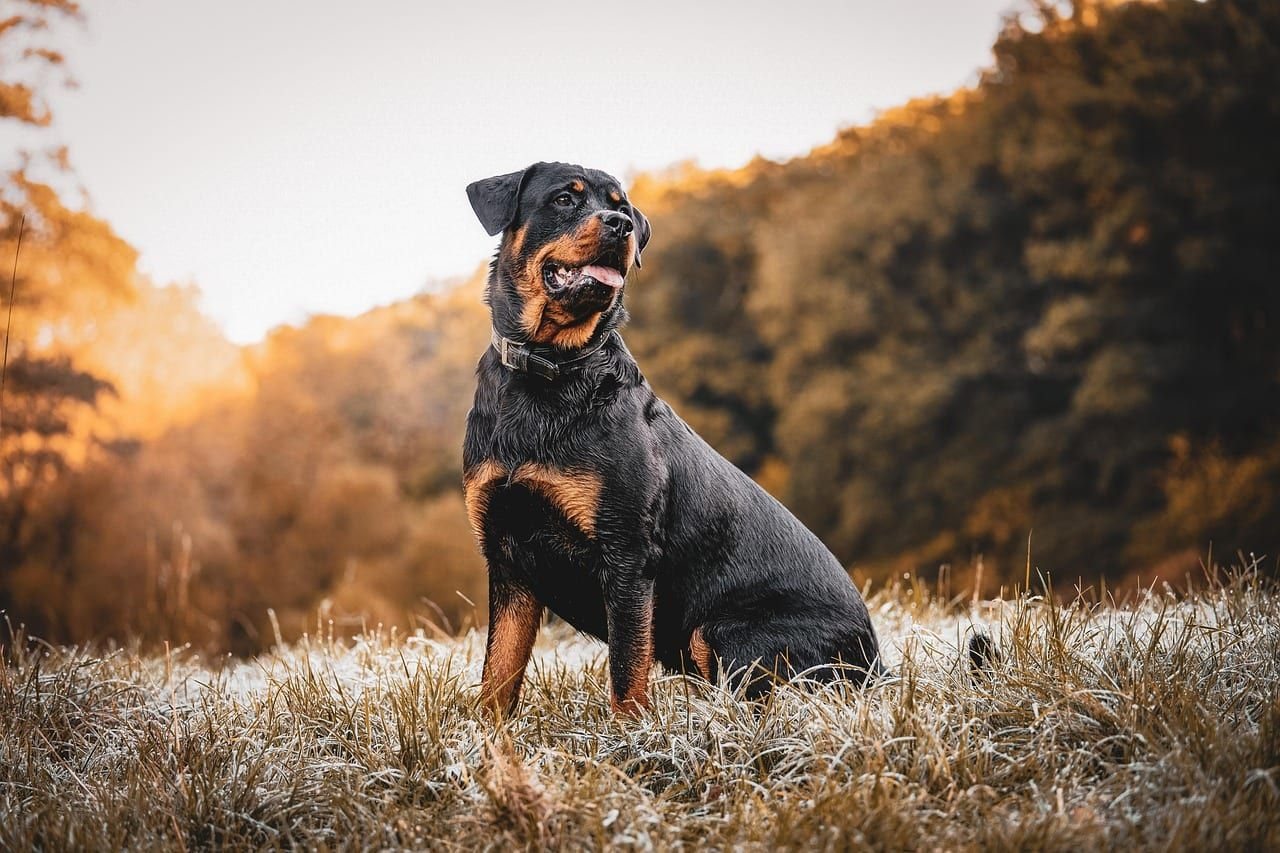
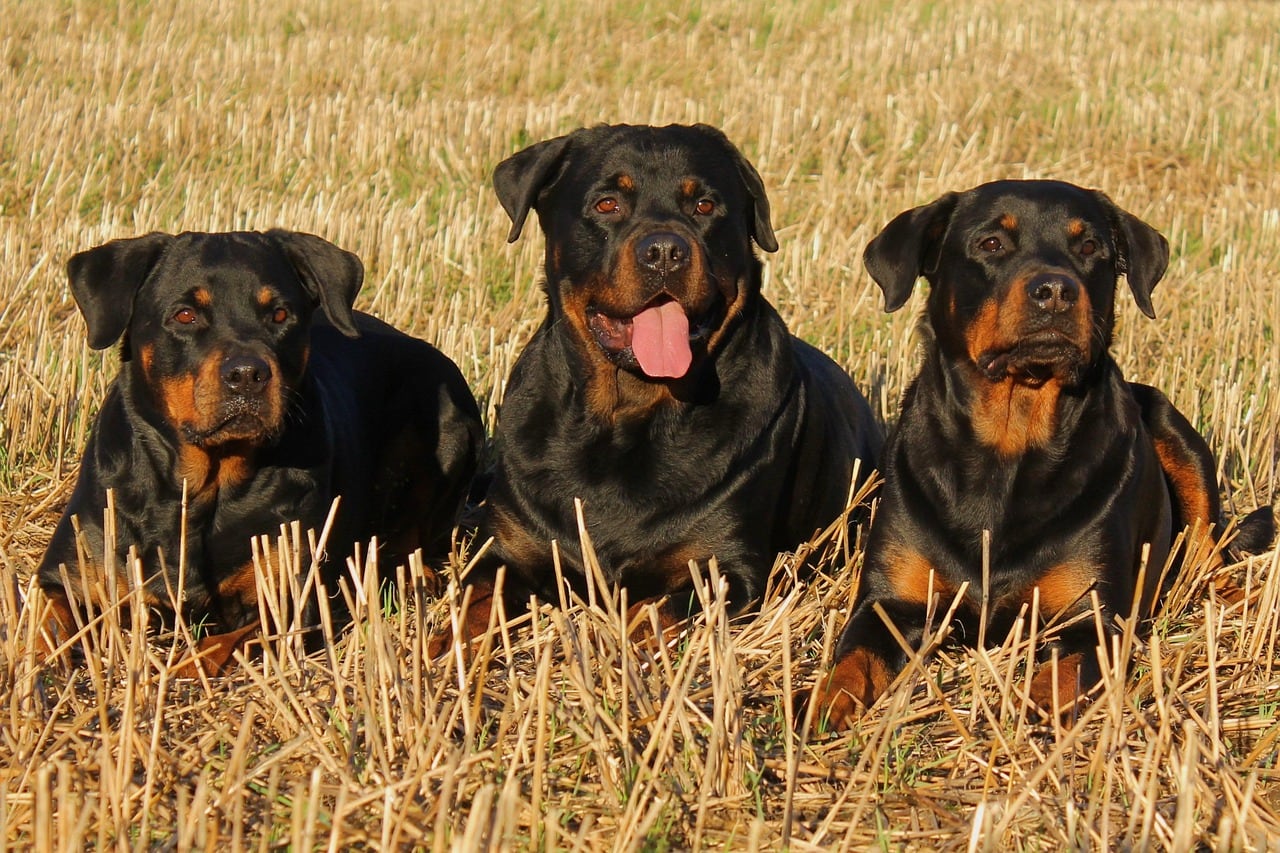
The Rottweiler is a massive, compactly built dog with strong muscles and a robust skeleton, which at first glance gives the impression of strength. The dog reaches 61–68 cm at the withers and weighs around 50 kg, the bitch is slimmer and shorter – 56–63 cm and weighs around 42 kg. The body is longer than it is tall, the chest is deep and wide, the back is firm and straight.
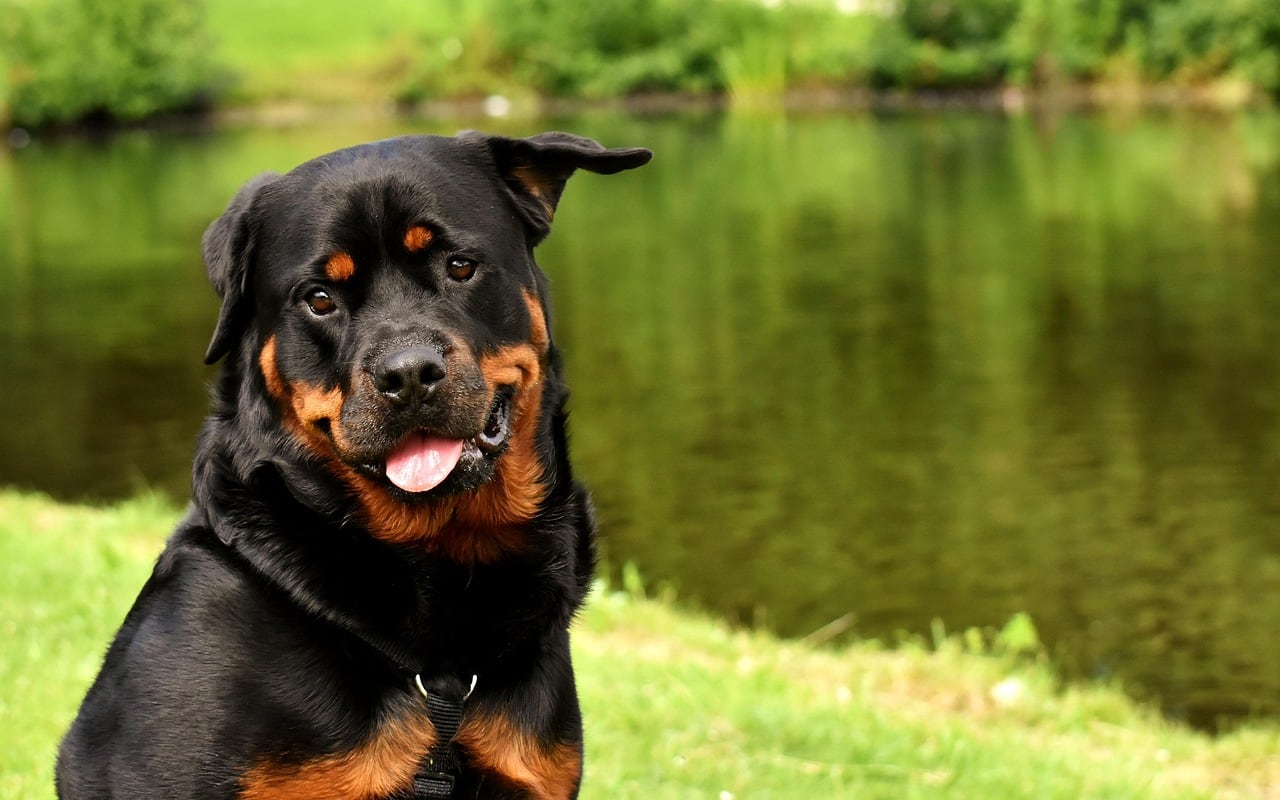
The head is massive, with a broad skull forehead and well-developed cheek muscles, the muzzle is wide with well-developed teeth. The ears are medium-sized, triangular, set high and hanging close to the cheeks, emphasizing the width of the head. The eyes are almond-shaped, dark, with a firm and confident expression.
The coat is short, coarse and close to the body, with an undercoat that is particularly noticeable on the neck and thighs. Color variations and typical color features are described in a separate section dedicated to coat and colors.
The tail is set on level with the back and carried naturally, without curling. A characteristic feature of the breed is a firm, confident stance and balanced movement with good hindquarters, which demonstrates a functional body structure built for endurance and strength.
Rottweiler Colors
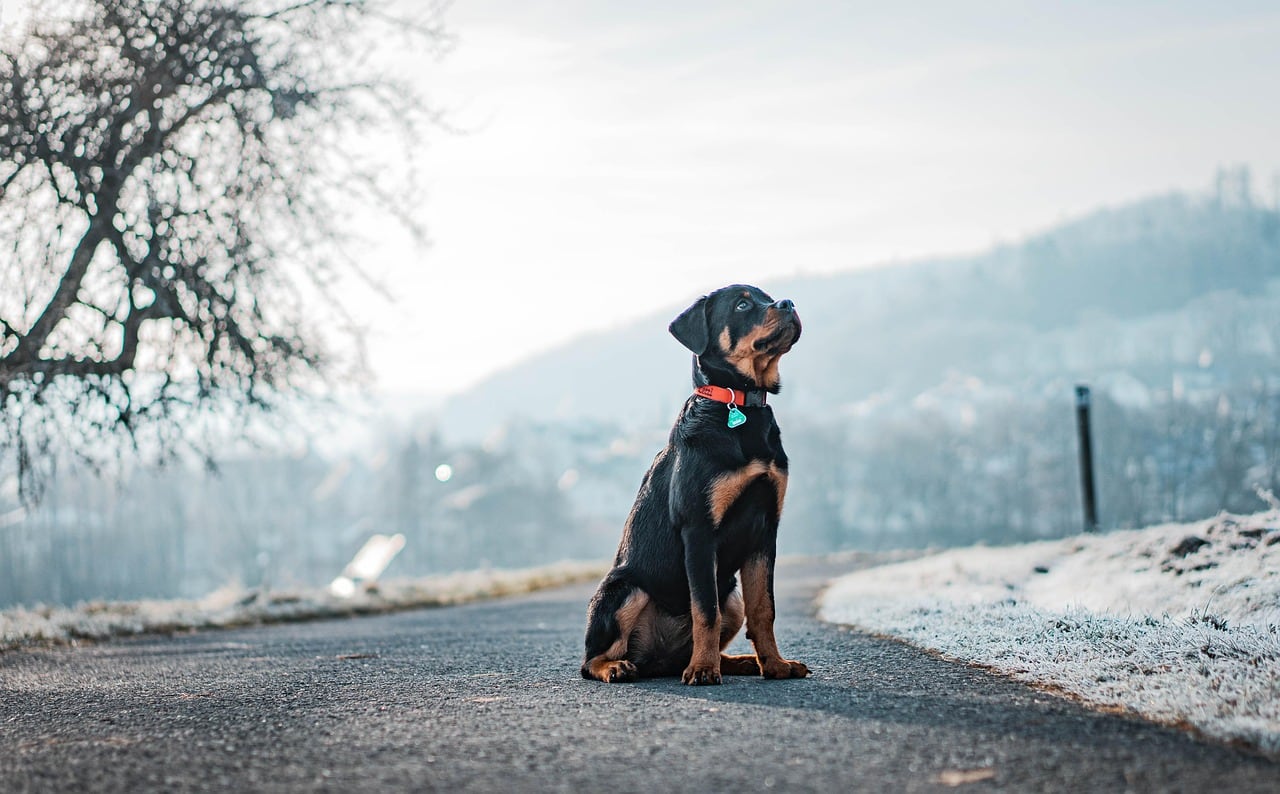
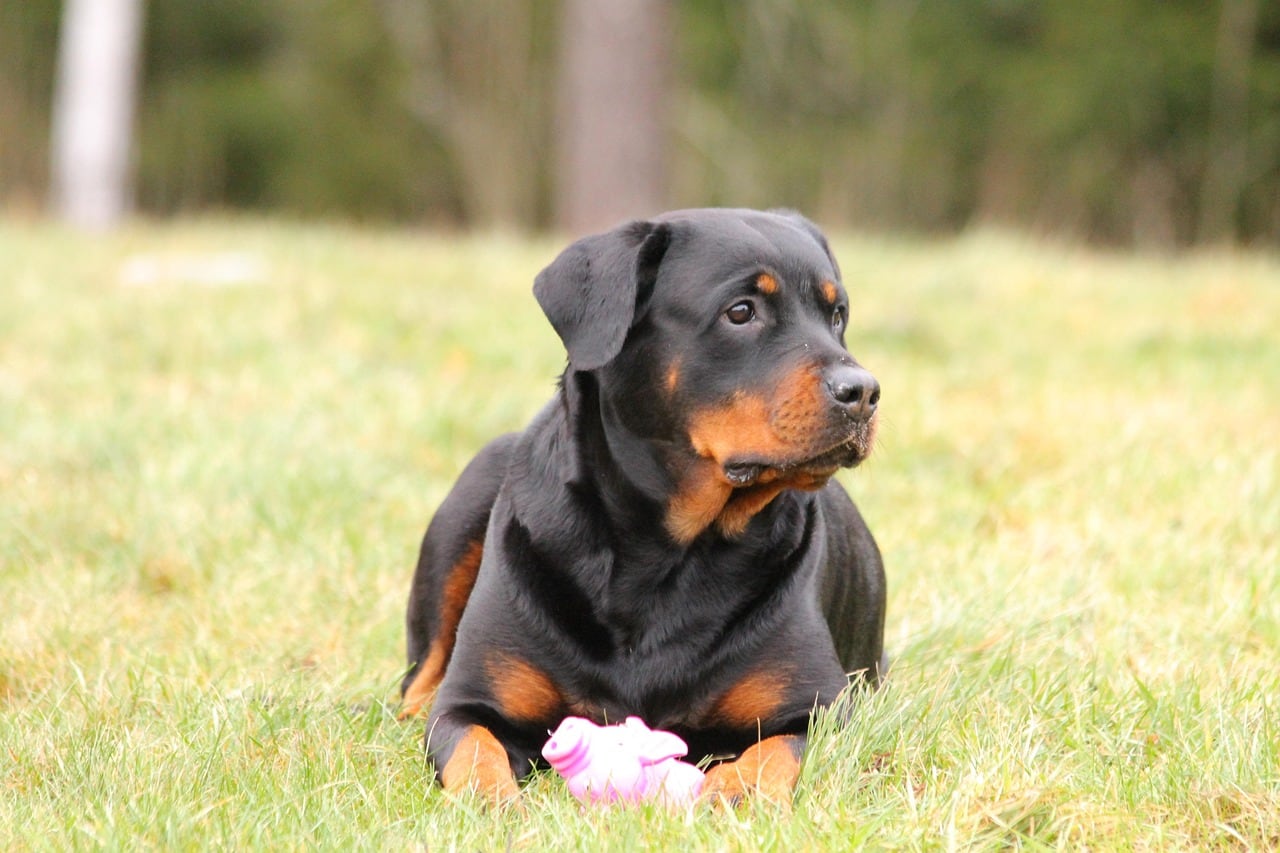
The standard color of the Rottweiler is black with clearly defined tan (brownish-red to mahogany) markings. The tan appears in typical places - above the eyes, on the muzzle, throat, chest, legs and under the tail, with black forming the basic, dominant shade of the coat.
Standard characters
- Base color: black
- Signs: tan, clearly defined
- Location of markings: eyebrows, muzzle, throat, chest, legs and underside of tail
Non-standard coloring
Outside the standard, Rottweilers sometimes have individuals with different coloring, for example with a dull or blurred tan, with an excessive amount of white fur on the chest, or with a different basic coat shade than black. Such dogs cannot participate in shows or breeding according to the FCI/CMKU standard, but the different color itself does not mean a health problem - if the dog comes from a responsible breed, its health is determined mainly by the genetic background of the parents, not the color of the coat.
Rottweiler nature
The Rottweiler is a calm, confident and very even-tempered dog that forms a strong bond with its family and shows a strong need for company. It tends to be reserved and wary of strangers, which, together with a natural distrust of unknown stimuli, supports its strong guarding tendencies - it will make it clear without prompting that something is happening in its surroundings.
This is an intelligent breed that learns quickly and reads even small signals from its owner well. However, this intelligence is combined with a certain amount of independence and self-confidence - the Rottweiler tends to evaluate situations with its own judgment, and if it does not feel clear and consistent leadership, it can also become stubborn. It is not aggressive, but rather a strong personality that needs understandable boundaries.
The energy level of this breed is high and is mainly manifested by the need to have a meaningful program - both physical and mental. A bored Rottweiler often finds work on his own, and this is usually more of a problem for the owner than for the dog itself. On the contrary, a sufficiently busy individual is calm, focused and easy to handle even in common domestic situations.
Typical behavioral manifestations
- Strong ties to family and the need to be part of everyday life.
- Alertness and natural territorial guarding without the need for special training.
- Quick learning of new commands, but also the ability to "test" boundaries if guidance is lacking.
- Needs regular mental and physical exercise, otherwise seeks its own entertainment.
- Moderate barking – barks mainly when prompted, not without reason.
Rottweiler and children
The Rottweiler is usually reliable and calm with its family background, and is considered a suitable breed for children - but consistent socialization from puppyhood, thoughtful upbringing and constant supervision by an adult are crucial. It is a strong and powerful dog, so even without malicious intent, a smaller child can easily knock it down or pull off the leash while playing, and this must be taken into account.
A high need for companionship means that the Rottweiler regards the family, including children, as its pack and tends to be protective of them. However, this alertness must be properly channeled from an early age - an insufficiently socialized or neglected individual may be distrustful of strange children or their friends.
What will make living with children easier?
- Early and ongoing socialization with situations that children bring – noise, sudden movements, visits from friends.
- Consistent training from puppyhood, ideally with the help of an experienced dog trainer – training the breed requires patience and systematicity.
- Constant adult supervision during every contact between the dog and small children, without exceptions.
- Teach children the basic rules of behavior towards dogs – respect their calmness while eating and resting.
- Enough exercise and mental stress so that the dog does not get frustrated and does not discharge excess energy inappropriately in the home.
With growing children who respect the Rottweiler and know the rules of coexistence, the relationship tends to be strong and stable in the long term.
Rottweiler and other dogs and pets
The Rottweiler's relationship with other animals stems from its historical use as a herding and guard dog, which was used to working independently and making decisions based on its own judgment. It tends to be self-confident and rather dominant towards other dogs, so gradual and controlled socialization from puppyhood is appropriate.
The Rottweiler is neutral with cats and small animals in the household - a clearly defined hunting instinct has not been documented in this breed, but it is a powerful and strong dog, whose reaction to an unknown smaller animal is always better not left to chance. It is best to introduce him to a cat or other animal gradually and under control, ideally at an early age.
- Relationship with other dogs: confident, can be dominant, requires socialization
- Relationship to cats and small animals: neutral, guided introduction is recommended
- It is advisable to supplement it with consistent training, which will support the ability to coexist with other animals.
Is the Rottweiler suitable for an apartment?
Probably not. The Rottweiler is a large and strong breed with a high need for exercise and mental stimulation, so it is not suited to being kept in a purely apartment – it needs plenty of space to rest and regular access to the garden or nature, where it can meaningfully discharge its energy.
The key is the amount of exercise that the owner can offer him. Without sufficient activity and mental exertion, he can become frustrated and less balanced. Therefore, a house with a garden or at least a home that allows for long walks and regular training is more suitable.
- He needs space to rest and exercise – a small apartment without the ability to compensate for this outside is not ideal.
- Barking is at a moderate level, so in a densely populated environment with thin walls, a louder reaction to extraneous sounds may be a problem for neighbors.
- He requires plenty of peace and stability in the home - frequent disturbances or a lack of privacy do not suit him.
- Daily exercise should include not only walks, but also activities that involve the head, otherwise there is a risk of unwanted symptoms of boredom.
How much exercise does it need?
The Rottweiler needs several hours of exercise a day, divided into several walks - this is a highly active breed that is not satisfied with a short walk around the block. In addition to physical exercise, mental work is equally important for him, because the need for mental stimulation is high in this breed and a bored dog without tasks will often find his own, less desirable, daily routine.
Suitable activities
- Longer walks and hiking trips in the field
- Obedience and the basics of sporting cynology
- Defensive and performance sports such as IGP/IPO under the guidance of an experienced coach
- Pulling a load or cart using one's physical strength
- Search and smell games as a form of mental work
The Rottweiler is well trained, although it is considered a moderately demanding breed - it needs a consistent and thorough leader with whom it can build a working relationship. This makes it suitable for more demanding canine disciplines, not just for regular walks.
Due to their short coat and massive body structure, it is advisable to avoid intense exercise in hot weather and to plan activities for cooler parts of the day.
Training and education
The Rottweiler is an intelligent dog that learns quickly when trained by a more experienced owner who can offer clear rules and consistency. It usually has no difficulty mastering basic obedience, but it is more challenging to lead it for a long time and maintain a consistent approach from the whole family.
He is primarily motivated by cooperation with a person and the opportunity to solve something together - he appreciates short, meaningful tasks where he sees a clear goal and a quick response. Positively guided training based on praise and reward works more reliably than harsh methods, which can lead to unwanted stubbornness or distrust.
Recommended approach
- Short training blocks, more often and with a clear structure, rather than long and tiring lessons.
- Consistency and the same rules for all household members – the Rottweiler quickly recognizes inconsistency and takes advantage of it.
- Enough mental stress in the form of obedience, finding objects or simple task games to keep him from getting bored.
- Calm, confident leadership without unnecessary pressure – responds better to respect than dominance.
Early and extensive socialization at an early age is essential – contact with different people, environments and situations helps to shape a balanced and predictable dog. Given its strength and high need for human company, training should not be underestimated or postponed until a later age.
Hair care and hygiene
The Rottweiler's short, coarse, close-fitting coat is one of the least maintenance-intensive of all large breeds. Brushing it once a week with a rubber brush or mitt will remove dead hair and promote blood circulation to the skin. Bathing is only recommended when absolutely necessary - frequent washing could damage the skin's natural protective layer.
During the shedding season, when the dog loses its undercoat more intensively, it is advisable to increase the frequency of combing to two to three times a week so that the hair does not end up all over the apartment and on clothes.
Ears, eyes and teeth
The drooping ears of a Rottweiler should be checked regularly, as they can accumulate grease and dirt and reduce air circulation. A weekly visual inspection and gentle cleaning with a suitable product helps prevent unpleasant odors or inflammation. The eyes can be wiped occasionally with a damp cloth to remove any morning discharge. It is a good idea to pay attention to the teeth by regularly cleaning them or at least using chewing aids that reduce tartar formation.
Claws and skin folds
Claws should be trimmed according to how quickly they grow - in active dogs that spend a lot of time on hard surfaces, they wear down naturally, in less mobile individuals, regular trimming is necessary to prevent deformation of the paws. Since the Rottweiler does not have pronounced skin folds or long hair that requires trimming, the care typical of breeds with wrinkles or long hair is not necessary.
Feeding
Due to its massive body structure and high activity level, the Rottweiler needs a high-quality complete food that is appropriate for its size, age and energy expenditure. A puppy requires food formulated for large breeds with slower weight gain - rapid growth can put an adverse strain on the joints and bones of such a heavy dog, so it is advisable to choose products that take this aspect into account. For an adult, it is primarily about maintaining muscle mass and energy needed for regular exercise and mental stress, which this breed requires.
The amount of food should be based on the current physical load - a dog that is intensively engaged in training or sports cynology needs a different energy intake than an individual with a calmer regime. Given that the Rottweiler belongs to a powerful breed, it is especially important to regularly check its physical condition by sight and touch - the ribs should be easily palpable, but not visible, and there should be a noticeable sign of narrowing of the figure in the waist.
Risk of being overweight
Excess weight for this heavy breed places increased strain on the joints and musculoskeletal system, so it is worth monitoring the amount of treats and overall energy intake, especially in dogs with lower physical activity or after castration, when metabolism usually slows down. Over the course of life, it is appropriate to gradually adapt the food to changing needs - from puppy food to food for active adult dogs to lighter options designed for seniors.
How long does a Rottweiler live?
The Rottweiler lives an average of 9 to 10 years, which is in line with the life expectancy of large and powerful breeds of a similar body frame.
The specific lifespan of an individual dog depends on several factors that the owner can largely influence.
- Genetics and breeding: The health of the parents and the responsible selection of a breeding pair have a fundamental influence on the predispositions with which a dog enters life.
- Physical condition: Due to the massive body structure, maintaining an appropriate weight is key - excess weight puts a strain on the joints and overall shortens the dog's active and overall lifespan.
- Exercise: The Rottweiler is a breed with a high level of activity and needs regular, sufficiently long exercise to maintain muscle mass and musculoskeletal condition.
- Prevention: Regular veterinary check-ups, vaccinations, and early detection of potential health problems help extend quality years of life.
- Nutrition: A quality diet appropriate to the dog's age, weight and activity level supports joint health, heart health and overall vitality.
- Health predisposition: The breed may have an increased predisposition to musculoskeletal problems, typical of large and heavy breeds, so it is advisable to pay increased attention to them from puppyhood.
Who is a Rottweiler suitable for?
The Rottweiler is best suited to experienced owners who can provide consistent training, plenty of exercise and mental stimulation. It is a dog that requires a high level of companionship and mental stimulation and is not suitable for an apartment or less active household.
Who is the breed suitable for?
- For experienced breeders who have already worked with large or strong breeds.
- For active individuals or families who can ensure regular physical and mental exercise.
- For owners living in a house with a garden where the dog has plenty of space.
- For families with children, if the dog is properly socialized from puppyhood and is raised consistently.
- For those looking for a dog that requires medium training but will appreciate its willingness to cooperate.
Who is the breed not suitable for?
- For beginners with no experience raising a large and strong breed.
- For seniors who might have trouble handling the physical strength of a dog.
- For owners of apartments or households without the possibility of regular walks and exercise.
- For people who spend most of the day away from home and cannot give their dog enough attention.
- For those looking for a dog without demands for company – the Rottweiler does not tolerate long-term loneliness.
Interesting facts about the breed
The Rottweiler comes from Germany, where it was used as a cattle and draft dog - its name is derived from the city of Rottweil, which is confirmed by its inclusion in FCI standard No. 147.
According to the FCI, it belongs to the molossoid type of dogs (group 2), i.e. in the same category as, for example, the boxer or the Great Dane, with whom it shares a robust body structure and strong constitution.
An interesting fact is the significant difference between the sexes in terms of size - while the male reaches up to 68 cm at the withers, the female remains noticeably smaller, which is a relatively pronounced sexual dimorphism in this breed.
Rottweiler Health
The Rottweiler is a large and powerful breed, with males weighing around 50 kg and females around 42 kg, which also reflects the demands for healthy skeletal and joint development. The average lifespan of 9–10 years corresponds to what can be expected for dogs of this size and body structure. The short, close-fitting coat does not require complex care, and the lower demands on coat care are therefore not a major health issue. Given the robust body structure and rapid growth during the growth period, it is advisable to pay particular attention to the musculoskeletal system and overall physical load during adolescence.
Joints and musculoskeletal system
For large and heavy breeds, such as the Rottweiler, the emphasis is generally on smooth growth and adequate exercise during puppyhood and adolescence to prevent overexertion of the joints and spine. Jumping, hard movements, and long walks on hard surfaces are typically not recommended for growing dogs in this weight category. For adults, it is advisable to maintain an appropriate body weight, as excess weight increases the strain on the joints and tendons.
What to look for when choosing a puppy
- Be interested in the health and condition of the parents, and possibly the results of any hip and elbow examinations, if the breeder has them available.
- Observe whether the puppy appears lively, has adequate physical condition and free, painless movement.
- Ask the breeder about how the puppies were raised – space for exercise, socialization, and stress at an early age.
- Choose breeders who provide information about the puppy's background and are willing to answer questions even after the sale.
Known predispositions
The breed is described to have an increased predisposition to:
- to hip dysplasia.
- to elbow dysplasia.
- to osteosarcoma (bone cancer).
- to subaortic stenosis (congenital heart defect).
- to von Willebrand's disease (blood clotting disorder).
- for enlargement and rotation of the stomach (gastric dilatation-volvulus) in dogs with deep chests.
- to hypothyroidism (reduced thyroid function).
- to entropion (inversion of the eyelid).
This overview is for informational purposes only and does not replace the examination or recommendations of a veterinarian.
What to buy for a Rottweiler
Practical basis that is suitable for this breed:
- Toys – Dog toys – fetching, chewing and interactive.
- Cosmetics – Shampoos, conditioners and hair care products.
- Bowls – Feed and water bowls, anti-swallow bowls and stands.
- Collars – Dog collars – leather, textile and semi-tight.
- Beds – Beds and mattresses for dogs of all sizes.
- Leashes – Leashes, switch leashes and tracking lines.
Useful instructions
Practical tips that are useful when caring for a dog:
Frequently asked questions
Is a Rottweiler suitable for beginners?
Probably not – the Rottweiler needs an experienced and consistent owner who can handle its training and socialization. It is a strong and confident breed that can be difficult to handle without proper guidance.
How does a Rottweiler behave towards children?
The Rottweiler is more suitable for children if it grows up in a family from a puppy and is properly socialized. Thanks to its robust build and calm nature, it can be a patient companion, but contact between children and a large dog should always be supervised.
How much does an adult Rottweiler weigh and how tall is it?
The male measures 61–68 cm at the withers and weighs around 50 kg, the female is smaller – 56–63 cm and approximately 42 kg. This is a large and powerful breed.
How long does a Rottweiler live?
The average lifespan of a Rottweiler is 9–10 years, which is within the normal range for large breeds.
Is a Rottweiler suitable for an apartment?
Probably not – a Rottweiler needs plenty of space and regular exercise, so an apartment is not ideal for him. A house with a garden will provide better conditions.
How difficult is it to care for a Rottweiler's coat?
Hair care is easy, as the Rottweiler has a short, coarse, and close-fitting coat that only needs occasional brushing. Shedding is moderate, so the household will not be completely hairless.
Is the Rottweiler an aggressive dog?
The Rottweiler is not inherently aggressive, its reputation is more related to its great physical strength and the need for consistent training. A properly trained and socialized individual is calm, confident and devoted to its people.
What was the Rottweiler originally bred for?
The Rottweiler originated in Germany, where it was used as a cattle dog to herd cattle and later as a draft dog and guard dog. This is reflected in its current need for work and mental stimulation.
How difficult is Rottweiler training?
Training difficulty is medium - the Rottweiler is intelligent and docile, but requires consistency and clear rules from the puppy. Without sufficient mental stimulation and work, he can be restless or destructive.
Does a Rottweiler get along with cats and other animals?
The Rottweiler's relationship with cats is neutral, the result depends mainly on early socialization and joint raising. Without getting used to it, it may show indifference or caution towards other animals.
Is Rottweiler suitable for seniors?
Probably not – it is a strong and active breed that requires a physically fit owner who can handle its pull on a leash and regular exercise. For less mobile seniors, the Rottweiler is not an ideal choice.
What health predispositions should you watch out for in a Rottweiler?
The breed may be predisposed to orthopedic problems due to its large build and rapid growth during puppyhood. Adequate exercise during development and regular veterinary check-ups are therefore recommended.
Resources and further information
- FCI Standard No. 147 – Rottweiler – Fédération Cynologique Internationale
- Source of body measurements – fci.be
Professional cooperation
This breed overview was created in cooperation with the Veterinary Clinic VYVET sro and MVDr. Adam Hylák .