
Published 10. 9. 2026
The Great Dane is a giant breed from Germany, classified in FCI Group 2 among the molossoid types (standard no. 235). Its powerful yet elegant body structure has earned it the nickname "Apollo among dogs" - the female measures 72-84 cm at the withers, and despite its size, it appears more noble than menacing.
The Great Dane is calm, friendly and strongly attached to its family, with whom it wants to spend most of its time - it does not tolerate loneliness well. It is rather friendly towards children, and gets along well with other dogs. However, due to its size and strength, it is not suitable for complete beginners or for a small apartment. The coat requires minimal care, but drooling should be expected as part of living with this breed.
Professionally consulted
The content was created in cooperation with the veterinary clinic Veterinární klinika VYVET sro and MVDr. Adam Hylák.


Quick overview
What is a Great Dane like?
The Great Dane (Deutsche Dogge, internationally known as the Great Dane) is a giant breed originating from Germany, classified in FCI Group 2 among the molossoid types. It is one of the tallest dog breeds in the world – males reach around 80 cm at the withers, females 72–84 cm. Despite its impressive size, it has a calm and balanced temperament, with a moderate need for exercise and mental stimulation, which distinguishes it from more boisterous working breeds.
This is a dog that is strongly attached to its family – it has a high need for company and does not tolerate loneliness well. It rarely barks, but it drools a lot, which should be counted among the operational disadvantages. It can be trained at a medium level, and its coat requires almost no care.
Due to its temperament, the Great Dane is more suited to experienced breeders with plenty of space - it is not suitable for an apartment. It is friendly with children and gets along well with other dogs, with cats it depends on the specific nature of the individual.
Origin and history of the Great Dane
The ancestors of the Great Dane go back deep into the history of breeding large, powerful dogs that were used in Europe to hunt big game and as guards for noble courts. The basis of the breed were powerful Molossian-type dogs, crossed with sighthounds, which provided the necessary speed and agility. This combination of strength and agility was key to its original purpose - hunting wild boar and deer, where the dog had to catch up and hold a large and dangerous animal before the hunter arrived.
Similar large dogs were bred for centuries in Germany and surrounding European countries under various local names, often derived from their role as hunting or boar dogs in the noble courts. It was only during the 19th century that German breeders began to strive to unify these regional types into a single breed with a consistent appearance and temperament, moving away from a purely hunting application towards a representative and social dog.
The unification of the various lines and the establishment of a single standard took place in Germany, where the breed began to be officially referred to as Deutsche Dogge – this name was intended to emphasize its German origin and distinguish it from earlier international designations. Germany is still listed as the country of origin within the International Cynological Federation FCI, where the breed is classified among the molossoid types of dogs. Since the days of hunting, the focus of breeding has gradually shifted to characteristics suitable for a family and companion dog, although it has still retained a powerful, impressive body structure reminiscent of its historical roots.
Appearance and size
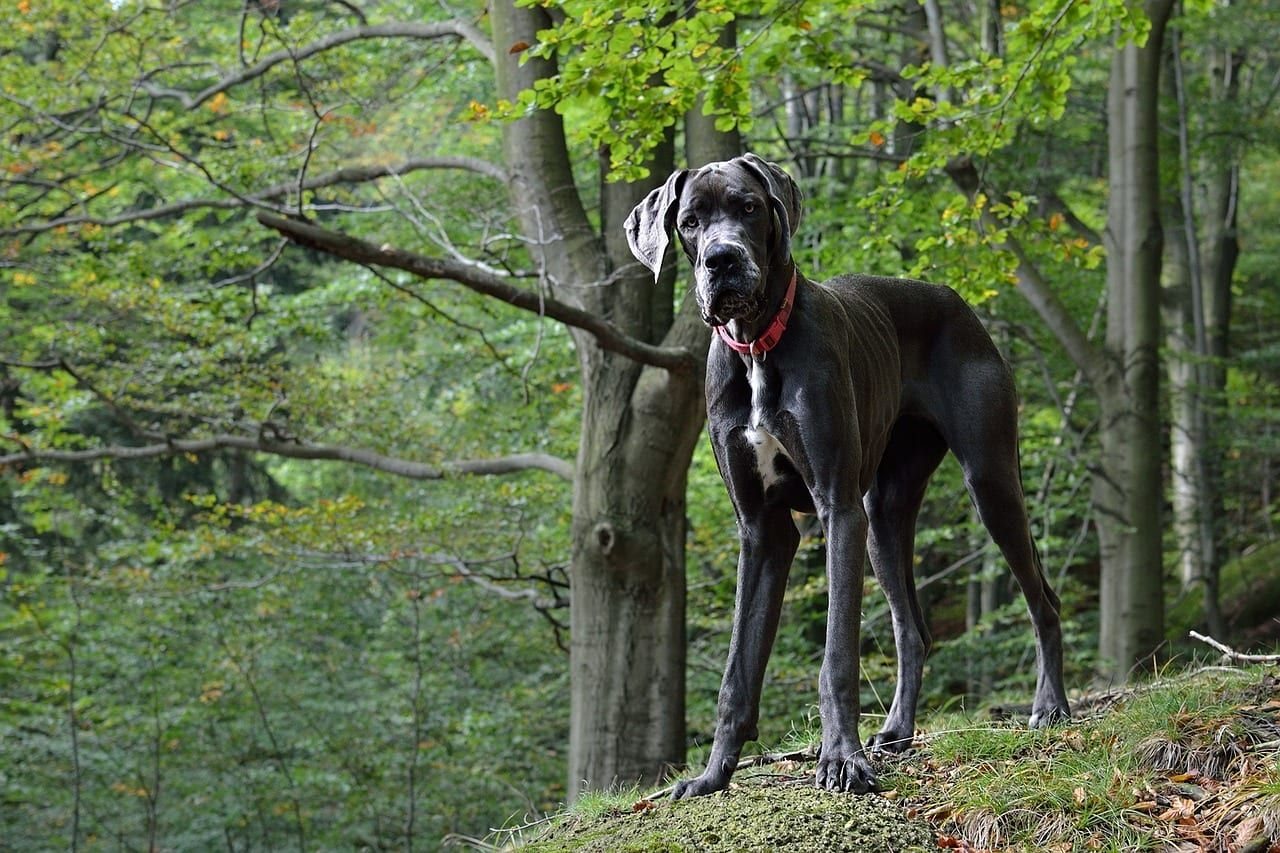
The Great Dane is one of the largest dog breeds ever – the male reaches around 80 cm at the withers, the female is slightly smaller, around 72–84 cm. The overall appearance is impressive: the strong, muscular body structure, despite its size, appears elegant and athletic, not cumbersome or angular.
The head is long and prominent, with a flat forehead and a deep muzzle, which gives the face a characteristic noble expression. The ears are set high, naturally hanging and medium in size, the eyes are rather round, dark and lively, with an intelligent look. The neck is long and muscular, smoothly merging into a deep chest and a well-built back. The tail is set high, tapering towards the end and hanging freely at rest, slightly raised when moving.
Coat and typical features
The coat is short, dense and close-fitting all over the body, without undercoat, which underlines the pronounced musculature and body lines. Color variants and their standards are described separately in the color section.
Typical features of the breed include long, slender limbs, a deep chest reaching almost to the elbows, and an overall upright, dignified stance. Differences between the sexes are primarily manifested in overall strength and height - males tend to be more robust and taller, females have a more delicate but still strong body structure.
Great Dane Colors
The FCI standard No. 235 for the Deutsche Dogge distinguishes several separate color and pattern traits for this breed, but a specific list of recognized shades and pattern traits is not part of the documents presented here, and therefore we do not provide it in order to avoid distorting the current wording of the standard.
We recommend that those interested in precise color classification verify the current version of the standard directly with the Czech Kennel Club or FCI, or consult a breed club before the specific color of the puppy is used as a decisive criterion in selection.
The nature of the Great Dane
The Great Dane is a calm and balanced companion whose powerful appearance contrasts with a relatively gentle nature. It is very devoted to its owner and family and needs a bond with its human intensely - it does not tolerate long separation or isolation in a kennel well. It is a dog that wants to be part of the family, not a guardian in the garden.
She handles training at a medium level – she is docile and wants to please, but she can still show a certain amount of independent thinking, especially if the training lacks a clear order and consistency. She appreciates a patient, matter-of-fact approach without unnecessary pressure, and reacts to rudeness or nervousness by withdrawing into herself.
Energy corresponds to a medium level - it needs regular exercise, but it is not a breed that requires sports loads from morning to night. Likewise, mental stimulation should be adequate, more in the form of joint activities and walks with stimuli than demanding training disciplines.
It rarely barks, which does not make it a guard dog in the traditional sense. Its guarding instinct is rather natural and calm - its size and presence create a deterrent effect without it having to actively attack or bark at strangers. It tends to be more reserved with strangers, but not aggressive.
In contact with other dogs, it is rather conciliatory, its attitude towards cats is individual and depends on experience and socialization. A certain physical laziness in the home environment is also a typical feature - it likes to rest next to the family, and it can exchange its calmness for a willingness to go for a walk at any time.
Great Dane and children
The Great Dane is rather suitable for children, but its enormous size and weight make it a breed that requires consistent adult supervision during any contact with a small child. It is a dog with a calm disposition and low barking, yet its size and careless movement alone can unintentionally beat or injure a small child - not out of aggression, but out of sheer physical superiority.
The relationship with children depends primarily on quality socialization at an early age and on education focused on calmness and controllability. The Great Dane has a high need for company and perceives the family as its pack, which, when properly led, creates a strong bond with children. Training the breed requires patience - it requires consistency, not harshness, and it is advisable to start with basic obedience as soon as possible, while the puppy is still manageable.
What to watch out for
- Never leave a small child with a Great Dane unattended, even with a dog with a balanced temperament.
- Teach both the child and the dog mutual boundaries – do not tease the Great Dane, do not let the child jump on the dog.
- Due to the high rate of drooling, it is advisable to plan on regular cleaning in places where the child plays.
- A moderate need for mental stimulation means that calm but regular activities with your child (walks, playing in the garden) benefit both parties.
For families with older children who respect the rules of coexistence with a dog, the Great Dane tends to be a balanced companion. For families with very young children or without previous experience with large breeds, a higher level of caution should be expected and, if necessary, consultation with the breeder regarding the specific nature of the puppy should be considered.
Great Dane and other dogs and pets
The Great Dane gets along well with dogs, especially if it is socialized from a puppy and used to regular contact with other individuals. Its relationship with cats and small animals is more variable and depends on its specific nature and upbringing - it is clearly not suitable for living with them, but the nature of the breed does not result in a significant hunting pressure.
This breed was originally used as a hunting and guard dog for large game, and later more as a companion and guard dog, which is reflected in its current behavior - it is a rather calm and balanced dog, without a strongly heightened hunting instinct, which is typical of breeds bred purely for hunting small game.
Living with other dogs
Thanks to its low barking rate and rather calm nature, the Great Dane usually behaves in a group of dogs without conflict. However, given its size and strength, it is advisable to pay attention to controlled socialization from puppyhood so that it can correct its physical dominance, especially when playing with smaller breeds.
Living with cats and small animals
The relationship with cats is neutral in this breed - the result of coexistence depends primarily on how the animals are accustomed to each other from a young age. With small animals (rodents, small birds), increased caution and supervision is appropriate due to the size and strength of the Great Dane, even though the hunting instinct itself is not significantly emphasized in the breed.
Is the Great Dane suitable for an apartment?
The Great Dane is not suitable for an apartment. It is an exceptionally large breed that, despite its overall average activity level, needs enough space to stretch out, turn around and move between rooms without constantly bumping into furniture. The ideal environment is therefore a family house with a garden, where it has enough space to rest and move freely.
But space requirements are not the only reason. The Great Dane is sensitive to climate - due to its short coat and robust body structure, it does not like extreme heat or cold, so it needs a temperate indoor environment with the possibility of retreating to a quiet corner. At the same time, it is a breed with a high need for contact with its family, so isolation in the garden without human proximity is not the solution - the Great Dane wants to be part of the household, it just needs more square meters than smaller breeds.
In terms of living with neighbors in an apartment building, its low barking rate plays in its favor - the Great Dane is not a typical "whistleblower" and does not unnecessarily bother the surroundings with its barking. A smaller advantage is that the training and mental stimulation requirements are at a medium level, so it does not require such an intensive daily program as some working breeds. However, it is still true that a large space for movement and rest is a basic condition for a happy life for such a large dog.
How much exercise does it need?
The Great Dane needs exercise at a moderate level of activity – regular walks and free movement, but not hours of intense exercise. Given its size and weight, it is better to divide exercise into several shorter walks rather than one exhausting walk, especially for growing dogs, where it is desirable to spare the joints and not overload them with vigorous running or jumping.
Quiet walks in the field, longer walks in nature and free movement without a leash in a safe environment are suitable. Thanks to the balanced nature, the mastiff is also well suited for owners who do not seek extremely demanding sports - a regular rhythm of movement and the opportunity to spend time together outdoors are sufficient.
Dog sports and mental stimulation
Mental stimulation should complement physical exercise, because even a physically tired dog needs to use his head. Obedience exercises, finding treats or simple task games are suitable, which correspond to the medium training difficulty of this breed - the Great Dane is docile, but works better in a calm and consistent approach than in a hectic pace.
- Longer walks in nature, ideally divided into several shorter sections
- Free movement in a secure area without the need for intensive running
- Basic obedience and simple task games for mental exercise
- Careful weighting of puppies and young individuals due to skeletal growth
Due to the short coat and large body surface, it is advisable to adjust the intensity and length of exercise on hot summer days and avoid more demanding activities in the hottest weather.
Training and education
Training a Great Dane requires patience and an early start – not because of stubbornness, but because of the enormous size the puppy will quickly grow to. Basic obedience, walking on a leash without pulling, and recalling need to be mastered at an age when the dog is still physically manageable, because an adult Great Dane can easily overpower an adult human with its strength.
They respond well to training if it is conducted in a positive and calm manner - they appreciate praise, petting and rewards in the form of treats, harsh methods or shouting at them lead to insecurity rather than cooperation. Short, frequently repeated lessons that respect the fact that this is a sensitive breed with a strong bond with its family are effective.
Socialization and specifics
Given its height and weight, it is important to introduce the Great Dane to common situations from puppyhood – strangers, other dogs, noise and travel – so that it does not appear insecure or unpredictable in adulthood. Low barking and a rather calm nature make it easy to live together, but the breed needs to have clearly set rules for movement around the house and around children, because even unintentional movement of such a large dog can be dangerous for a smaller child.
Mental stimulation is managed in the form of short training games, scent tasks or walks with elements of obedience - long, physically demanding training sessions are not necessary and are not suitable for a growing individual. Due to the high need for human company, the Great Dane learns best when training is combined with time spent with the owner, not as an isolated drill.
Hair care and hygiene
The short and smooth coat does not require complex grooming - regular brushing with a rubber brush or glove is enough to remove loose hair and keep the coat shiny. Due to the moderate shedding rate, combing once or twice a week is sufficient, but during the shedding period it is advisable to slightly increase the frequency.
Bathing should only be done exceptionally, for example when there is visible dirt, because the short coat is easy to clean and over-washing could disrupt the skin's natural protection.
Due to the high rate of drooling, it is practical to have a cloth on hand to wipe the muzzle, especially after drinking or eating - drooling is more pronounced in this breed than in many others.
Ears, eyes and teeth
It is advisable to regularly check the hanging ears and, if necessary, gently clean them to prevent the accumulation of dirt and moisture. The eyes should be checked occasionally and any dried secretions wiped away. It is good to brush the teeth regularly, ideally several times a week, to prevent the formation of tartar.
Claws and joints
Due to the large body weight and the strain on the joints, it is advisable to trim the claws regularly to prevent incorrect foot position and unnecessary strain on the joints when walking.
Feeding
The Great Dane is one of the giant breeds for which nutrition plays a key role during the growth period - rapid weight gain and great growth place extraordinary demands on the puppy's skeletal and joint system. It is therefore appropriate to choose a complete food specifically designed for large and giant breeds, which has a modified calcium and phosphorus ratio and does not support too rapid bone growth.
For an adult, the food should correspond to the medium level of activity that this breed exhibits - i.e. it is not a high-energy diet like for sporting or working dogs, but neither is it a diet intended for a small breed with little mobility. The amount of food should be continuously adjusted to age, current physical load and health status.
Physical fitness check
Due to the large body frame, overweight in the Great Dane is less noticeable than in smaller breeds, but it is all the more important to regularly check the ribs by palpation and monitor the silhouette in profile. Excess weight puts a strain on the joints and spine, which is more risky in such a large dog than in smaller breeds. The food ration should therefore be divided into several smaller portions per day, which also helps to reduce the risk associated with the rapid intake of a large amount of food at once.
Life stage adaptation
- Puppy and young dog: food for large/giant breeds with controlled energy and mineral content to support slow growth.
- Adult dog: balanced complete food suitable for medium physical activity.
- Older dog: adjust the dose according to reduced energy expenditure and any health restrictions.
When making any changes to the feeding ration or type of feed, it is advisable to proceed gradually and, in case of uncertainty, consult a veterinarian about the appropriate composition of the diet, especially with regard to the size and specific requirements of this breed.
How long does a Great Dane live?
The average lifespan of a Great Dane is between 7 and 10 years. This is typical for large and giant breeds, whose lifespan is generally shorter than that of small breed dogs - the body of a large dog wears out faster and aging occurs more intensively.
What affects lifespan?
How long a Great Dane lives is influenced by a combination of innate predispositions and how the dog is cared for throughout its life.
- Genetics: the puppy's origin and the health status of the parents significantly influence the predisposition to a number of diseases and the dog's overall vitality.
- Physical fitness: maintaining an appropriate weight without being overweight reduces the strain on the joints, spine and heart, which is crucial for such a large dog.
- Exercise: Due to its moderate activity level, the Great Dane needs regular, but reasonably dosed exercise - especially during the growth period, it is important to avoid overloading the skeleton.
- Prevention: regular veterinary check-ups allow you to detect potential health complications early and address them before they threaten the quality and length of life.
- Nutrition: quality food appropriate to the dog's age, size and activity level supports healthy skeletal and muscular development and helps prevent overweight.
- Health predisposition: the breed may have an increased predisposition to spine problems (cervical spine instability), heart diseases such as dilated cardiomyopathy, and other problems typical of large breeds, such as stomach bloating.
Responsible care in these areas provides a good foundation for the Great Dane to reach the upper limit of its natural lifespan.
Who is the Great Dane suitable for?
The Great Dane is a giant dog with a high need for human closeness, which is best suited to a household with plenty of space and an owner who expects long-term daily contact - this dog does not want to spend time alone in the garden, but wants to be part of the action in the house.
Who is the breed suitable for?
- For families and individuals living in a house with a garden where the dog has enough space to move and rest.
- For owners who are willing to spend a lot of time with their dog and involve it in family life - the Great Dane does not tolerate long-term loneliness.
- For households with children, where supervision of interaction is ensured - due to the dog's size, careless contact can easily knock a small child over.
- For dog owners who want a calmer companion with a moderate need for exercise and mental stimulation, not an extremely active sporting dog.
- For those who can handle the training that requires patience and consistency – manageable, but not trivial for such a large and strong individual.
- For households that are not bothered by increased drooling and regular coat care is secondary to them – the coat itself is easy to groom.
Who is the breed not suitable for?
- For apartment living – due to its size and need for space, the Great Dane is not suitable for smaller living spaces.
- For complete beginners with no experience with a large breed – handling a dog of this weight and strength requires confidence in leadership and training.
- For people who leave their dog alone for long hours – their high need for companionship makes the Great Dane an unsuitable candidate for lonely days.
- For households where drooling is a problem - this breed is significantly higher than many others.
- For owners looking for a dog with a long life expectancy – the lifespan of this giant breed tends to be shorter than that of smaller dogs.
Interesting facts about the breed
The Great Dane is one of the largest dog breeds in the world, as reflected in its inclusion in FCI standard No. 235 under the Molossoid breeds. In English-speaking countries, it is known as the Great Dane, despite its German origins.
The difference between the standard for a dog and a bitch is quite significant in this breed - while a dog reaches around 80 cm at the withers, the standard height for bitches ranges from 72–84 cm, so individuals within the breed can overlap in height.
Despite its impressive size, the Great Dane is a breed with a low tendency to bark, which, combined with its high need for human company, makes it a calm and sociable dog rather than a noisy guard dog.
Great Dane Health
The Great Dane is a giant breed with a relatively short average lifespan of 7-10 years, which is common for large and gigantic breeds and is related to rapid growth and stress on the body. Given its body size and weight, it is advisable to pay increased attention to the heart and musculoskeletal system, which are generally the most stressed in large breeds. Professional literature repeatedly focuses on two areas of this breed - the cardiovascular system and the cervical spine. Regular veterinary checks and adequate stress during growth can help detect potential problems early.
Heart and cardiovascular system
Great Danes may be at increased risk for dilated cardiomyopathy (DCM), a heart muscle disease that affects the heart's ability to pump blood efficiently. This disease is relatively more common in large and giant breeds and often manifests itself later in life, so regular cardiac monitoring is recommended throughout the dog's life.
Cervical spine and musculoskeletal system
Another issue that professional sources address in this breed is the so-called wobbler syndrome (cervical vertebral instability) – a condition related to the cervical spine that may be related to the rapid growth and large body weight typical of this breed. Given the size and weight of the dog, it is generally advisable to ensure that the puppy's growth occurs gradually and without excessive strain on the bones and joints.
What to look for when choosing a puppy
- Ask the breeder about the health status and possible cardiological examinations of the puppy's parents.
- Find out whether the condition of the cervical spine and musculoskeletal system in adult individuals is monitored in the breeding facility.
- Choose a puppy from a breeder who follows recommendations for gradual growth and appropriate exercise for large breeds during adolescence.
- Monitor the overall vitality and condition of the puppy and its parents during a personal visit to the kennel.
Known predispositions
The breed is described to have an increased predisposition to:
- to gastric dilatation-volvulus (GDV), with studies in large breeds ranking Great Danes among the breeds with the highest lifetime risk of this condition.
- to hip dysplasia in connection with rapid growth and large body weight during the development period.
- to elbow dysplasia (elbow dysplasia) in connection with rapid growth and large body constitution.
- to hypothyroidism (reduced thyroid function).
- to eyelid problems such as entropion or ectropion, which are more commonly reported in large breeds with looser facial skin.
Discussed risks
The breed is described to have an increased predisposition to:
- to dilated cardiomyopathy (DCM), a disease of the heart muscle leading to its weakening and enlargement of the heart chambers.
- to the development of osteosarcoma (bone tumor), which is associated with large and giant breeds with high body weight and long bones.
- to cervical spondylomyelopathy (so-called wobbler syndrome), a disorder affecting the cervical spine and spinal cord in large and giant breeds, with the developmental form being described mainly in young individuals of this breed.
This overview is for informational purposes only and does not replace the examination or recommendations of a veterinarian.
What to buy for a Great Dane
Practical basis that is suitable for this breed:
- Toys – Dog toys – fetching, chewing and interactive.
- Cosmetics – Shampoos, conditioners and hair care products.
- Bowls – Feed and water bowls, anti-swallow bowls and stands.
- Collars – Dog collars – leather, textile and semi-tight.
- Beds – Beds and mattresses for dogs of all sizes.
- Leashes – Leashes, switch leashes and tracking lines.
Useful guides
Practical tips that are useful when caring for a dog:
Frequently asked questions
How big is a Great Dane?
The Great Dane is one of the tallest breeds ever – the male reaches around 80 cm at the withers, the female is usually 72–84 cm. It is a massive dog with a corresponding body weight, which is not directly stated in the standard.
How long does a Great Dane live?
The average lifespan of a Great Dane is 7-10 years, which is quite normal for such a large breed. The shorter lifespan of giant breeds is related to faster growth and stress on the body.
Is a Great Dane suitable for an apartment?
The Great Dane is not ideal for an apartment, despite its medium activity level. Its size requires plenty of space to move and rest, so it is more suitable for a house with a garden.
Is the Great Dane suitable for children?
The Great Dane is rather suitable for children, due to its nature it tends to be calm and friendly towards the family. However, due to its size, it is necessary to monitor interactions with smaller children to avoid accidental knockdowns during play.
Is the Great Dane suitable for beginners?
The Great Dane is not suitable for beginners. The training difficulty is medium, but the size and strength of the dog require experience and confidence from the owner when leading.
Does the Great Dane bark a lot?
The Great Dane sheds moderately, has a short coat, and is easy to care for. Regular brushing is enough to keep the coat in good condition.
Why does a Great Dane drool so much?
The Great Dane is a breed with a high rate of drooling, which is related to the structure of the lips and head typical of the Molossoid type of dogs. Owners should expect this, especially after drinking water or feeding.
What health problems can occur in Great Danes?
Great Danes may be predisposed to wobbler syndrome, an instability of the cervical spine, and dilated cardiomyopathy, which affects the heart muscle. These are topics that should be discussed with the breeder and veterinarian.
Does a Great Dane need a lot of company?
The Great Dane has a high need for company and does not tolerate long-term loneliness. It is used to being part of the family and is strongly attached to its people.
Does the Great Dane get along with other dogs and cats?
The Great Dane gets along well with dogs, but its relationship with cats is rather individual and depends on socialization from puppyhood. Thanks to its low barking rate, it does not appear conflictive in a group of animals.
Does a Great Dane bark a lot?
The Great Dane has a low barking rate and rarely barks, making it a quiet companion that doesn't make unnecessary noise.
Resources and further information
- FCI Standard No. 235 - Great Dane - Fédération Cynologique Internationale
- Source of body measurements – fci.be
- Expert resource - cgejournal.biomedcentral.com
- Expert Resource - petplace.com
- Expert Resource - sciencedirect.com
- Expert resource - vet.cornell.edu
Professional cooperation
This breed overview was created in cooperation with the Veterinary Clinic VYVET sro and MVDr. Adam Hylák .