
Published 31. 8. 2026 · Updated 1. 9. 2026
The Prague Ratter is the smallest Czech dog breed and one of the few that originated directly in the Czech Republic. It is classified in FCI Group 9 (section Continental Toy Spaniel and others, standard no. 363) and measures 20–23 cm at the withers, regardless of gender. The short, smooth coat requires minimal care and the breed almost does not shed or drool.
The Ratter has a lively, affectionate and strong bond with its family – it does not tolerate loneliness well, as it has a high need for company. It is rather friendly towards children and usually gets along well with dogs. It is destined to live in an apartment due to its size and low space requirements. It can be handled by beginners and seniors, and training is moderately demanding due to the breed's intelligence.
Professionally consulted
The content was created in cooperation with the veterinary clinic Veterinární klinika VYVET sro and MVDr. Adam Hylák.
Quick overview
What is the Prague Ratter like?
The Prague Ratter is the smallest domestic breed – it measures 20–23 cm at the withers, regardless of gender. It is a breed classified in FCI group 9 among companion dogs, which is reflected in its nature: it is strongly attached to its family and needs the company of people to a high degree, it does not like being left alone for long periods. It has a lively and attentive temperament, barks more often, which makes it a good alarm dog. The short, smooth coat requires only minimal care and the breed almost does not shed.
It is suitable for apartments and for seniors, it gets along well with older children, and due to its small size, supervision is appropriate for small children. Even a less experienced owner can handle the training, although the dog is often stubborn and will appreciate a patient, consistent approach. It needs medium activity, which makes it suitable for quieter households.
Origin and history
The Prague Ratter is a breed with roots in Bohemia, where small, short-haired rat-catching dogs have been kept since the Middle Ages as rodent hunters in households and farms - hence its name and the English designation Prague Ratter. Its small stature and lively nature made it a valued helper where it was necessary to keep a home free of mice and rats, without the dog taking up much space or requiring a demanding diet.
The ancestors of the breed are considered to be small European rat-catching dogs and miniature pinschers, which were crossed in the Czech lands for centuries without systematic breeding. It is said that these real small dogs were popular with the nobility and in bourgeois households, where they fulfilled the role of companion and pest hunter at the same time. During the 20th century, especially after the world wars, the population almost disappeared - small rat-catching dogs were decreasing and the breed was on the verge of extinction.
The turning point came in the second half of the 20th century, when a group of Czech breeders decided to systematically restore and stabilize the remnants of the original population. By targeting individuals with typical characteristics – a small head, a fine skeleton and short hair – they managed to create a comprehensive breeding base. The breed standard was subsequently developed and the breed gained international recognition from the FCI, which made the Prague Ratter an officially defined breed and spread beyond the borders of the Czech Republic, where it is now mainly bred as a companion dog for apartments.
Appearance and size
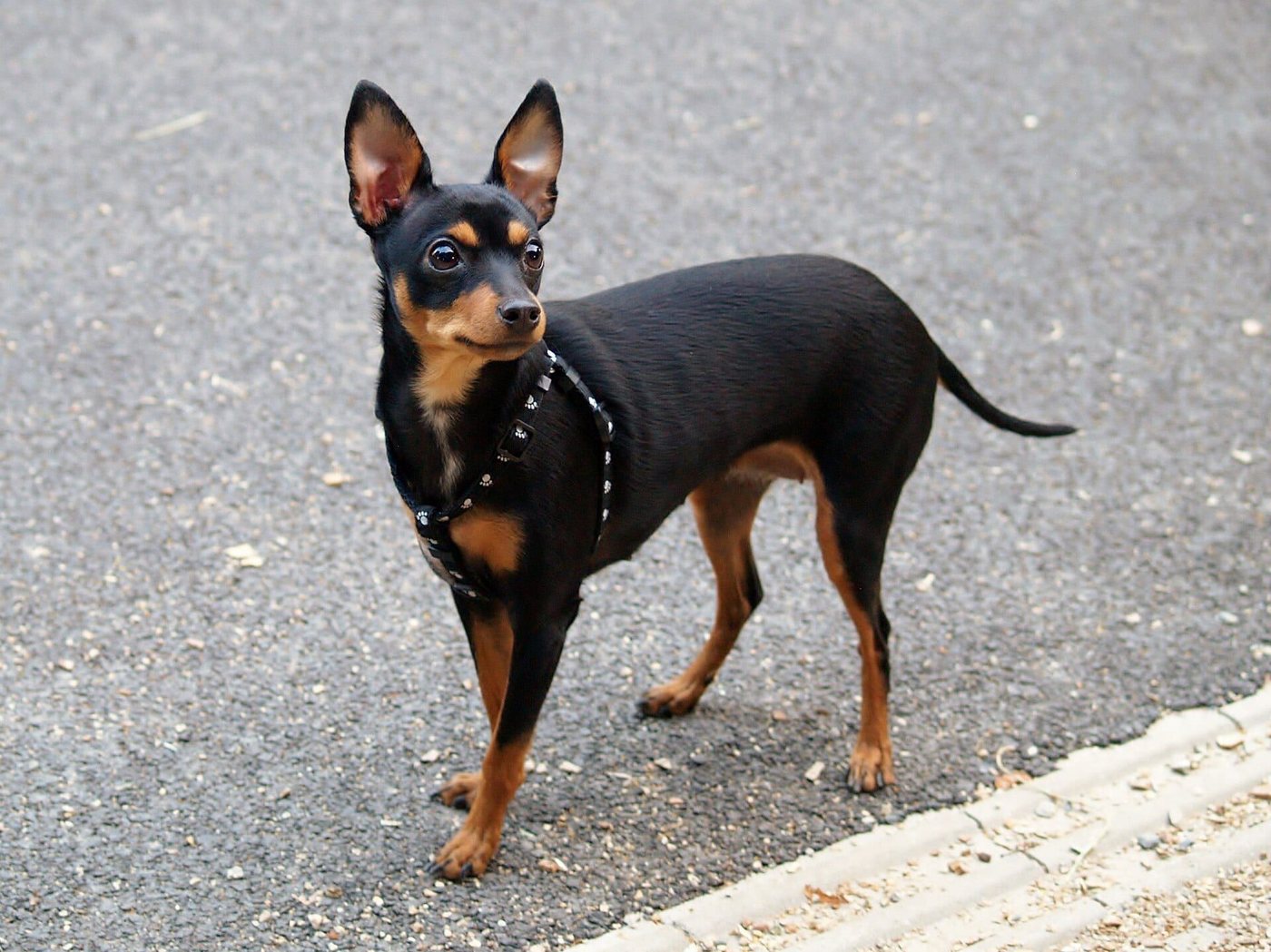
The Prague Ratter is one of the smallest breeds of dog – it measures 20–23 cm at the withers, regardless of gender, so the height of a male or female does not differ significantly. It is a small dog with a smooth, short coat that lies close to the body and does not require complex grooming.
The body is slender, but at the same time strong and proportionally balanced - the Ratter should not appear fragile or excessively delicate. The head is symmetrical, with prominent dark eyes, which give the expression an alert and attentive touch. The ears are carried erect or semi-erect, which is one of the typical distinguishing features of the breed. The tail is set high and the dog holds it erect when moving.
Typical signs
- Small stature combined with a strong, not fragile, skeleton
- Short, smooth coat without undercoat
- Erect or semi-erect ears
- Dark, lively eyes
- High-set tail
The coat color variations that the breed standard allows are described separately in the section dedicated to colors.
Colors of the Prague Ratter
The FCI standard for the Prague Ratter precisely defines the recognized colors and their characteristics, but a specific list of color variants is not part of the generally available breeding reports with which this atlas works. Therefore, we recommend that those interested in the exact color palette and possible non-standard deviations check directly in the current version of the FCI standard No. 363 or at the breed club.
The nature of the Prague Ratter
The Prague Ratter is an active, lively companion with a strong bond with its owner - the need for human closeness is one of its strongest character traits and it generally does not like solitude. It is a dog with good learning ability, which can be quite receptive to training, but from time to time it will show its own head and try to get its own way, so consistent leadership is worth it from puppyhood.
He has a moderate energy level – he is not an explosive dog that requires hours of exercise, but he does not tolerate boredom and lack of stimulation well. He likes to get involved in household activities, observes what is happening around him, and reacts to new situations lively, sometimes even louder, because he has an average to higher tendency to bark, especially if he notices something unusual. Thanks to his alertness and quick reaction to sounds, he often becomes a fairly reliable "informer" of what is happening in front of the house, although this is more of a warning than a real guard function.
Relationship with family and surroundings
The Ratter is devoted and sociable to its own family, it likes to be the center of attention and seeks contact with people. It gets along well with children, but its small body structure means that it needs sensitive treatment - it does not tolerate rough handling or overly boisterous games. It is usually open to other dogs and gets along with them without any major problems, and it is rather neutral towards cats, so it depends on specific experience and socialization.
- Strong bond with owner, dislikes being left alone for long periods of time
- Bright and docile, but sometimes asserts his own will
- Moderate need for exercise and mental exertion
- Tendency to loudly alert to unusual stimuli
- Good tolerance with other dogs, rather neutral attitude towards cats
The Prague Ratter and the Children
Living with children is relatively easy for the Prague Ratter, but with the caveat that it is a small dog with a relatively fragile body structure. Given its small size (height at the withers 20–23 cm for both males and females), it is necessary to take into account that careless handling, rough play or a fall from the arms can result in injury. Families with small children should therefore take into account the dog's fragility rather than its nature.
Temperamentally, it is a social dog with a high need for contact with the family, which has a positive impact on the relationship with children - the Ratter usually seeks proximity to people and likes to get involved in household activities. Moderate barking means that it can react more loudly to stimuli (loud play, sudden movements), which is a good idea to discuss with children in advance and teach them how to handle the dog calmly.
The role of education and supervision
Training the Prague Ratter is rated as moderately difficult – it is a bright breed that learns willingly, but requires consistency and patience. That is why thorough socialization of the puppy to children's expressions (shouting, running, touching) is of fundamental importance so that the dog gets used to these stimuli and does not react to them anxiously or defensively.
- Small children should always be supervised by an adult when in contact with a dog, especially due to the risk of unintentional injury to a small dog.
- It is advisable to teach older children the basic rules - do not lift the dog without body support, do not disturb it while eating and resting, and respect its space.
- Positive experiences from an early age help build a relationship where the dog sees children as part of the pack, not as a source of stress.
If these principles are followed, the Prague Ratter can function as an attentive and affectionate companion in a family with children, whose high need for human closeness complements well with a group of children.
Prague Ratter and other dogs and pets
As the breed's name suggests, the Prague Ratter was historically used to kill rodents, and although it rarely fulfills this role today, the hunting instinct remains in its nature to a moderate extent. It is mainly expressed in its interest in the movement and scents of small animals, not in aggression towards other creatures.
The Prague Ratter gets along with dogs of its own size and other sizes without any problems, especially if it is used to their presence since puppyhood. However, due to its smaller size, it is advisable to monitor encounters with significantly larger dogs to avoid unwanted injuries during play.
The relationship with cats is individual - in a shared household, where they grow up together from a young age, both animals usually get used to each other and function without conflicts. However, with a strange cat or when meeting for the first time in adulthood, increased attention and even chasing may occur, due to the aforementioned hunting instinct.
Caution is advised with small animals such as rodents or small birds. Given the breed's original purpose, the Prague Ratter may react to their rapid movements with increased interest, so it is not recommended to leave them unattended in one room.
Is the Prague Ratter suitable for an apartment?
Yes, the Prague Rat is one of the breeds best adapted to apartment life. Its small size, low space requirements, and calm nature make it an ideal companion even for smaller households without a garden.
Although this is a small dog, its activity level is at a medium level - it is not enough to just run around the apartment, it needs regular outdoor walks and opportunities to exercise. However, due to its size, it can also do with shorter walks supplemented with play or short training sessions, which will also satisfy its medium-demanding need for mental stimulation.
The key factor for a happy life for a Rat Terrier in an apartment is companionship. This breed has a high need for human contact and does not tolerate long-term isolation. Therefore, apartment breeding works best where the dog has its owner available most of the day, or the opportunity to spend time with another person or animal in the household.
When it comes to peace in the home, the Rat Terrier barks at a moderate level - it can alert you to an unusual sound or visitor, but with sufficient socialization and training, it is not an excessively noisy breed. In apartment buildings with thin walls, it is still advisable to pay attention to training and wean it from unnecessary barking at external stimuli.
Summary of conditions for comfortable apartment breeding
- Regular outdoor walks, even if it is not a particularly active breed
- Enough human company during the day, ideally without long periods of solitude
- Short training and play activities for mental exercise
- Basic training to reduce barking, especially in prefabricated houses
How much exercise does it need?
The Rat Terrier needs regular, but rather shorter exercise spread over several walks during the day - it is a small dog with a medium level of activity, which can do with walks around the neighborhood and occasional free movement in a safe place. It is not a dog built for long endurance performances, but it still needs enough stimuli so that it does not remain locked up at home.
Suitable activities
- Short to medium-length walks several times a day
- Free movement in the garden or in a fenced area
- Search and sniff games that use his natural curiosity
- Basic obedience and command training as a form of exercise and mental work at the same time
Due to the medium training intensity and medium need for mental stimulation, it is worth combining physical exercise with short training blocks for the Rat Terrier - learning new tricks or small agility elements for small breeds can keep the dog entertained just as well as a longer walk. Thanks to the low need for physically demanding exercise, it is also suitable for owners who do not seek out intensive sports activities themselves.
Short hair means that the dog is less cold-tolerant than breeds with thick undercoats, and will appreciate clothing on frosty days. In the hot summer months, it is advisable to choose walks outside the hottest part of the day and offer plenty of shade and water, as is sensible for any small breed.
Training and education
Training a Prague Ratter requires patience and consistency rather than hard drill - this is an intelligent dog that cannot be broken by strictness, but cannot be controlled without clear rules. Basic obedience can be mastered in a reasonable time if the owner chooses short, frequent lessons and avoids monotonous repetition, which quickly bores the dog.
The strongest motivation for a ratter is the proximity of a person and their praise - this is why positive management based on rewards, whether with treats or games, works best. Harsh methods or raising your voice do not work with this breed, rather they lead to insecurity and unwillingness to cooperate.
What to watch out for
- Short learning blocks – a few minutes several times a day will do more than one long lesson.
- Consistency throughout the household so that the dog does not receive conflicting signals.
- Early socialization with people, other dogs, and common outdoor stimuli, as the breed tends to be more wary of unfamiliar environments.
- Barking control – without clear guidance, your rat may respond to stimuli more loudly than desired.
Due to their high need for human companionship, the Rat Terrier learns readily where they perceive training as a shared activity, not an isolated task. Regular contact with different situations and people from puppyhood helps to keep their self-confidence balanced and prevents excessive shyness or, conversely, unnecessary noise towards their surroundings.
Hair care and hygiene
The short, smooth coat requires little maintenance – a weekly brushing with a rubber brush or damp mitt will remove loose hair and keep the surface shiny. Trimming and cutting are not necessary for this breed, as the coat does not grow long and does not form calluses like in wire-haired breeds.
The shedding is low, so the ratter does not burden the household with excessive cleaning of its fur - therefore it is also suitable for owners who prefer a clean apartment. Bathing is only necessary in the case of real dirt, as frequent washing could disrupt the natural protective layer of the skin.
Ears, eyes, teeth and claws
It is advisable to check the ears regularly and, if necessary, clean them gently, as accumulated sebum or dirt can lead to irritation. Due to the small structure of the muzzle and jaw, the breed may have an increased predisposition to tartar, so regular dental care is recommended - cleaning or at least regular check-ups with a veterinarian. It is enough to monitor the eyes visually and gently wipe any discharge. Even in small and less active individuals, the claws grow faster than they wear out from walking on hard surfaces, so they need to be trimmed regularly to prevent deformation of the toes.
Feeding
Due to their small size, a high-quality complete food designed for small breeds that matches their age, weight and level of physical activity is essential for the Rat Terrier – i.e. different compositions for growing puppies, adults and seniors. The small body size and fast metabolism mean that this breed is more likely to experience an excess of calories per body weight, so it is advisable to choose a food that is energy-balanced rather than extremely nutritious.
Fitness and risk of overweight control
Although this is a dog with a medium need for exercise, its small skeleton tolerates excess weight significantly worse than that of larger breeds - excess weight unnecessarily burdens the joints and spine. It is therefore recommended to regularly check the body condition by palpating the ribs and observing the dog's silhouette from above, and to address any deviations in time by adjusting the amount of food instead of feeding between meals.
- Choose food according to age, size and activity, not according to one universal recipe.
- Adjust the amount to your current condition, not just the recommendations on the package.
- Treats should be included in your total daily energy intake.
- Regularly weigh and assess body condition, especially in less mobile individuals.
How long does the Prague Ratter live?
The exact lifespan for this breed is not stated in the standard or in verified documents, but in general, small breeds of dogs are among the long-lived categories and, with good care, live to a greater age than large dogs. The Prague Ratter can be expected to live for many years with appropriate care, but a specific number would be just speculation without a reliable source.
What affects lifespan?
The actual lifespan of a particular individual depends on a combination of innate predispositions and the conditions in which the dog lives throughout its life.
- Genetics: Choosing a puppy from a breeder who pays attention to the health of the parents reduces the risk of hereditary problems and promotes longevity.
- Physical condition: Maintaining a lean, muscular physique without being overweight is key for a small breed – excess pounds put a strain on joints and internal organs.
- Exercise: The Prague Ratter belongs to breeds with a medium-high need for exercise; regular walks and games keep them in shape without putting unnecessary strain on their small body.
- Prevention: Regular veterinary checkups, vaccinations, and deworming help detect potential problems early, when they are easier to resolve.
- Nutrition: Quality food appropriate for the dog's breed size and age supports a healthy metabolism and reduces the risk of diet-related health complications.
- Health predisposition: As with small breeds, there may be an increased predisposition to joint or dental problems, which should be taken into account when caring for and choosing food.
Who is the Prague Ratter suitable for?
The Prague Ratter is a small, social dog that needs to be in daily contact with its family and has difficulty enduring long periods of solitude. Due to its size, it is also suitable for an apartment, and its demands for exercise and mental stimulation can be met even by an owner with a normal pace of life.
Who is the breed suitable for?
- For people living in an apartment who appreciate a small dog that doesn't require a lot of space.
- For seniors looking for a companion with lower physical activity requirements.
- For families with children, where respectful contact is ensured, appropriate for the dog's small size.
- For owners who spend most of their time at home or can take the dog with them - a ratter needs a lot of company.
- For beginners who are willing to commit to consistent, though not too demanding, training.
- For households with another dog, with whom he can get along well.
Who is the breed not suitable for?
- For people away from home for a long time - a high need for company means that the ratter does not tolerate loneliness well.
- For very active owners looking for a dog as a partner for demanding sporting activities.
- For households where a small dog would be exposed to rough treatment by small children.
- For breeders who expect trouble-free coexistence with cats - the relationship tends to be neutral rather than automatically friendly.
Interesting facts about the breed
The Prague Ratter is the only dog breed with a standard recognized by the FCI that originated directly in the Czech Republic – in the international classification it carries number 363 and is classified in the ninth group among continental spaniels. Its English name Prague Ratter refers to the historical role of the Ratter as rodent hunters in Prague households and yards.
Also interesting is its inclusion in the Continental Toy Spaniel and others section, where it finds itself alongside breeds such as the Continental Toy Spaniel or the Brussels Griffon - even though at first glance it has little in common with them in terms of appearance or origin.
Prague Ratter Health
For the Prague Ratter, no specific health predispositions specific to this breed are listed in the recognized breeding standards. It is a small breed with a short, smooth coat and low maintenance, which is rather an advantage in terms of coat and skin health. However, due to its small size (height at the withers 20–23 cm for both sexes), it is generally advisable to pay attention to topics that are addressed more often in small breeds than in large breeds. Specific diagnoses specific to the Prague Ratter cannot be substantiated from the available data, so a general framework of care appropriate to its size and build is provided below.
Care considering small stature
It is generally recommended to monitor the condition of joints and teeth in small breeds, as the small body structure and smaller jaw may mean that this category of dogs requires more regular care in these areas. This applies to the Prague Ratter as well as to other small breeds - it is a preventive approach, not a confirmed predisposition of this breed specifically.
What to look for when choosing a puppy
- Verify the puppy's origin and the opportunity to meet its parents, or the conditions in which it grew up.
- Monitor whether the puppy appears alert, has adequate physical condition, and is used to regular contact with people.
- Ask the breeder about the health history of the breeding pair and how the puppies were socialized in the first weeks of life.
- Choose a breeder who provides transparent information and is willing to answer additional questions even after the puppy is purchased.
Known predispositions
The breed is described to have an increased predisposition to:
- to patellar luxation (dislocation of the kneecap), which is a common disease in small and dwarf breeds.
- to dental problems such as tartar and weaker teeth.
- to bone fragility due to the small body constitution.
Discussed risks
- to von Willebrand's disease, a hereditary blood clotting disorder.
- Genetic testing for malignant hyperthermia is recommended for the breed as a preventative measure in breeding.
- to fontanelle defects (incomplete fusion of the skull bones).
- to reduced thyroid function (hypothyroidism).
Individual / uncommon
The breed is described to have an increased predisposition to:
- to increased sensitivity to cold due to low body weight and thin fur.
This overview is for informational purposes only and does not replace the examination or recommendations of a veterinarian.
What to buy for a Prague Ratter
Practical basis that is suitable for this breed:
- Car seats for dogs – Car seats and safety equipment for transporting a dog by car.
- Toys – Dog toys – fetching, chewing and interactive.
- Cosmetics – Shampoos, conditioners and hair care products.
- Bowls – Feed and water bowls, anti-swallow bowls and stands.
- Collars – Dog collars – leather, textile and semi-tight.
- Beds – Beds and mattresses for dogs of all sizes.
- Leashes – Leashes, switch leashes and tracking lines.
Useful instructions
Practical tips that are useful when caring for a dog:
Frequently asked questions
Is the Prague Ratter suitable for an apartment?
Yes, it is a small breed with medium activity, so it is very suitable for apartment living. It needs regular contact with its owner rather than a large space.
How big is the Prague Ratter?
Both males and females measure 20–23 cm at the withers, making them a truly small breed. However, they are classified as small dogs with a relatively compact body structure.
Is the Prague Ratter suitable for children?
Rather yes, but due to their small size, it is necessary to explain to children how to handle them gently. Their small body size means that rough play can be risky for the dog.
Is the Prague Ratter suitable for beginners?
Rather, yes, the training is rated as moderately difficult, so it is manageable even for owners without previous experience with raising a dog. Consistency and patience during socialization are key.
How much care does the Prague Ratter's coat require?
Very little – the coat is short and smooth, and the care required for it is rated as low. This is also reflected in the low rate of shedding and minimal drooling.
Does the Prague Ratter get along with other dogs and cats?
It gets along well with other dogs, its relationship with cats is rather neutral and depends on specific experience and socialization. For such a small breed, it is advisable to live with larger animals, always under supervision.
How much exercise does a Prague Ratter need?
The activity level is rated as medium, so this is not a dog that requires long sports performances. However, regular walks and mental stimulation are definitely good for him.
Is the Prague Ratter a noisy breed?
Barking is rated as moderate, so it will be loud, but it is not an extremely vocal breed. The amount of barking also depends on the training and the amount of stimulation the dog receives.
Is the Prague Ratter suitable for seniors?
Yes, thanks to its small size, low grooming requirements and moderate training, it is a good choice for seniors. In addition, its high need for companionship is appropriate for a dog that spends a lot of time with its owner.
Where does the Prague Ratter come from and what is its original purpose?
It is a breed originating from the Czech Republic, classified in FCI Group 9 among continental hounds and related breeds. Its name refers to its historical use in controlling rodents in households.
Does the Prague Ratter need a lot of company?
Yes, this breed has a high need for companionship, so it is not suitable for a household where it would spend long hours alone.
What breeds are similar to the Prague Ratter?
Similar breeds include the Continental Toy Spaniel, Russian Toy, Maltese, Brussels Griffon, and Belgian Griffon. They share a small stature and are classified in FCI Group 9.
Resources and further information
- Prague Ratter Dog Friends Club, zs – Prague Ratter Dog Friends Club (KPPPK)
- Prague Ratter Club of America – Breed Standard
- Prague Ratter – Czech-Moravian Cynological Union (CMKU) breed list – Czech-Moravian Cynological Union (CMKU)
- FCI Standard No. 363 – Prague Ratter – Fédération Cynologique Internationale
- FCI Standard No. 363 – Prague Ratter – Fédération Cynologique Internationale (FCI)
- Source of body measurements – zena-in.cz
- Prague kennel – KCHMPP.sk – Club of breeders of small and medium dog breeds (Slovakia)
- Professional resource – alavis.cz
- Expert source – veterinarniportal.cz
Professional cooperation
This breed overview was created in cooperation with the Veterinary Clinic VYVET sro and MVDr. Adam Hylák .