
Published 30. 8. 2026
The German Shepherd Dog is a large breed originating from Germany, classified in FCI Group 1 among cattle and sheepdogs (Sheepdogs section, standard no. 166). The male dog measures 60–65 cm at the withers and weighs 30–40 kg, the female is smaller – 55–60 cm and 22–32 kg. A typical feature is a double coat with a dense undercoat, which requires regular care and can fill a vacuum cleaner during the molting period.
It is a dog with a high need for exercise and mental activity, which is easy to manage and learns quickly - that is why you will meet it with rescuers, police and in sports cynology. It is devoted to its family and is friendly to children, but it does not tolerate loneliness or isolation in an apartment well. It is more suitable for active owners with a house and garden than for beginners without experience or seniors looking for a calm companion.
Professionally consulted
The content was created in cooperation with the veterinary clinic Veterinární klinika VYVET sro and MVDr. Adam Hylák.
Quick overview
What is a German Shepherd like?
The German Shepherd Dog is a large, strong and versatile breed from FCI Group 1, which is one of the most widespread working dogs in the world. Males grow to 60–65 cm and weigh 30–40 kg, while females are slightly smaller – 55–60 cm and 22–32 kg. It is a highly active dog with a great need for mental stimulation, which is easy to train and quickly understands new tasks. However, it requires plenty of exercise, work and company – it does not tolerate loneliness or apartment living well.
He is balanced, confident and loyal to his family, he is friendly towards children and gets along with other dogs without any problems. Thanks to his willingness to cooperate and clear communication, he is also suitable for less experienced owners, if they are willing to devote time and regular training to him. On the other hand, he is less suitable for seniors or quiet residential environments - he needs an active approach and space to move.
Origin and history
The German Shepherd originated in Germany at the end of the 19th century by combining various regional breeds of herding dogs, which differed in body structure, coat and temperament in individual German regions. The aim of the breeders at that time was not to create an ornamental dog, but a functional assistant to shepherds capable of guarding and leading flocks of sheep over long distances, and therefore the emphasis when selecting parent pairs was primarily on working ability, endurance and obedience.
The key moment was the founding of a breed club at the end of the 19th century, which set the first standard and began to purposefully unify the breed type from the existing local variants of shepherd dogs. Gradually, the idea gained ground that the German Shepherd Dog should be primarily a working dog with a balanced temperament, high intelligence and the ability to learn quickly, which later made it a universal service dog.
During the 20th century, the breed's use expanded far beyond herding - it was used by the police, the military, in search and rescue operations and as a guide dog for the blind. This versatility, along with exports to many countries after both world wars, helped the German Shepherd become one of the most widespread and recognized breeds in the world. The FCI classified the breed in Group 1 (sheep and herding dogs) and the standard has been continuously adjusted since then to meet both the working and exterior requirements of modern breeding.
Appearance and size
The German Shepherd is a large, strong breed with a rectangular body frame – its length is slightly greater than its height at the withers. Males reach a height of 60–65 cm and a weight of 30–40 kg, while females are smaller and more slender, with a height of 55–60 cm at the withers and a weight of 22–32 kg. This difference is also noticeable in the overall impression – males appear more powerful and stocky, females more elegant and lighter.
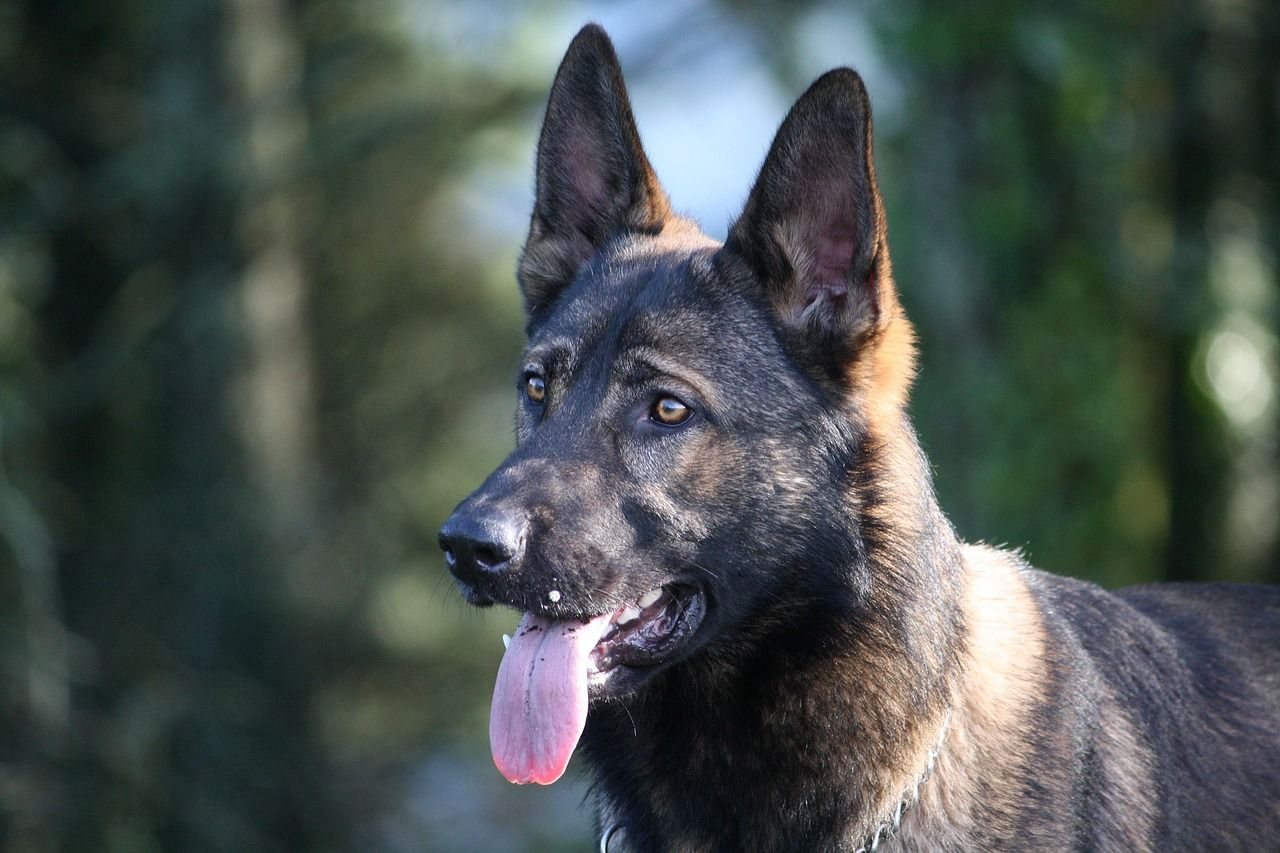
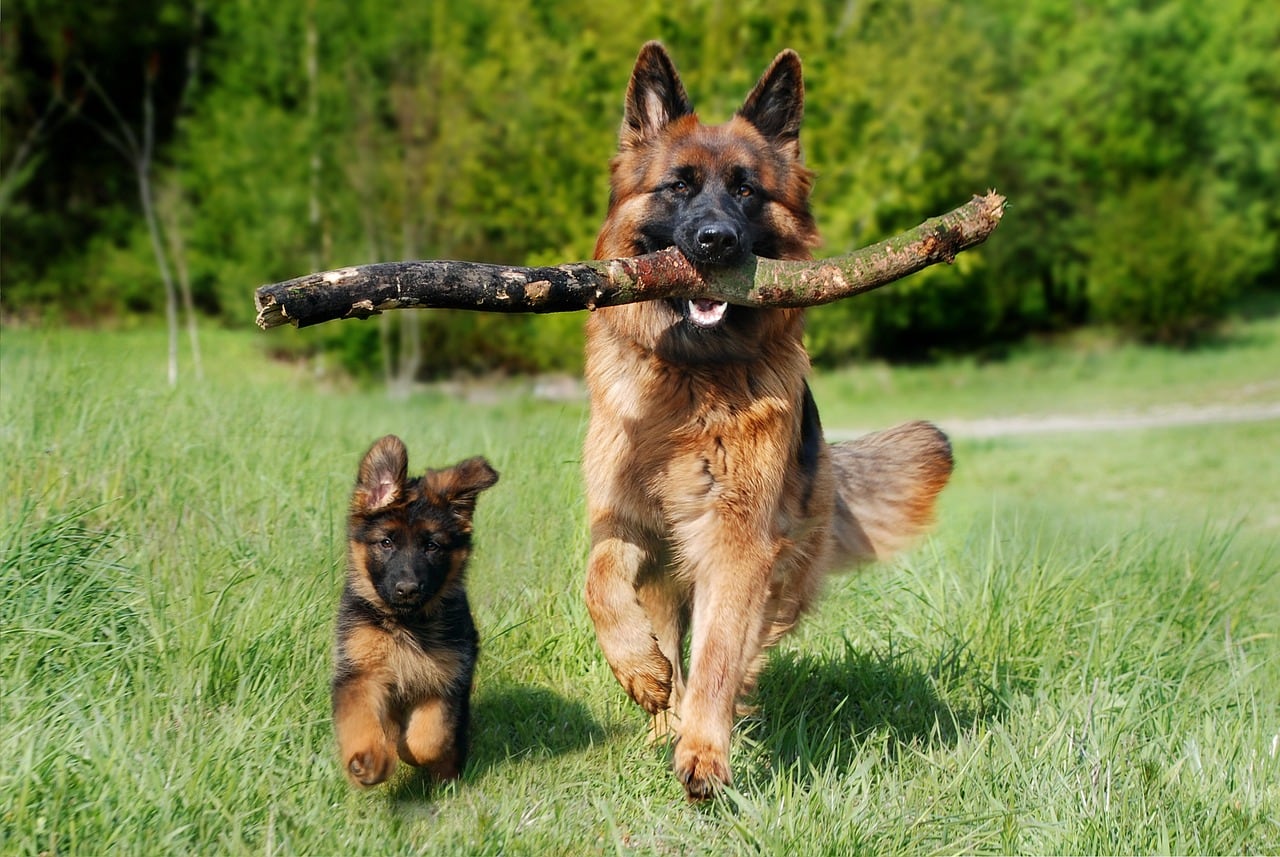
The head is wedge-shaped, symmetrical, with a slightly arched forehead and a smooth transition to a long, strong muzzle. The ears are erect, medium-sized, set high and directed forward, which gives the expression of alertness. The eyes are almond-shaped, rather dark, set slightly obliquely - their color should match the color of the coat.
The body stands on strong, muscular limbs, the chest is deep but not too wide, the back is firm and slightly sloping towards the rump, which is one of the typical features of the breed. The tail is richly furred, reaches at least to the hock and is carried in a slight arch when at rest, never curled over the back.
Hair and coat
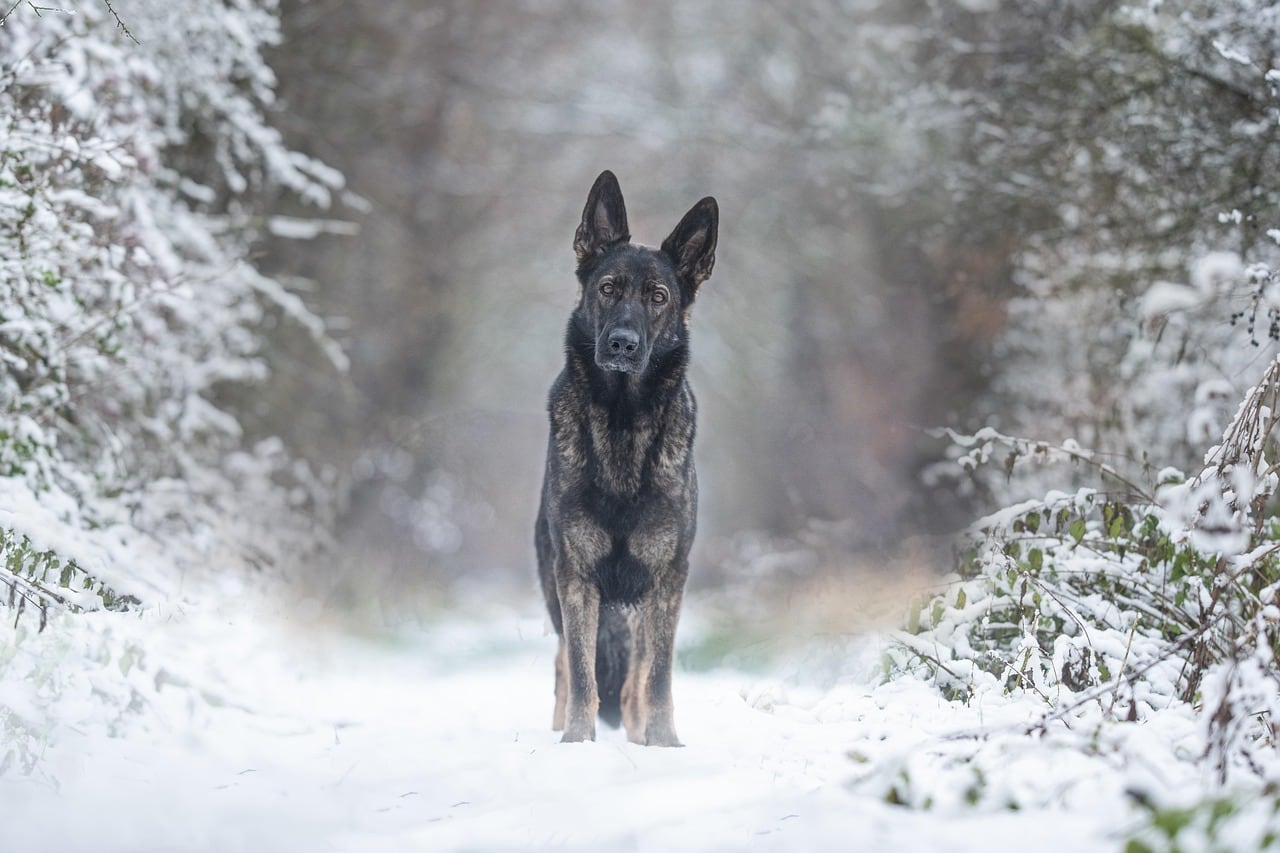
The coat is double, with a dense undercoat that protects the dog well in various weather conditions. The length of the outer coat is medium, close-fitting on most of the body, thicker around the neck and on the back of the legs. Due to the composition of the undercoat, there is a more pronounced seasonal shedding. We describe the color variants and their standard combinations in a separate section dedicated to color.
German Shepherd Colors
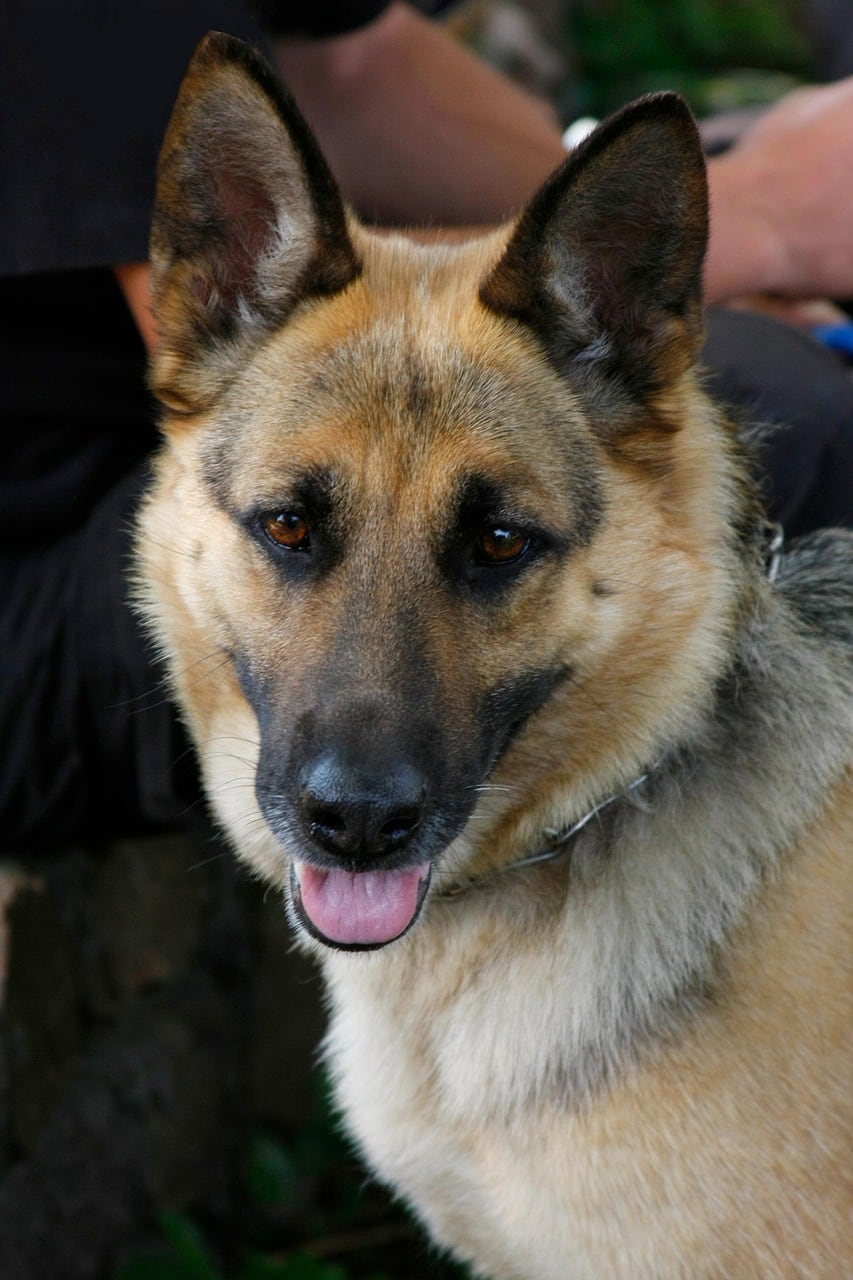
The FCI standard for the Deutscher Schäferhund defines a specific palette of recognized colors and their distribution on the body, including the transitions between the darker coat on the back and the lighter areas on the limbs and lower body. The exact listing of individual shades and their combinations is part of the official text of the FCI standard No. 166, to which show and breed clubs also adhere when assessing color.
Outside the standard range, German Shepherds sometimes have color variants that are not recognized by the FCI standard - typically a significantly light or pure white color. Such a deviation in itself does not mean that the dog has a health problem, it is primarily a non-compliance with the requirements of the standard, which is important for show judging and breeding, not necessarily for the health of the individual.
German Shepherd Personality
The German Shepherd is a working dog with a high need for activity and mental stimulation - without meaningful daily activities, he will quickly become restless or exhibit undesirable behavior. He forms a strong bond with his owner and likes to be in constant contact with him, and he does not tolerate loneliness or isolation from his family well.
They are among the most intelligent breeds of all, which is manifested in their quick understanding of new commands and their ability to independently assess situations. However, this independence also has a flip side – the dog can be stubborn and test boundaries if it senses uncertainty on the part of its handler. Therefore, consistent and calm leadership from a puppy forms the basis of a balanced nature.
Relationship with family and surroundings
They tend to be tolerant and protective of children, and in a pack they usually behave reliably and predictably. They are rather conciliatory towards dogs, but their relationship with cats is individual and depends on socialization and the specific experiences of the individual.
The guarding instinct is deep-rooted - he watches strangers and unknown stimuli vigilantly, although not always loudly, and barks moderately rather than excessively. Thanks to the combination of alertness and calm self-confidence, he acts as a natural guardian of the home and family, without being aggressive without reason.
The energy of this breed is high and needs regular outlet in the form of movement and mental work - a bored individual easily succumbs to destructive manifestations or excessive vigilance. On the contrary, a busy and socially engaged dog is balanced, confident and very easy to control.
German Shepherd and children
In relation to children, the German Shepherd is considered a suitable companion, its high need for company and strong bond with the family make it a dog that likes to get involved in household activities and naturally follows what is happening in the family. At the same time, it is a breed with a strong need for mental stimulation and high activity, which means that living with children works best where the dog has enough stimuli and exercise and does not accumulate energy that it would otherwise have to discharge on its own.
Early and consistent socialization of the puppy plays a key role - introducing it to children of different ages, their movements, noises and unpredictable behavior. The German Shepherd learns quickly and responds well to training, which makes it easier to set clear rules from puppyhood. It is precisely thanks to the lower training intensity that it is possible to work relatively effectively on basic obedience and impulse control, which is beneficial for living with children.
Surveillance and borders
Even with a breed with a balanced temperament, children and dogs should be supervised by an adult when they are together, especially younger children who cannot read dog signals correctly. It is recommended:
- teach children basic rules of behavior towards dogs (do not disturb them while they are eating and resting, do not touch the bowl)
- provide the dog with a quiet place where he can retreat
- gradually build mutual trust through joint games and walks
- Due to the size and strength of the breed, make sure that the dog can master basic commands even in the presence of children.
Due to the large body constitution and high activity, it is advisable to take into account the physical dimensions of the dog - even a friendly and playful individual can accidentally knock down a smaller child. Responsible upbringing, consistent leadership and respect for the needs of the breed are therefore the basis for a calm and safe coexistence with children.
German Shepherd and other dogs and pets
The German Shepherd usually gets along well with other dogs, especially if he is used to their presence from puppyhood. This is a breed with a high need for human company and a rather sociable nature, so a solitary lifestyle does not suit him - this also applies to living with a pack of other dogs in the household, where, with proper socialization, he can find his place without unnecessary conflicts.
The relationship with cats and small animals needs to be assessed individually. The German Shepherd was originally bred as a herding dog to guard and direct a flock of sheep, not as a hunting breed, so a pronounced predatory instinct is not a typical trait. However, thanks to its herding past, it may retain an interest in watching and "controlling" the movement of smaller animals in its surroundings, which is manifested more in chasing and herding than in an actual attempt to catch prey.
Recommendations for living with other animals
- It is advisable to start introducing a cat or other small animal at an early age and proceed gradually.
- For an adult dog with no experience with small animals, caution and a gradual, controlled introduction are in order.
- Thanks to their high need for mental stimulation and low training requirements, herding tendencies can be well controlled through obedience and training to remain calm in the presence of other animals.
- German Shepherds usually handle meeting other dogs outside the home (on walks, in the park) without any problems if they are regularly socialized from puppyhood.
Is the German Shepherd suitable for an apartment?
Rather not - this large, active dog is only conditionally suitable for an apartment environment and is definitely not a breed that would be content with limited space without sufficient compensation through exercise.
Its size and temperament make it a good choice for a house with a garden, where it has plenty of space to move around and relax. It can do well in an apartment, but only if the owner can provide long walks and plenty of physical and mental exercise outside the home - the space of an apartment alone will not meet its needs.
What to watch out for
- A high need for exercise means longer daily walks and active activities, not just short walks around the house.
- Moderate barking can be a problem in a block of flats if the dog is often left alone or bored.
- A high need for mental stimulation requires regular head engagement – training, games, olfactory activities – otherwise excess energy will manifest itself in undesirable behavior.
- A strong bond with the family and a high need for company mean that long periods of solitary confinement in a small apartment are not suitable for the dog.
- A dense double coat with significant shedding requires cleaning, which is more noticeable in a smaller space.
If the owner lives an active life, has the opportunity to exercise the dog outdoors daily and provides him with a home program for his mind, the German Shepherd can function well in a larger apartment. However, without these conditions, an environment with its own space and easy access to the outside is more suitable for him.
How much exercise does it need?
The German Shepherd is a breed with high demands for exercise and needs at least an hour or two of active exercise per day, divided into several walks. A leisurely walk on a leash is not enough for him - he needs space to run and the opportunity to use his physical fitness and sense of smell.
Due to the high need for mental stimulation, it is advisable to combine physical exercise with training and tasks that keep the dog's mind occupied. Thanks to the low training requirements and natural willingness to cooperate, he easily engages in supervised activities, which makes him a popular candidate for canine sports.
Suitable activities
- Obedience and basic and advanced training
- Sport cynology (e.g. agility, obedience)
- Scent work and search activities
- Longer hikes and running with the dog for fit individuals
- Retrieval games and activities that develop cooperation with the owner
A dog that does not get enough exercise or mental stimulation may compensate for its energy with undesirable behavior - that is why the German Shepherd Dog is more suitable for active owners who can offer it a regular program. Thanks to its thick double coat with undercoat, it can withstand colder weather, but at higher temperatures it is advisable to adjust the intensity and duration of exercise during more physically demanding activities to avoid overheating.
Training and education
It can handle training with minimal effort - it is one of those dogs that learns quickly, willingly cooperates with humans and learns new exercises after just a few repetitions. It is this easy learning that is the reason why it so often becomes a service, rescue or assistance dog.
He is mainly motivated by the opportunity to work together with his owner and have a clearly defined task. He responds well to praise, voice and treats, and even fetch or pulling a toy works for him as a reward for a completed task. A positively guided approach works best, where desirable behavior is rewarded and undesirable behavior is ignored or redirected - harsh methods tend to be counterproductive and can damage his trust in humans.
Due to his high need for mental stimulation, physical exercise alone is not enough – he also needs “brain work”. Short but frequent training blocks are more effective than long and exhausting lessons, as they will keep his attention and prevent frustration. Consistency is also important: the rules should always apply to all members of the household in the same way, otherwise the dog will easily find its own interpretation of what is allowed.
Socialization
Early and consistent socialization is key for this breed - exposure to a variety of people, environments, sounds, and other animals helps balance their natural alertness and need to protect their family. A well-socialized individual gets along with dogs without any problems, but with cats and other small animals it depends on the puppy's specific experience and setting.
Breed specifics
- It needs regular contact with its owner - long-term loneliness or lack of involvement in family activities will manifest itself in restlessness or undesirable behavior.
- As a working breed, it appreciates meaningful tasks – obedience, tracking, agility or defensive sports under the guidance of an experienced trainer.
- A moderate tendency to bark can be well controlled with training and sufficient stimulation.
- Due to its high activity and training requirements, it is more suitable for more experienced or very committed owners than for complete beginners.
Hair care and hygiene
A double coat with a dense undercoat is one of the German Shepherd's defining characteristics and also determines how much time its owner spends with a brush in hand. The top coat is medium length, but the undercoat is so dense that the German Shepherd manages to shed in a big way - practically all year round, with a more pronounced peak in spring and autumn, when the winter and summer coats are replaced.
Combing and shedding
Regular brushing is a must for this breed, not an optional extra. Outside of the shedding season, it is enough to brush the coat with a brush with coarse teeth once or twice a week to remove dead hair and keep the coat aerated. During periods of intensive undercoat change, it is advisable to increase the frequency to every other day, ideally with the help of a rubber scraper or a special undercoat comb, which will remove loose hair before it ends up all over the apartment.
Bathing
The German Shepherd does not need frequent bathing - the natural oily film in the coat protects the skin, and too frequent washing, on the contrary, disrupts it. Bathing is more suitable in exceptional cases, for example after significant soiling, using a shampoo specifically designed for dogs.
Ears, eyes, teeth and claws
- Ears: The erect pinnae of this breed allow good ventilation of the ear canal, but it is still worth checking them regularly when combing and wiping them gently if necessary.
- Eyes: an occasional visual check is sufficient to ensure they are not red or excessively watery.
- Teeth: Due to the breed's size and susceptibility to tartar formation, regular teeth cleaning or the inclusion of dental treats in the diet is recommended.
- Claws: in active individuals who move a lot on hard surfaces, the claws wear down naturally; in dogs with less exercise, they need to be trimmed from time to time.
Due to the type of coat, the German Shepherd does not need any trimming or grooming by a groomer - this is a breed that can do with regular home care and enough space to clean the fur around it.
Feeding
Due to its large size and high level of physical activity, the German Shepherd needs a high-quality complete food that matches its life stage and energy expenditure. For puppies and young dogs, it is crucial to choose a food specifically designed for large breeds - it regulates the growth rate and the ratio of calcium and phosphorus, which affects the proper development of joints and skeleton. An active adult individual then needs enough quality protein and energy, while an older dog will appreciate a lighter food that is gentler on digestion and joints.
Adapting feeding to age and load
The amount and type of food should correspond to the dog's specific workload - a working or sports-intensive individual has significantly higher energy requirements than a dog with a calmer regime. When transitioning between life stages (puppy → adult → senior), it is advisable to change the food gradually and monitor how the dog reacts to it - in terms of coat, stool and overall condition.
Physical fitness check
Regular body condition assessment is important for this breed – the ribs should be easily palpable under a thin layer of subcutaneous tissue and the waist should be visible from above. Excess weight puts a strain on the joints and spine, which is more risky in a large and active breed than in smaller dogs. Conversely, malnutrition or an inappropriate composition of food in a growing individual can adversely affect skeletal development.
- Choose food according to the age, size and physical activity of the particular dog.
- Monitor body condition and continuously adjust the amount of feed.
- Transitions between types of feed should be made gradually, not in leaps.
- For puppies, make sure to use food designed for large breeds for controlled growth.
How long does a German Shepherd live?
The average German Shepherd lives between 9 and 13 years. However, the actual lifespan of a particular individual depends on a combination of genetic predispositions, overall physical condition, and the care that the owner provides the dog throughout its life.
What affects lifespan?
- Genetics: The origin of the puppy and the health status of the parents significantly influence the predisposition to a number of diseases, so it is worth taking an interest in the breeding background and any examinations of the parental couple.
- Physical condition: Maintaining a lean, athletic build without being overweight reduces stress on the joints and spine, which is an important longevity factor for this large and active breed.
- Exercise: The German Shepherd is a breed with a high need for exercise and mental stress. Regular but adequate exercise (without overloading the joints, especially during the growth period) contributes to overall vitality.
- Prevention: Regular veterinary examinations, vaccinations and early detection of potential health problems allow for faster intervention and a better prognosis.
- Nutrition: A quality diet appropriate to the dog's age, size, and activity level supports the health of the musculoskeletal system and digestive system throughout its life.
- Health predisposition: The breed may have an increased predisposition to problems with the hip and elbow joints and other musculoskeletal diseases, which should be taken into account when choosing exercise and nutrition.
Who is the German Shepherd suitable for?
The German Shepherd is a dog for owners who can offer him regular exercise, clear guidance, and plenty of stimulation for both mind and body. He is a highly active breed, with a strong need for human companionship and mental stimulation, making him more of an all-day companion than a backyard or apartment dog.
Who is the breed suitable for?
- For active people who are willing to dedicate time to their dog for long walks, runs or dog sports
- For those interested in training and dog sports – thanks to the low training requirements, they learn obedience and more complex tasks well
- For families with children, to whom he is friendly and sociable
- For households with other dogs, with whom they usually get along well
- For homeowners with a garden where they have plenty of space to move around
- For people who want to have a dog as a full-fledged member of the family, because it needs intensive contact with people
Who is the breed not suitable for?
- For residents of small apartments without the possibility of regular outdoor play
- For seniors or people with limited physical fitness who would not be able to handle its movement demands
- For owners who leave their dog alone for long hours – a strong need for companionship and stimulation could manifest itself in unwanted behavior
- For households looking for a dog with minimal coat care – due to its thick undercoat and significant shedding, it requires regular brushing
- For people who want a rather calm, undemanding companion without the need for a day job
Interesting facts about the breed
The German Shepherd is registered under the FCI standard No. 166 and falls into group 1, section of sheepdogs, which classifies it among dogs bred primarily for herding and working purposes. It is known worldwide under the English name German Shepherd Dog, In Czech, the nickname “vlčák” is also common; the English abbreviation is GSD.
The breed comes from Germany and its official name in the language of its country of origin is Deutscher Schäferhund – literally German Shepherd Dog, which refers to its original working purpose of guarding and herding herds.
Even today, it can be found not only as a family companion, but also in working roles - its high need for mental stimulation and low training requirements make it a popular choice where continuous cooperation with the dog is expected.
German Shepherd Health
The German Shepherd usually lives for 9 to 13 years with good care. It is a large, heavy and physically very active breed, in which the body structure and its load play a crucial role - therefore it is advisable to monitor how the dog reacts to long-term stress and adapt the exercise regimen to it according to age and condition. Given the height of 55–65 cm and weight of 22–40 kg, the body places greater demands on the joints and spine than in smaller breeds. The double coat with a dense undercoat requires regular care, especially during periods when the dog sheds significantly. Specific health risks may vary between individual lines, so it makes sense to be interested in the health status of the parents of a particular puppy.
Locomotor system
Due to the size, weight and high need for exercise, it is advisable to gradually increase the load on the German Shepherd, especially during the growth period, when the bones and joints are not yet fully developed. Sharp jumps, long runs on hard surfaces or excessive load at an early age are not ideal for a growing dog of this size. In adults, regular but adequate exercise helps maintain the muscles that support the joints and spine.
Coat and skin care
A dense double coat with an undercoat means significant seasonal and year-round hair loss. Regular brushing of the undercoat reduces dead hair burden on the skin and helps keep the coat and skin in good condition, especially in the warmer months when the burden on thermoregulation is greater.
What to look for when choosing a puppy
- Be interested in the health and fitness of both parents, including how they tolerate physical stress in old age.
- Check to see if the puppies come from a breeder who ensures that young dogs are exercised gradually and appropriately.
- Ask the breeder for available health documentation for both parents and the litter.
- Pay attention to the puppy's movement - it should move freely, without signs of pain or instability.
- Keep in mind that the breed requires regular grooming and plenty of space to move throughout its life.
Known predispositions
The breed is described to have an increased predisposition to:
- to hip dysplasia, with studies estimating the prevalence in German Shepherds at around 35%.
- elbow joint disease (elbow dysplasia) – the British VetCompass study found an approximately 4x higher chance of occurrence in German shepherds compared to crossbreeds.
- to degenerative myelopathy associated with a mutation in the SOD1 gene, as shown in a study on a reference population of German Shepherds in the United Kingdom.
- to exocrine pancreatic insufficiency caused by pancreatic acinar atrophy, which is the most common cause of this disease in this breed.
- to acute gastric dilatation and volvulus (GDV/bloat), with German Shepherds being among the breeds at risk.
- to perianal fistulas (anal furunculosis), where this disease is described as the most commonly affected breed in German Shepherds.
This overview is for informational purposes only and does not replace the examination or recommendations of a veterinarian.
What to buy for a German Shepherd
Practical basis that is suitable for this breed:
- Toys – Dog toys – fetching, chewing and interactive.
- Cosmetics – Shampoos, conditioners and hair care products.
- Bowls – Feed and water bowls, anti-swallow bowls and stands.
- Collars – Dog collars – leather, textile and semi-tight.
- Beds – Beds and mattresses for dogs of all sizes.
- Leashes – Leashes, switch leashes and tracking lines.
Useful instructions
Practical tips that are useful when caring for a dog:
Frequently asked questions
Is the German Shepherd suitable for an apartment?
Probably not – this is a large and active breed that needs plenty of exercise and space for regular exercise. It can only function in an apartment if it is provided with long daily walks and sufficient mental stimulation.
How much does a German Shepherd weigh and how big is it?
Males measure 60–65 cm at the withers and weigh 30–40 kg, females are slightly smaller – 55–60 cm and 22–32 kg. This is a large breed with a strong skeleton and muscular body.
How long does a German Shepherd live?
The average lifespan is between 9-13 years. The specific lifespan depends on genetics, care and the stress on the joints during life.
Is a German Shepherd suitable for beginners?
This is a breed neutral in terms of suitability for beginners - even a less experienced owner can handle it if they are willing to invest time in training and socialization. Without sufficient mental and physical exercise, the dog can become restless or destructive.
How much do German Shepherds shed?
Shedding is high in this breed, due to its double coat with a dense undercoat. Regular brushing throughout the year helps keep the coat in good condition and reduces the amount of hair in the home.
Is the German Shepherd aggressive?
This is a balanced and confident breed by default, aggression is not a typical trait. The dog's behavior is significantly influenced by socialization, training and the experiences the dog grows up with.
What is the German Shepherd most often used for?
Thanks to its high intelligence and low training requirements, it is used as a service, rescue or assistance dog, as well as in sporting cynology. This versatility stems from its original use as a herding and guard dog in Germany.
Does the German Shepherd get along with children and other dogs?
It is rather suitable for children and usually gets along well with dogs if it is socialized from a puppy. The relationship with cats is individual and depends on the experiences of a particular individual.
What health problems can a German Shepherd have?
The breed may be predisposed to joint problems, particularly hip and elbow problems, due to its size and body structure. Adequate exercise during growth and maintenance of optimal weight is therefore advisable.
How much exercise does a German Shepherd need per day?
This is a breed with a high level of activity that needs not only physical exercise, but also mental stimulation in the form of training or search games. A lack of stimulation often manifests itself in undesirable behavior.
Is the German Shepherd suitable for seniors?
Probably not – its size, strength, and exercise and training requirements can be physically and time-consuming for older owners. It is better suited to active individuals who can provide it with plenty of exercise.
Resources and further information
- FCI Standard No. 166 – German Shepherd Dog – Fédération Cynologique Internationale
Professional cooperation
This breed overview was created in cooperation with the Veterinary Clinic VYVET sro and MVDr. Adam Hylák .