
Published 10. 9. 2026
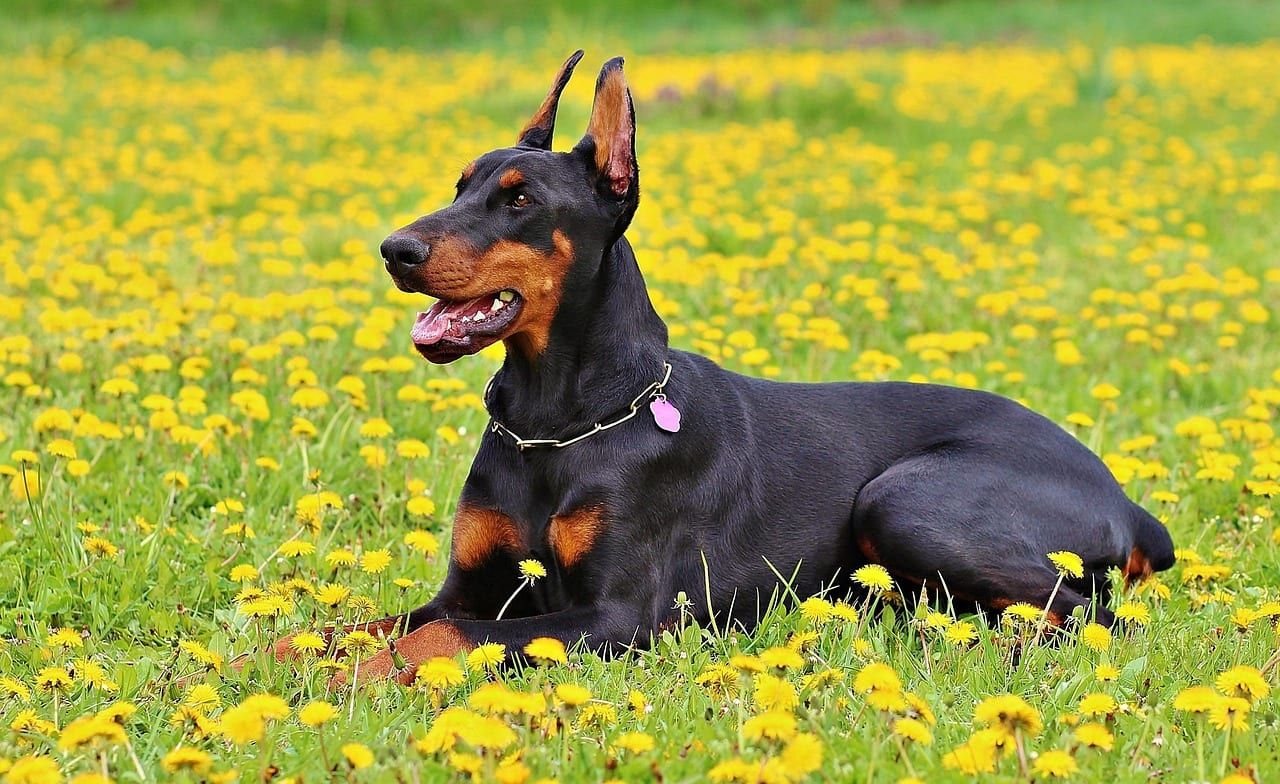
Doberman (Dobermann) is a large breed originating from Germany, classified in FCI group 2 among pinschers and schnauzers (section Pinscher and Schnauzer type, standard no. 143). The male reaches a height of 68–72 cm and weighs 40–45 kg, the female is slimmer – 63–68 cm and 32–35 kg. The short coat requires minimal care, shedding is only moderate. The body is athletic, muscular, built for performance.
In terms of temperament, this is a dog with a high need for exercise and mental stimulation - the Doberman does not stand out in a good sense of the word for boredom or inactivity. It is tied to its family and seeks out human company intensely, it does not tolerate loneliness well. It has a rather positive attitude towards children, it can handle training at a medium level of difficulty, but it requires more experienced and consistent leadership. It is not an ideal choice for beginners or seniors, on the contrary, an active owner who gives it clear rules and enough load will be rewarded with a reliable and sociable companion.
Professionally consulted
The content was created in cooperation with the veterinary clinic Veterinární klinika VYVET sro and MVDr. Adam Hylák.
Quick overview
What is a Doberman like?
The Doberman is a large, athletic breed originating from Germany, classified in FCI Group 2 between the Pinscher and Schnauzer. Males grow to 68–72 cm and weigh 40–45 kg, while females are slightly smaller – 63–68 cm and 32–35 kg. It combines strength, agility and high working intelligence, making it one of the breeds with a significant need for exercise and mental exertion.
By nature, it is a dog that is alert, loyal and strongly attached to its family, which can also be sociable and friendly. Training requires consistency and a more experienced approach, because the Doberman quickly understands, but at the same time needs a clear guiding hand.
- More suitable for active owners with time for long-term training and plenty of exercise.
- It is one of the more suitable breeds for children, but is not recommended for seniors and complete beginners.
- Short hair means low maintenance, but mental stimulation requirements are high.
Origin and history of the Doberman
The Doberman originated in the late 19th century in Thuringia, Germany, where it was bred by Karl Friedrich Louis Dobermann, a tax collector and gravedigger. He needed a reliable guard dog to accompany him on risky errands around the area, where he often carried collected money. No exact records of the breeds used have been preserved, but cynological tradition cites the Old German Pinscher, Rottweiler, German Shepherd, and Smooth Hound as probable ancestors, possibly even the Manchester Terrier – a combination that was supposed to produce a dog that was alert, strong, and at the same time agile enough.
After Dobermann's death, Otto Goeller took over the breeding, who further unified the type of dog and was responsible for the establishment of the first breed club in Germany at the turn of the 19th and 20th centuries. It was thanks to his work that the breed received a stable form, the name after its founder and gradually international recognition. The standard was refined in the following years and the breed was included in the FCI within the 2nd group between pinschers and schnauzers.
From the beginning, the Doberman was bred as a versatile guard and working dog - it was used by tax collectors, guards and later by the police and the army, where it proved its worth thanks to its alertness, courage and ability to learn quickly. In the 20th century, it spread from Germany to the whole world and, in addition to service cynology, it also established itself as a social and sporting dog, without losing its original guard nature.
Appearance and size
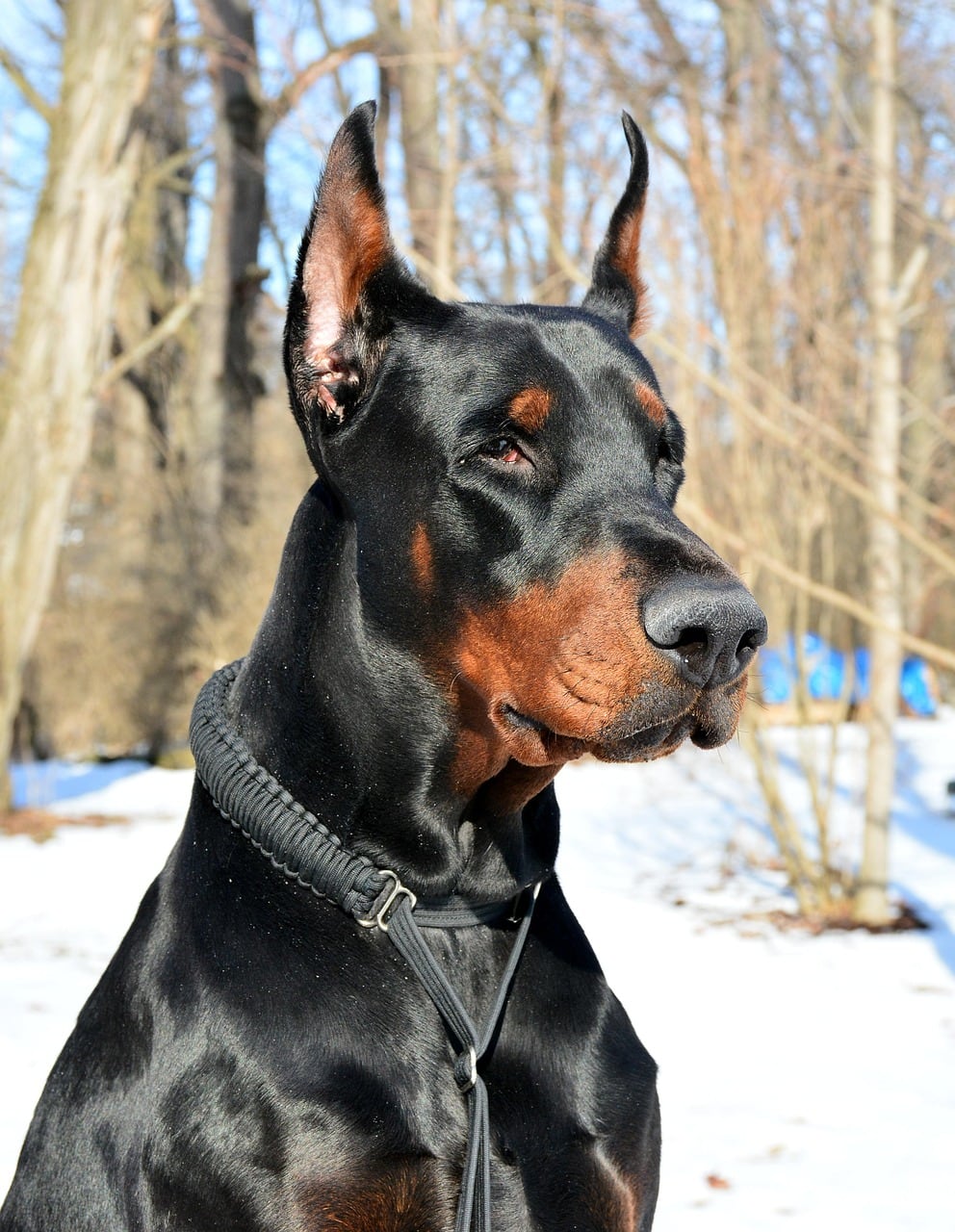
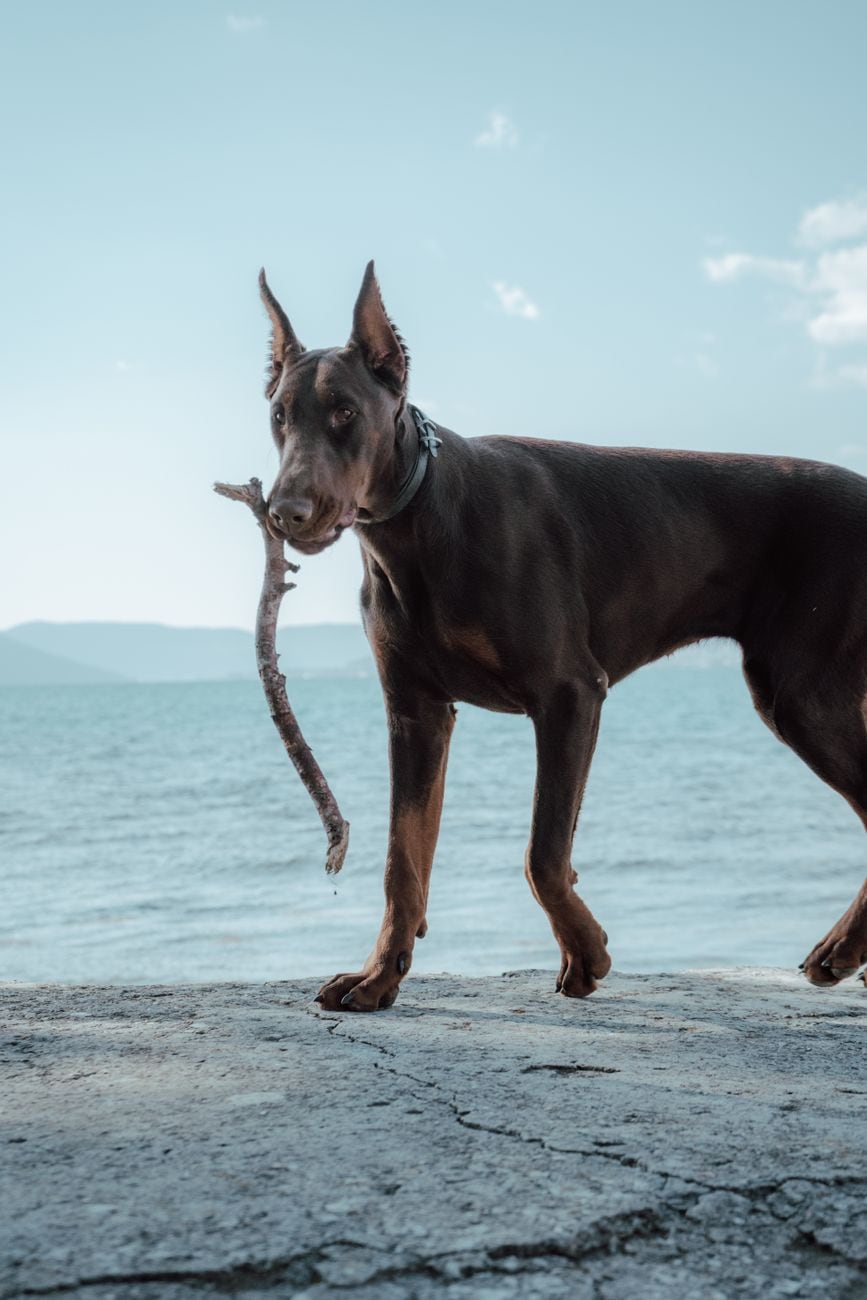
The Doberman is a tall, athletically built dog with a square, compact body and pronounced musculature that is clearly visible under the short coat. The male reaches 68–72 cm at the withers and weighs 40–45 kg, the female is smaller and lighter – 63–68 cm and 32–35 kg. The difference between the sexes is therefore not only in height, but also in the overall strength of the build.
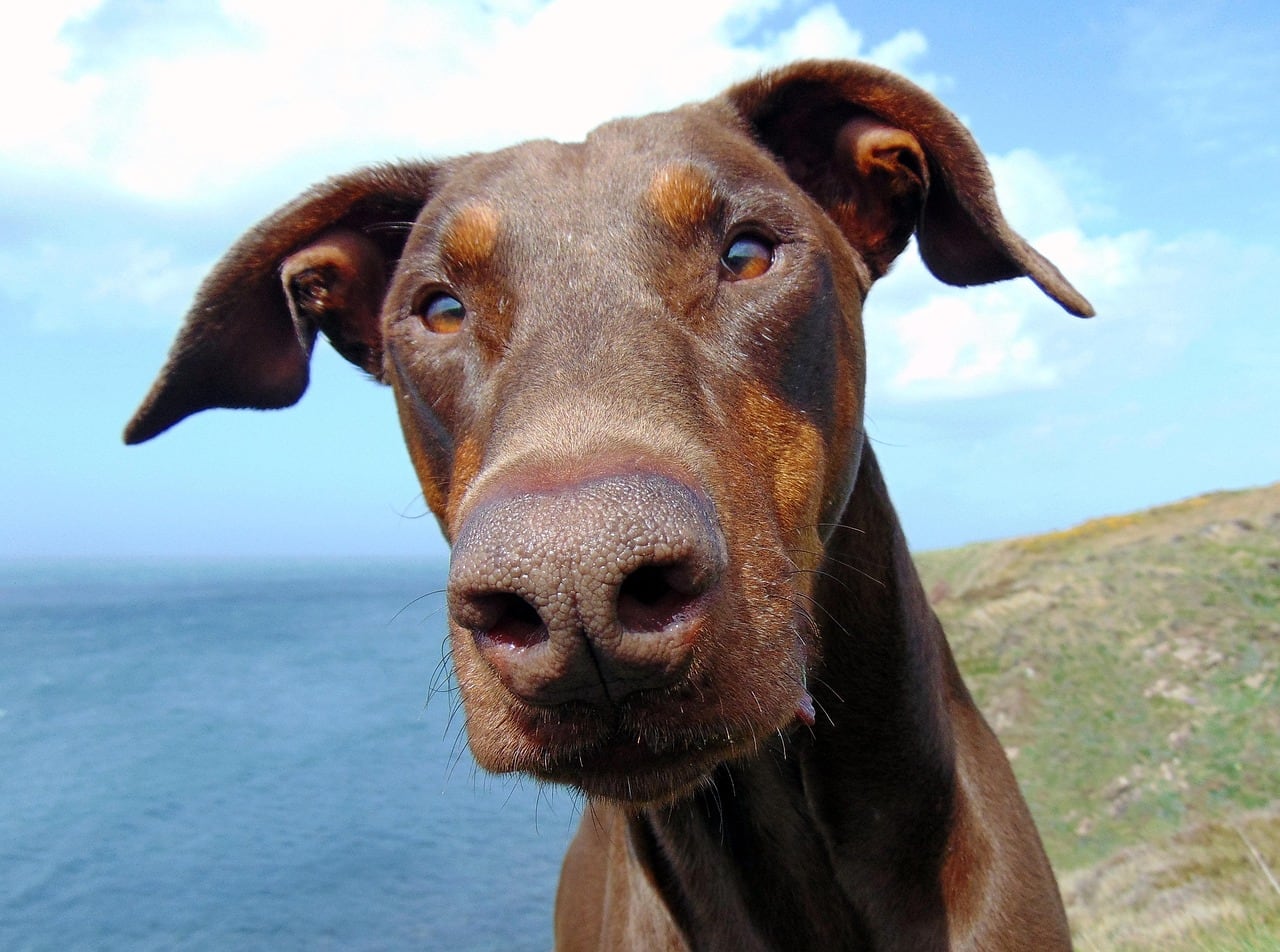
The head is wedge-shaped, elongated, with a flat crown and only a slight trace between the muzzle and the forehead. The muzzle is long and straight, the muzzle is tightly closed. The eyes are medium-sized, almond-shaped, set slightly obliquely, which gives the Doberman a concentrated, alert expression. The ears are set high, in their natural state drooping and lying close to the cheeks.
The neck is muscular and dry, smoothly merging into the back, which is short and firm, with a slightly sloping croup. The chest is deep, reaching approximately to the elbows, the belly is tucked in, which underlines the athletic, "sharpened" profile of the body. The tail is set high and carried horizontally or slightly above the line of the back.
The coat is short, dense and close-fitting, with no undercoat, requiring minimal grooming. Color variations and markings are described in a separate section on color.
The overall impression is elegant, yet powerful – the Doberman appears to be a dog built for both speed and endurance.
Doberman Colors
The FCI standard for the Doberman defines specific recognized colors and color markings, but an exact list of these colors is not available in this overview. Those interested in breeding or participating in shows are recommended to check the current version of the standard with the Czech Kennel Club or the relevant breed club.
Doberman's nature
The Doberman is a dog with high internal energy, sharp judgment and a strong bond with its owner. It is a breed that needs a partnership based on trust - it is intensely attached to its owner and actively seeks his closeness, it does not like solitude or being pushed to the sidelines of family events.
The intelligence of the Doberman is significant and is manifested in the quick understanding of new tasks and the ability to independently evaluate situations. However, this also has a downside - the dog can be stubborn and test where the boundaries are if the training is not conducted consistently and with clear rules from the puppy. This is not a breed that follows automatically, but rather a dog that makes decisions and expects understandable guidance from the owner.
The Doberman has a strong guarding instinct. He is vigilant towards his territory and family, he watches strangers and unknown stimuli with attention and, if necessary, shows distrust. At home, however, he is usually calm and composed, and his barking is more purposeful - a warning of something unusual - than unreasonable.
Energy and mental demands are high. A Doberman who doesn't get enough exercise or tasks to keep his mind occupied will seek out his own release - often in ways his owner doesn't expect. Conversely, a dog who gets regular physical and mental exercise will be balanced, focused, and willing to cooperate.
In relation to other dogs and other animals in the household, the Doberman's reaction is individual and depends on socialization and the specific situation - automatic friendliness cannot be expected, nor can a conflictive nature be expected.
Doberman and children
The Doberman tends to be attached and protective of children in the family. Its characteristics listed in the documents include a good relationship with children. However, it is also a large, strong and energetic breed with a high need for exercise and mental stimulation, which places demands on how it is set up to live with children.
Early and consistent socialization of the puppy is essential - familiarization with children's noise, movement and unexpected situations should be done gradually and positively. Given the medium difficulty of training, it is advisable that a more experienced adult family member, not the child himself, master basic obedience and control of the dog.
What to watch out for
- The Doberman's size and strength mean that even an unintentional bump or playful push can easily knock a small child over.
- A dog needs plenty of exercise and mental stimulation - unfulfilled energy can manifest itself in restlessness or unwanted behavior in the household.
- Interaction between a dog and small children should always be supervised by an adult, even with a dog with a balanced temperament.
- The child should be taught how to treat the dog properly – to respect its rest, space at the bowl, and quiet moments.
Given the above, the Doberman is not recommended as a first dog for families without experience raising dogs, as managing its temperament and setting rules for living with children requires patience and consistency.
Doberman and other dogs and pets
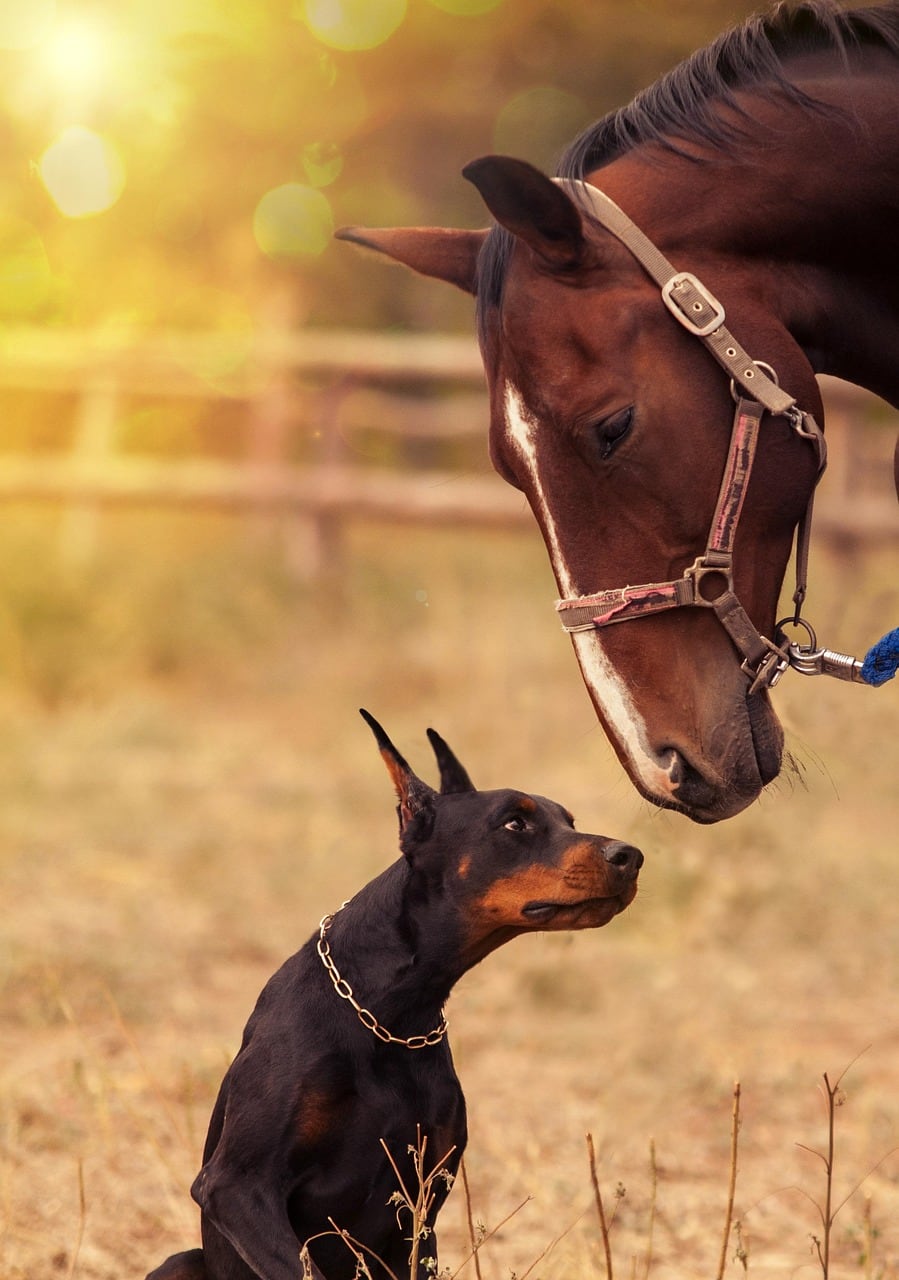
The Doberman's relationship with other dogs is usually neutral - its coexistence with a group or another dog in the household usually depends mainly on socialization and the specific nature of the individual, not on a fixed breed trait. The same is true with cats: the Doberman does not have a clear relationship with them that would automatically predispose it to hunting or, conversely, to problem-free coexistence.
The Doberman was originally bred as an alert guard and companion dog, not as a hunting breed focused on small game. Nevertheless, it is a dog with a high level of activity and a strong need for mental stimulation, which can manifest itself in an interest in fast-moving objects - therefore, it is advisable to carefully manage coexistence with smaller animals (rodents, rabbits) from puppyhood and not leave new animals unattended.
Recommendations for coexistence
- Introducing them to other dogs and cats should be done gradually and preferably from an early age.
- Always supervise new small animals in the household at first until you are sure of the reaction of a particular individual.
- Due to its high need for companionship and mental stimulation, the Doberman will appreciate active involvement in household activities rather than isolation from other animals.
Is a Doberman suitable for an apartment?
Living in an apartment is rather unsuitable for a Doberman, although not completely impossible - what matters more is what the owner offers around the housing itself than square meters. This is a large dog with a high need for exercise and mental stimulation, so an apartment can only function as a place to sleep and rest, not as the main space for fulfilling its needs.
For a Doberman to function happily in an apartment, the following conditions should be met:
- Enough space to move and stretch out – ideally an apartment with the possibility of running around freely in at least some rooms, not a cramped studio apartment.
- Several long walks a day with room to run, as just walking down the street is not enough to cover his high level of activity.
- Regular mental stress – training, search games or sports activities, otherwise energy can be redirected into restlessness or unwanted behavior in the household.
- Close contact with the family, because the Doberman has a high need for company and long-term solitude in an empty apartment does not suit him.
As for barking, the Doberman is more of a medium-barking breed, so it is not a major problem in an apartment building with thin walls, as long as he has enough exercise and is not bored. He will maintain his calmer nature more when he has had a physically and mentally fulfilling day - otherwise he can be restless even inside the apartment.
How much exercise does it need?
The Doberman is one of the dogs with high demands for exercise - it needs at least an hour or two of active exercise per day, divided into several walks. Just a leisurely walk on a leash is not enough, because this is an energetic and hardy breed that was bred for work and long-term physical exertion.
In addition to the length of the movement itself, its quality is also important. The Doberman will appreciate a combination of free movement, running and controlled activity where he can use his speed and agility.
Suitable activities and dog sports
- Running alongside a bike or running owner
- Agility and other agility sports
- Obedience and sporting cynology (e.g. obedience)
- Longer hikes and stays in nature where he can run around freely
- Fetch games and object searches
Physical fatigue alone is not enough - the Doberman needs plenty of mental stimulation as well. Obedience training, solving tasks or training games help him use his intelligence and prevent boredom, which often manifests itself in restlessness or destructive behavior in this breed.
Thanks to their short coat without undercoat, it is advisable to take the weather into account - on frosty days they will appreciate exercise in motion rather than standing still, while in hot months it is necessary to plan activities outside the hottest part of the day and ensure plenty of water and shade.
Training and education
Even a less experienced owner can handle training a Doberman, but he is willing to devote time to it and be consistent - this is a dog with a high need for mental stimulation, which quickly gets bored with monotonous repetition and, on the contrary, gives excellent results if the training is varied and meaningful. He is primarily motivated by contact with the owner and praise, he responds well to treats and play, so positively guided training with clear rules brings much better results than harsher methods based on pressure.
Access to training
Short but regular training sessions work better than long, grueling sessions – Dobermans learn new commands quickly, but they lose interest just as quickly if tasks are repeated in the same way. It works well to alternate obedience with play or sniffing games that engage the dog both physically and mentally.
- Consistency in rules – the whole family should have the same expectations of the dog.
- Gradually increase the difficulty and length of the exercise depending on how the dog masters the basics.
- Positive motivation (treats, toys, praise) instead of hard pressure.
- Engaging in mentally challenging activities, such as finding objects or training games.
Socialization
Since the Doberman is rather neutral towards other dogs and cats and does not always automatically seek out their company, it is advisable to regularly expose him to various situations, people and animals from puppyhood. Well-managed socialization helps raise a balanced dog that, as an adult, calmly handles normal contact with its surroundings and new stimuli do not stress him unnecessarily.
Hair care and hygiene
The short, smooth and close-fitting coat makes the Doberman one of the easiest breeds to groom. It is enough to brush his coat once a week with a rubber brush or glove, which removes dead hair and promotes blood circulation to the skin. During the shedding season, which is usually moderately intense for Dobermans, it is advisable to increase the frequency of brushing to two to three times a week.
Bathing should only be done when absolutely necessary – when dirty or when the dog has a strong odor. The short coat without undercoat is easy to keep clean, and frequent bathing tends to damage the natural protective layer of the skin. Due to the thin coat and low amount of subcutaneous fat, Dobermans are less able to tolerate the cold, which also affects their care – after bathing or being outside in rainy weather, it is advisable to dry the dog thoroughly.
Ears, eyes and teeth
The Doberman has floppy ears, which need to be checked regularly and cleaned as needed to prevent moisture and dirt from accumulating in the ear canal. The eyes can be wiped occasionally with a damp cloth to remove any morning discharge. Dental care should be a regular part of hygiene - brushing teeth or dental treats help reduce tartar buildup.
Claws and pads
Due to their high activity, the claws of dogs that move a lot on hard surfaces often wear down naturally, but it is still advisable to check their length regularly and trim them if necessary to prevent foot deformity or pain when walking. The paw pads are worth checking after strenuous exercise outdoors to see if they are cracked or injured.
Feeding
Due to its robust muscular body structure and high activity level, the Doberman needs a high-quality complete food with sufficient animal protein content to support the maintenance of muscle mass and cover the energy expenditure of this active breed. The choice of food should always correspond to the age, weight and current physical load of the individual.
Life stage adaptation
Doberman puppies grow quickly and it is advisable to choose a food designed for large breeds in the growth phase, which helps regulate the pace of development of the skeleton and joints. An adult dog in active training or with higher physical exertion will appreciate a food with a higher energy content, while for less active individuals or dogs in senior age, it is appropriate to reduce the energy content of the food to prevent excessive fat accumulation.
Physical fitness check
Due to the Doberman's athletic constitution, it is easy to see if the weight is increasing beyond the optimal level - the ribs should be easily palpable under a thin layer of subcutaneous fat and a waist should be visible in the lumbar region. Regular monitoring of body condition and possible adjustment of the amount of food are essential care, because excess weight puts a strain on the joints and musculoskeletal system and can negatively affect the dog's overall vitality.
- Choose food according to the age, weight and level of physical activity of a particular dog.
- For puppies, prefer large breed food that supports controlled growth.
- Regularly assess your physical condition by feeling and adjusting portions to prevent overweight.
- Ensure constant access to fresh water, especially during increased physical exertion.
How long does a Doberman live?
The average lifespan of a Doberman is 10 to 12 years. This is a large breed, and this range is within the normal range for dogs of similar size and build.
What affects lifespan?
The specific age a dog will live to depends on a combination of innate predispositions and the conditions it lives in. The most significant factors include:
- Genetics and ancestry – the health of the parents and grandparents has a direct impact on the predispositions a dog will bring into life. Choosing a breeder who pays attention to health examinations of breeding dogs is therefore essential.
- Physical fitness – the Doberman is an athletic dog with strong musculature, and maintaining an optimal weight without a tendency to be overweight helps reduce the strain on the joints and heart.
- Exercise and mental stress - due to the high need for activity and mental stress, the Doberman needs regular and sufficiently demanding exercise. Lack of exercise and lack of mental stimulation in this breed can affect not only its behavior, but also its overall condition.
- Prevention and veterinary care - regular preventive check-ups, early detection of potential health problems, and dental and coat care (although not demanding for short hair) contribute to the overall quality and length of life.
- Nutrition – due to its size and weight, the Doberman needs a balanced diet appropriate to its activity and age, with puppies and young dogs during their growth period deserving special attention.
- Health predisposition – the breed may be predisposed to certain heart diseases and other health problems typical of large breeds. Regular veterinary check-ups help detect potential problems early.
Who is a Doberman suitable for?
The Doberman is a dog for experienced and active owners who can offer him enough exercise, consistent training and regular mental stress. His high need for company means that he is not suitable for a household where he would spend long hours alone - he needs to be part of the family and have close contact with people.
Who is the breed suitable for?
- For active people who will provide him with enough exercise and mental stimulation - whether in the form of training, sports cynology or long walks.
- For owners with previous experience in dog training who can handle consistent and thorough training.
- For families with children, where the dog is socialized from puppyhood and where supervision of the interaction between the dog and children is ensured.
- For households where the dog will spend most of its time near people, not isolated in the garden or in a kennel.
- For those looking for a social dog capable of functioning as a companion and household watchdog.
Who is the breed not suitable for?
- For complete beginners with no experience training larger and more temperamental breeds.
- For seniors who might have difficulty with the dog's physical strength and the demands on its regular exercise.
- For people who cannot devote enough time to their dog - long-term solitude is not good for them due to their high need for human company.
- For households looking for an undemanding sofa companion without interest in regular activity and training.
Interesting facts about the breed
The Doberman is one of the breeds whose name is also the surname of its creator – Karl Friedrich Louis Dobermann, after whom the dog is still named (originally Dobermann). It originated in Germany and is classified in FCI Group 2, Pinscher and Schnauzer section, alongside other German breeds such as the Giant Schnauzer, Miniature Schnauzer or German Pinscher, with which it shares a coat type and some personality traits.
Although the Doberman is classified as a large breed, its coat care is among the least demanding – the short coat requires minimal grooming and shedding remains at a moderate level throughout the year. This contrasts with the high demands for exercise and mental engagement, which make it a dog for experienced and active owners rather than beginners.
Doberman Health
The Doberman is a large breed with an average lifespan of 10-12 years, which corresponds to the expected lifespan of dogs of similar size. The short coat means minimal grooming requirements, but at the same time it does not provide significant thermal insulation. Due to the high need for exercise and mental stress, regular and sufficiently long energy expenditure is important to maintain good condition. Specific health predispositions should always be assessed by a breeder or veterinarian based on the pedigree and health examinations of the parents.
Short coat and thermoregulation
Due to their short, close-fitting coat, the Doberman has virtually no extra insulation under the skin, which can make them more sensitive to cold and damp. In colder weather, it is advisable to adjust the length of time they spend outside and possibly consider dog clothing.
Locomotor system
As a large and athletic breed with high activity requirements, the Doberman's joints and muscles are put under more strain than smaller or less active breeds. Gradual conditioning in puppyhood and adequate exercise in adulthood help keep the musculoskeletal system in good condition.
What to look for when choosing a puppy
- Ask the breeder about health examinations and certificates for both parents.
- Look at the environment in which the puppies were raised and their overall condition and behavior.
- Ask whether the puppies have been socialized from an early age and accustomed to common stimuli.
- Choose a puppy from a breeder who is willing to provide information about the health and temperament of the parents even after the puppy is purchased.
Known predispositions
The breed is described to have an increased predisposition to:
- to dilated cardiomyopathy (DCM), a heart disease affecting the heart muscle.
- to von Willebrand's disease, a blood clotting disorder.
- to cervical vertebral instability, known as wobbler syndrome.
- to hypothyroidism, i.e. reduced thyroid function.
- to hip dysplasia.
- to color alopecia in blue and brown individuals (color dilution alopecia), manifested by thinning of the coat.
- to gastric rupture (gastric dilatation and volvulus), i.e. acute bloating and twisting of the stomach.
Discussed risks
The breed is described to have an increased predisposition to:
- to chronic hepatitis, an inflammatory liver disease.
This overview is for informational purposes only and does not replace the examination or recommendations of a veterinarian.
What to buy for a Doberman
Practical basis that is suitable for this breed:
- Toys – Dog toys – fetching, chewing and interactive.
- Cosmetics – Shampoos, conditioners and hair care products.
- Bowls – Feed and water bowls, anti-swallow bowls and stands.
- Collars – Dog collars – leather, textile and semi-tight.
- Beds – Beds and mattresses for dogs of all sizes.
- Leashes – Leashes, switch leashes and tracking lines.
Useful guides
Practical tips that are useful when caring for a dog:
Frequently asked questions
Is a Doberman suitable for beginners?
Rather not – the Doberman needs an experienced owner who can handle its high need for exercise, mental stimulation and consistent training. The training difficulty is medium, but the combination of strength and temperament requires a steady hand.
How big is a Doberman and how much does it weigh?
The male measures 68–72 cm at the withers and weighs 40–45 kg, the female is smaller – 63–68 cm and 32–35 kg. This is a large and muscular breed.
How long does a Doberman live?
The average lifespan of a Doberman is 10–12 years.
Is a Doberman good with children?
Rather yes, the Doberman is usually suitable for children in the family if it is properly socialized from puppyhood. However, due to its size and strength, adult supervision is always appropriate.
Is a Doberman suitable for an apartment?
The Doberman's suitability for apartment living is neutral - his short coat and low drooling do not prevent him from being kept in an apartment, but sufficient daily outdoor activity is key. Without enough exercise and mental stimulation, he can get bored in an apartment.
How much exercise does a Doberman need?
The Doberman has a high level of activity and requires regular, prolonged exercise and mental exertion. It is a breed for active owners who can provide enough stimulation.
Doberman Pinschers a lot?
The Doberman's shedding rate is moderate, despite its short coat. This means that coat care is low - regular brushing is sufficient.
Why is the Doberman considered a guard dog?
The Doberman was originally bred in Germany as a protection and watchdog, which is reflected in its alertness and high need for human companionship. It belongs to FCI Group 2 among the Pinscher and Schnauzer-type breeds.
Does the Doberman get along with other dogs and cats?
The Doberman's relationship with other dogs and cats is neutral, the result depends a lot on socialization and the individual nature of the individual. Without targeted introduction from the puppy, coexistence with other animals cannot be automatically assumed.
Is a Doberman suitable for seniors?
No, the Doberman is not suitable for seniors. Its high need for exercise, mental stimulation, and physical strength place demands on its owner that older people are usually unable to meet.
Does a Doberman bark a lot?
The Doberman's barking is moderate - it barks when it needs to warn of an intruder or an unusual situation, but it is not an extremely barking breed.
What breeds are similar to the Doberman?
Related breeds include the Giant Schnauzer, Schnauzer, Miniature Schnauzer, German Pinscher, Miniature Pinscher and Affenpinscher, as they all fall into the same FCI section of the Pinscher and Schnauzer type.
Resources and further information
- FCI Standard No. 143 – Dobermann – Fédération Cynologique Internationale
- Body Measurement Source – ebkc.org
Professional cooperation
This breed overview was created in cooperation with the Veterinary Clinic VYVET sro and MVDr. Adam Hylák .