
Published 3. 9. 2026
The Australian Stumpy Tail Cattle Dog is a medium-sized breed from Australia, classified in FCI Group 1 Cattle Dogs (Cattledogs Section, Standard No. 351). It differs from its close relative, the Australian Cattle Dog, primarily in its naturally short tail, from which it is named. The short, smooth coat requires minimal care, although the breed does shed moderately.
In terms of temperament, it is an energetic, alert and hard-working dog - its high need for exercise and mental stimulation makes it a companion for experienced and active owners rather than for a calm home regime. It is suitable for children, but is not suitable for an apartment and usually does not get along well with seniors or complete beginners. Its relationship with cats is neutral, it handles training well with medium difficulty, if it is given enough tasks and stimuli.
Professionally consulted
The content was created in cooperation with the veterinary clinic Veterinární klinika VYVET sro and MVDr. Adam Hylák.
Quick overview
What is the Australian Cattle Dog?
The Australian Stumpy Tail Cattle Dog is a medium-sized working breed from Australia, classified in FCI Group 1 Cattle Dogs. It is a tough, alert dog with a high need for exercise and mental exertion - it should have a task all day long, otherwise it will find its own, often unwanted entertainment.
By temperament, it is an independent-minded dog that needs consistent, but not harsh, leadership - it handles training well, but requires a more experienced owner. It does not tend to bark or drool significantly, its coat is short and its care is easy.
It is especially suitable for an active family with plenty of outdoor space, and tends to be friendly with children. On the contrary:
- not ideal for an apartment due to the need for movement and space
- not the best choice for complete beginners or seniors
- They are neutral towards cats, coexistence depends on socialization
Origin and history
The Australian Cattle Dog originated in Australia in the 19th century as a working dog for Australian settlers and cattle drivers. Its job was to drive cattle over long distances across rough, arid terrain, and therefore its development emphasized endurance, heat tolerance, and the ability to independently control the movement of large and often grumpy animals by biting their heels – hence the English name “Cattle Dog”.
The ancestors of the breed are considered to be working sheepdogs brought by European immigrants, which were crossed with the local dingo. This crossing was supposed to bring higher endurance, quiet and economical working technique and less tendency to loud barking, which was desirable for quiet work with shy cattle. The characteristic short or completely missing tail appeared naturally in some litters and breeders purposefully strengthened this trait, which gradually separated the short-tailed line from the cattle dogs with full tail length.
For a long time, the short-tailed and full-tailed cattle dogs were bred together as a single working population, distinguished by appearance rather than official lineage. It was only with the gradual systematization of breeding in the 20th century that the short-tailed variant became established as a separate breed with its own standard, distinct from the more commonly known Australian Cattle Dog. Its spread outside Australia was slow, and the breed remains strongly tied to working breeding in its country of origin.
Appearance and size
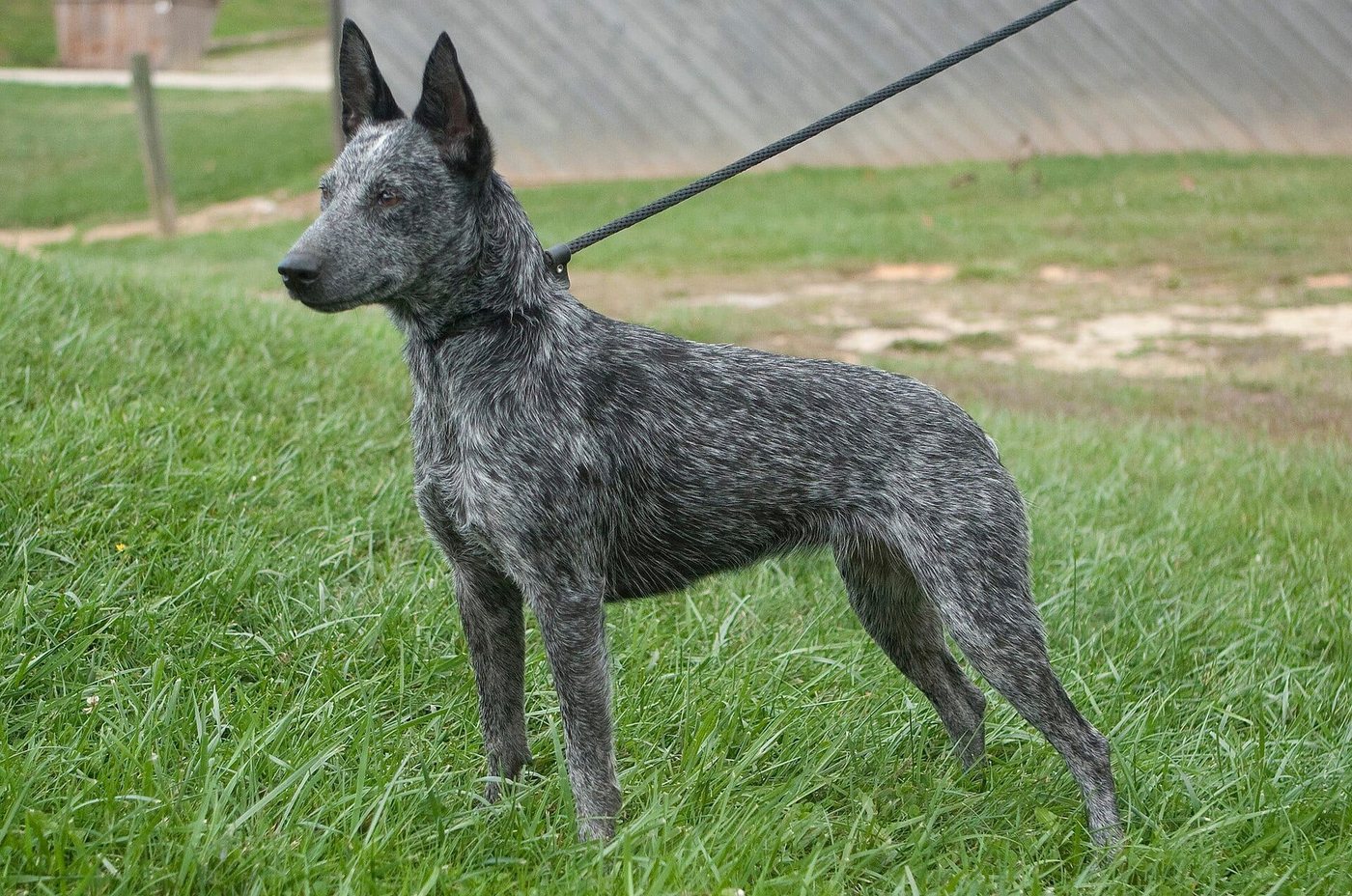
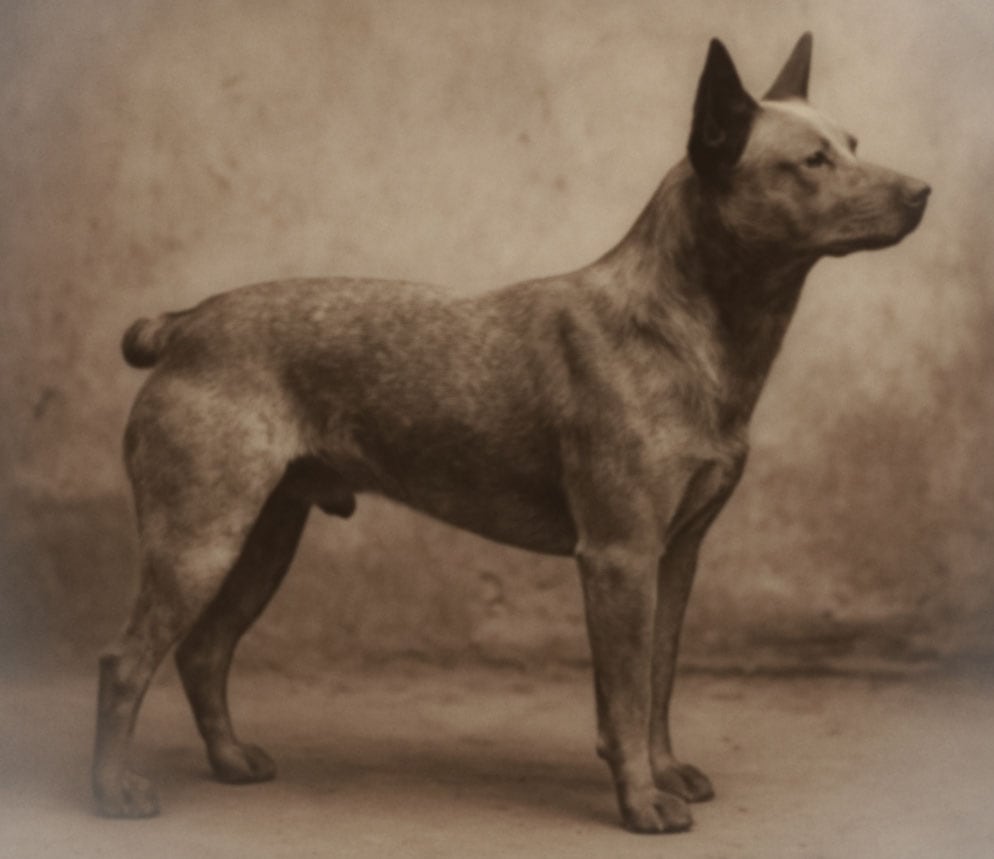
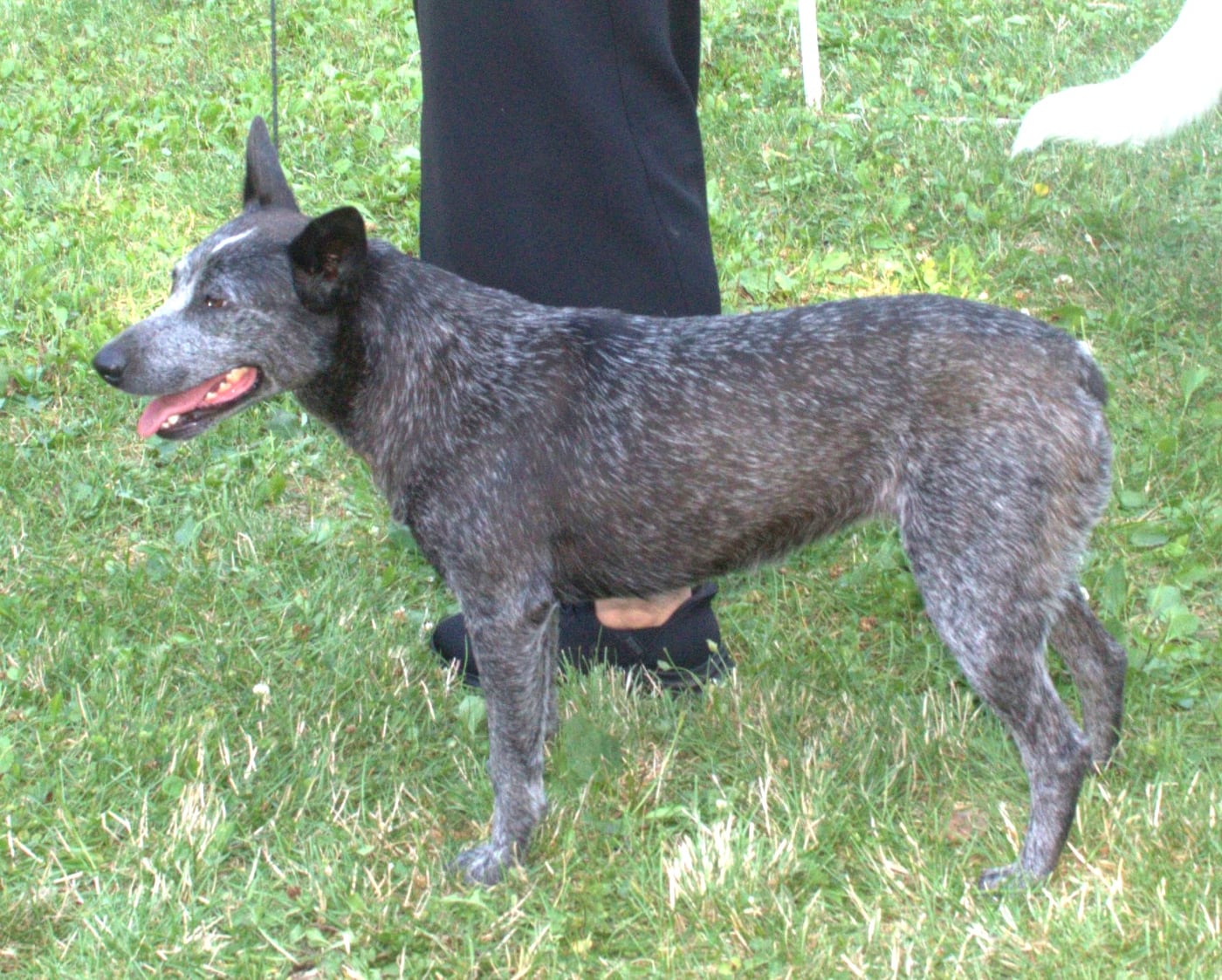
The Australian Cattle Dog is a medium-sized breed with a strong, compact build that reflects its origins as a working cattle dog used to long hours of movement in difficult terrain. The body is slightly longer than it is tall, with a strong back and well-muscled legs that give the dog the stamina and agility needed for working with livestock.
The head is broad between the ears, with a domed forehead and a prominent stop, the muzzle is strong and gradually tapers. The ears are erect, medium in size, set rather wide apart, giving the breed an alert expression. The eyes are dark, oval, deep-set and slightly slanted, emphasizing the keen and attentive gaze typical of working hounds.
The coat is short, smooth and close-fitting, consisting of a dense undercoat and a coarser topcoat, which protects the dog from the weather even when working outside all day. The color variants and their distribution are described in a separate section dedicated to color.
The typical and naming feature of the breed is a short tail – either naturally bobtailed or significantly shortened, unlike the long-tailed Australian Cattle Dog. The differences between the male and female are not precisely quantified in the available data, but in general, in cattle breeds of this type, the male is slightly more robustly built than the female.
Australian Cattle Dog Colors
A specific list of standardized color variants and their exact definitions are not available in the documentation for this breed, so we do not list them here to avoid giving inaccurate information. In general, this cattle breed from Australia is associated with a spotted (marbled) coat color in shades of blue or red, similar to the related Australian Cattle Dog, but we recommend checking the detailed specification according to the FCI standard No. 351 directly with the breed club.
Since this is a breed with short and smooth fur, any color variations are not associated with a change in care requirements - these remain low regardless of the specific shade of color.
Australian Cattle Dog Personality
This is a dog with a strong working nature - energetic, alert and strongly attached to its owner, while taking care of the family with a natural protective care. It requires a partner who can offer it enough physical and mental exertion, otherwise it will find its own - often undesirable - way to use up its excess energy.
The intelligence of this Australian cattle dog is high, which is manifested in its quick learning of new commands and ability to independently assess situations in the field. However, this independence also means a certain degree of stubbornness - the dog is used to making its own decisions and expects clear, consistent and fair leadership from its owner, not mechanical repetition of commands.
He is devoted to his people and requires a reasonable amount of company - this is not a dog that would be satisfied with long hours alone, but at the same time he is not one of the types that clings to constant physical contact. He tends to be reserved and alert with strangers, which makes him a reliable guardian of the homestead and household. He barks purposefully, more to warn than out of boredom.
It is friendly towards children, especially if it grows up with them from puppyhood, and has a neutral, wait-and-see attitude towards strange dogs and cats. A typical manifestation of its behavior is the attempt to "chase" and organize movement in the surroundings - whether it is other animals, children at play, or cyclists and cars, which needs to be regulated from puppyhood.
Due to the combination of high energy, need for mental stimulation, and tendency to make independent decisions, this breed is not suitable for beginners - it will be appreciated by a more experienced owner who gives it work, regular exercise, and clear rules.
Australian Cattle Dog and children
Living with children is possible for this breed, but it requires a more experienced approach - it is more suitable for families where someone is able to consistently lead the upbringing and ensure the dog has enough exercise and mental stress. It is a working herding breed with high activity and a strong instinct to control the movement in its surroundings, which can also be manifested by an attempt to "chase" running or screaming children.
The relationship with older children is usually good if the dog has been thoroughly socialized since puppyhood and the children learn to respect its boundaries. For smaller children, constant adult supervision is appropriate - not only because of the dog's herding instincts, but also because it is a strong and temperamental breed that can be unintentionally too aggressive when playing.
What to watch out for
- Teach children not to make sudden, escape movements that can trigger the cow reflex in a dog.
- Ensure the dog has enough physical and mental exercise so that it does not channel excess energy into inappropriate games with children.
- Do not underestimate training and basic obedience - thanks to the medium training difficulty, he responds well to consistent leadership.
- Always ensure adult supervision when in contact with young children, especially in the first years of living together.
Australian Cattle Dog and other dogs and pets
The breed's relationship with other animals is strongly influenced by its original working purpose - it is a cattle dog bred to work with cattle on the vast Australian farms. The instinct to chase, control movement and define space remains even in dogs that have never seen cattle, and it is reflected in coexistence with all animals in the household.
Relationship with other dogs
He usually gets along well with dogs from his pack or household if he is properly socialized from puppyhood. However, due to his nature and need for a clear structure, he can be dominant towards strange dogs, especially in situations where he feels the need to defend his territory or "guard" the group.
Relationship with cats
Cohabitation with cats is described as neutral - the outcome depends mainly on whether they grew up together from an early age and on the nature of the particular cat. The herding instinct may manifest itself in an attempt to follow or direct the animal in motion, which not every cat will appreciate.
Small animals and the instinct to chase
Caution is advised with small, fast-moving animals. The breed was bred to work with significantly larger animals, but its herding reflex – to track and direct a moving target – can easily be transferred to small domestic animals or rodents. Therefore, without targeted training and gradual socialization, living with small pets cannot be automatically recommended.
Is the Australian Cattle Dog suitable for an apartment?
Not suitable for an apartment. This is a working cattle breed with a high need for exercise and mental stimulation, and small spaces and the quiet of the city are not suitable for it in the long term.
If he were to live in an apartment, he would need a lot of physical activity outside the home every day – long walks, jogging or dog sports – and plenty of tasks to keep his mind occupied. Without this, he would easily become restless and seek out his own (usually undesirable) activities. A house with a garden, where he has space to move freely and where he can naturally release his energy, is more suitable for him.
- A high level of activity requires regular and sufficiently long exercise, not just short walks.
- A high need for mental stimulation means that training, search games or work are necessary, otherwise frustration is likely.
- Moderate barking in an apartment building with thin walls can easily bother neighbors.
- A moderate need for company doesn't mean that he can be left alone at home for long hours - he still needs the owner's active involvement.
An apartment does not automatically rule out its breeding, but without a large outdoor area and a time-consuming daily program, it is not an ideal environment for this breed.
How much exercise does it need?
The Australian Cattle Dog needs a significant amount of exercise every day - it is a working cattle breed with a high level of activity that is difficult to be satisfied with a short walk on a leash. It requires long walks, runs or other physical activity, ideally spread over several parts of the day.
In addition to the sheer volume of exercise, mental stimulation is also key, which this breed needs at a high level. Without enough tasks and stimuli, the cattle temperament may seek discharge in undesirable ways - for example, excessive barking or an attempt to "chase" everything around it, including children or other animals in the household.
Suitable activities
- long walks and runs, ideally in the field
- dog sports such as agility, obedience or herding trials
- Cycling companion for an adult
- search and smell games for mental exercise
- training obedience and new commands as a daily routine
Due to its high activity level and need for mental stimulation, this breed is more suitable for experienced and active owners who can offer it a regular program - not only physical, but also work or sports activities.
Training and education
Training the Australian Cattle Dog requires more experienced guidance, although the breed itself learns quickly and likes to work alongside humans. It is a dog with a strong working nature, which is motivated by meaningful activity, not mechanical repetition of commands - boredom or incomprehensible guidance will easily lose interest and begin to look for its own program.
They respond best to positive training based on rewards, clear rules and short but regular lessons. Long and monotonous training sessions are not suitable - better results are achieved by alternating activities, involving sniffing and herding games and gradually increasing the difficulty of tasks. Their high need for mental stimulation means that physical fatigue alone is not enough to satisfy them.
Socialization and specifics
Early and consistent socialization is key for this breed - the dog should get to know different people, environments and situations from a puppy age so that its natural alertness and moderate barking do not degenerate into excessive suspicion of foreign stimuli. Due to its herding origin, it has a tendency to follow movement and possibly "collect" moving objects, which is advisable to channel into controlled games and exercises at an early age.
Due to their high activity level and need for clear leadership, this breed is not suitable for novice owners without experience with working breeds - however, in the hands of an active and consistent leader, they are a very docile and reliable companion.
Hair care and hygiene
The short, smooth coat does not require complex grooming – brushing once a week is enough to remove dead hair and maintain a healthy appearance of the skin. During the shedding season, which is moderately intense for this breed, it is advisable to increase the frequency to two to three brushings per week to prevent the coat from spreading throughout the house.
Bathing should only be done when really needed, for example after getting dirty while walking or active outdoor activities - frequent washing could disrupt the skin's natural protective layer.
- It is advisable to check the ears regularly and, if necessary, clean them gently to prevent dirt accumulation and possible inflammation.
- It is enough to wipe the eyes occasionally with a damp cloth if minor discharge appears in the corners.
- It is a good idea to brush your teeth regularly, which will reduce the formation of tartar and prevent gum problems.
- Claws need to be trimmed depending on how quickly they grow - in active dogs that move a lot on hard surfaces, they naturally wear down less often, while in others they need to be checked regularly.
Thanks to the short coat without undercoat, there is no need for trimming or dealing with skin folds, so overall coat care remains easy and time-saving even for owners who are more concerned with the dog's physical activity than its appearance.
Feeding
Due to the high workload and energy expenditure, the diet requires a high-quality complete food with sufficient animal protein and fat content to cover the energy requirements of an active cattle dog. The choice of food should correspond to the age, size and level of movement of the individual - a puppy, an adult working dog and a less active senior have different nutritional needs.
Since this is a breed built for hard work, it is advisable to continuously adjust the amount of food to the current physical load. Dogs that spend most of the day in intensive exercise have a significantly higher energy requirement than dogs with a calmer regime, and vice versa - when exercise is restricted, food intake must be reduced to prevent excessive fat accumulation.
Physical fitness check
Regular monitoring of body condition (visibility of ribs when viewed from above, visible waistline behind the ribs) helps to detect early signs of overweight. In a breed with a strong need for exercise and mental stimulation, limited energy expenditure can easily lead to a calorie surplus if the feed ration is not reduced in proportion to the lower load.
- Choose food appropriate for age category and activity level.
- Regularly evaluate body condition and adjust the amount of feed according to actual movement.
- Pay attention to a balanced ratio of proteins, fats and other nutrients, especially for individuals who work hard.
- Prevent overweight by limiting treats and adjusting portions with reduced physical activity.
How long does an Australian Cattle Dog live?
The exact lifespan of this breed is not reliably documented, but in general, medium-sized cattle dogs with a balanced body structure and low coat care requirements tend to have a long life corresponding to their size category if well cared for. Therefore, we prefer not to give specific years, but the actual lifespan of a particular individual always depends on a combination of genetics, lifestyle and health care.
What affects lifespan?
- Genetics and parentage – the health of ancestors and responsible breeding significantly influence the predispositions of the offspring.
- Physical condition – due to the high activity of the breed, it is important to keep the dog in a lean, muscular condition without being overweight.
- Exercise and mental stimulation – this cattle dog needs not only enough physical exercise, but also regular mental stress, otherwise it suffers from frustration, which can affect its overall well-being.
- Prevention and veterinary care - regular preventive examinations, vaccinations and deworming are among the basics that can prevent many health complications.
- Nutrition – a quality diet appropriate to the dog's age, activity level and size supports the health of its joints, coat and internal organs.
- Health predisposition – the breed may have an increased predisposition to certain hereditary diseases, so it is advisable to consult the breeder or veterinarian about specific risks.
Who is the Australian Cattle Dog suitable for?
The Australian Cattle Dog is a working breed with high demands on exercise and mental exertion, and is best suited to experienced and active owners who can provide meaningful daily activities. Without enough work or more demanding training, excess energy can easily manifest itself in inappropriate ways.
Who is the breed suitable for?
- For active people or families who spend a lot of time outdoors and can offer their dog regular, intensive exercise.
- For owners with experience in training cattle breeds who can handle consistent and thorough training.
- For households with plenty of space outside the apartment, ideally with the possibility of free movement in the garden or in the field.
- For families with children, where the dog can act as a companion while actively spending time.
- For owners who appreciate a dog with low grooming requirements, but also anticipate the need for regular mental stimulation in the form of training, sports or work tasks.
Who is the breed not suitable for?
- For beginners without experience with more demanding working breeds who might underestimate the need for guidance and training.
- For owners living in an apartment without the possibility of regular intensive walks and exercise.
- For seniors or people looking for a calm, undemanding companion for the household.
- For households where the dog would spend a large part of the day alone without physical or mental exertion.
- For owners who prefer a dog with low activity needs and minimal training requirements.
Interesting facts about the breed
The most striking feature of this breed is its naturally short tail, which distinguishes it from its close relative, the Australian Cattle Dog, which has a long tail. The English name Australian Stumpy Tail Cattle Dog refers directly to this feature, as "stumpy tail" means stumpy tail.
The breed originated in Australia for working with cattle and is listed under FCI standard number 351 in Group 1, Cattle Dog Section, excluding Swiss Mountain Breeds. Although it shares a working purpose and geographical origin with the Australian Cattle Dog, it is a separately recognized breed with its own standard, not a mere color or coat variant.
Due to the high need for mental stimulation and physical activity, this breed is ranked in professional sources as a dog suitable for experienced and active owners rather than for beginner breeders.
Australian Cattle Dog Health
The Australian Cattle Dog is considered a robust and hardy breed, which, thanks to its relatively narrow genetic base and working background, does not have an extensive list of typical health problems. It is a dog bred for demanding work in harsh Australian conditions, which is reflected in its solid body structure and overall vitality. Nevertheless, it is advisable to pay attention to the health background of the breeding pair before purchasing a puppy and pay attention to the joints and eyesight, where predispositions are most often described in related cattle breeds.
Joints and musculoskeletal system
Similar types of cattle breeds may have an increased predisposition to hip or elbow dysplasia, which is related to the strain that these breeds endure when working in the field. Given the high need for exercise and mental stimulation, it is advisable to ensure adequate exercise, especially during the puppy's growth period, when the musculoskeletal system is most vulnerable.
Vision
In related Australian cattle breeds, an increased predisposition to hereditary eye defects is mentioned in the professional literature, therefore regular ophthalmological examinations are recommended for breeding individuals.
Hearing
In Australian Cattle Dog breeds, a possible predisposition to congenital hearing disorders has been described in connection with coat color and genetic basis. Therefore, a hearing test (BAER) in puppies can be part of a health check for responsible breeders.
What to look for when choosing a puppy
- Request information about parents' health examinations, especially of the hip and elbow joints and vision.
- Ask the breeder about the results of any hearing tests on the puppy and its parents.
- Monitor the puppy's overall activity, mobility, and limb structure from an early age.
- Verify that the breeding pair comes from a club breeding facility with supervision of the health of the line.
- Consider future stress and lifestyle – the breed needs plenty of exercise and mental stress, which is also reflected in the long-term health of the individual.
Known predispositions
- to congenital sensorineural deafness, which is described as an autosomal recessive trait mapped to chromosome CFA10.
- to progressive retinal atrophy (PRA), a hereditary eye disease leading to gradual vision loss.
- to primary lens luxation, a hereditary eye disease for which DNA screening of breeding pairs is recommended.
- It is recommended that puppies of this breed have a BAER hearing test because the breed carries a gene for deafness.
- to cancer.
- to thyroid problems (hypothyroidism).
Discussed risks
The breed is described to have an increased predisposition to:
- to hip dysplasia, when the joint does not fit properly in the socket and pain and osteoarthritis may occur.
- to elbow dysplasia.
This overview is for informational purposes only and does not replace the examination or recommendations of a veterinarian.
What to buy for an Australian Cattle Dog
Practical basis that is suitable for this breed:
- Car seats for dogs – Car seats and safety equipment for transporting a dog by car.
- Toys – Dog toys – fetching, chewing and interactive.
- Cosmetics – Shampoos, conditioners and hair care products.
- Bowls – Feed and water bowls, anti-swallow bowls and stands.
- Collars – Dog collars – leather, textile and semi-tight.
- Beds – Beds and mattresses for dogs of all sizes.
- Leashes – Leashes, switch leashes and tracking lines.
Useful instructions
Practical tips that are useful when caring for a dog:
Frequently asked questions
Why does this dog have a short or no tail?
The short tail is a natural trait of the breed, not a docking like other cattle dogs. This is what distinguishes it from its close relative, the Australian Cattle Dog, which has a full-length tail.
Is the Australian Cattle Dog suitable for beginners?
Rather not, it is a breed with high activity and high need for mental stimulation, which requires an experienced and consistent owner. The training difficulty is medium, but without sufficient stress it can be difficult to handle.
Is it suitable for an apartment?
Probably not – this is a highly active breed that needs space and plenty of exercise. It does better in a house with a garden or in an environment where it can regularly release its energy.
Is he good for children?
Rather yes, it is suitable for children, but it is still a working cattle breed with a strong instinct. Therefore, contact with small children should always be supervised, especially because of possible signs of cattle behavior.
Is this breed suitable for seniors?
Rather not, its high demands for exercise and mental stimulation usually exceed what seniors can provide on a regular basis. It is better suited to active owners with experience with working breeds.
What health predispositions can occur in the breed?
The breed may be predisposed to some joint and hereditary health issues typical of medium-active dogs, but it is always advisable to consult a breeder or veterinarian for specific diagnoses. Before purchasing a puppy, it is recommended to ask about the health examinations of the parents.
How is it different from the Australian Cattle Dog?
The main difference is the tail – the short-tailed variety has a naturally short or absent tail, while the Australian Cattle Dog has a full-length tail. The two breeds are otherwise very similar in temperament and working ability.
Resources and further information
- FCI Standard No. 351 - Australian Stumpy Tail Cattle Dog - Fédération Cynologique Internationale
- Source for predisposition - dogtime.com
- Predisposition resource - dogacademy.org
- Source for Predisposition - showsightmagazine.com
- Source of body measurements – curafyt.com
- Resource on predisposition - ncbi.nlm.nih.gov
Professional cooperation
This breed overview was created in cooperation with the Veterinary Clinic VYVET sro and MVDr. Adam Hylák .