
Published 1. 9. 2026
The Australian Cattle Dog is a medium-sized working breed from Australia, bred for herding cattle in demanding conditions. It is classified in FCI Group 1 (Standard No. 287) and its short, double-layered coat does not require complex maintenance, although shedding is common. It is a tenacious, alert and highly intelligent dog that forms a strong bond with its owner and instinctively watches over its surroundings.
The activity and need for mental stimulation are extremely high in this breed - they are not satisfied with a short walk and without meaningful work or sport they easily get bored. Therefore, they are more suitable for experienced and physically active owners who can offer them enough exercise and tasks. They are friendly with children, usually get along well with dogs, but their nature makes them not very suitable for apartments or seniors.
Professionally consulted
The content was created in cooperation with the veterinary clinic Veterinární klinika VYVET sro and MVDr. Adam Hylák.
Quick overview
What is an Australian Cattle Dog like?
The Australian Cattle Dog is a medium-sized working breed from FCI Group 1, bred in Australia to hunt cattle on vast pastures. Its nature corresponds to this - it is a tough, persistent and extremely energetic dog with a very high need for exercise and mental stimulation. The short, smooth double-layered coat does not require demanding care, but the breed sheds significantly.
In training, he is bright and docile, but still requires a more experienced and consistent leader who can offer him meaningful work - without it, he will easily get bored and look for a job on his own. He is strongly attached to his people and needs company intensely, but long periods of solitary stay in an apartment do not suit him.
- More suitable for active owners with training experience
- It tolerates living with children and other dogs well, and is neutral towards cats.
- Not an ideal choice for beginners, seniors, or purely apartment keeping
Origin and history of the Australian Cattle Dog
The Australian Cattle Dog originated in Australia during the 19th century as a working breed for herding and herding cattle on vast grasslands, where the European-type herding dogs used at the time were failing due to the heat, long distances and ferocious behaviour of the cattle. Settlers therefore sought a dog that could not only guard the cattle but also actively and harshly direct them by biting their heels – hence the English nickname “heeler”.
The breed is considered to be based on the crossing of imported collies (often blue merles) with the Australian dingo, thanks to which the dogs gained resistance to climate, endurance and a specific way of working with cattle by crouching and sneaking and low bites. Other breeds were later mixed into the breed, including the Dalmatian, which was supposed to give the dogs an affinity for working with horses and a guarding instinct towards the family, and the Australian Kelpie, which contributed to their significant work commitment and obedience.
The resulting type of dog gradually became established in the second half of the 19th century, primarily in the New South Wales region, where it was bred by cattle drivers to serve the needs of large ranches. The breed proved so successful that it quickly spread throughout Australia as the standard working dog on Scottish farms.
The formal description and standardization of the breed's characteristics took place in the early 20th century, when the first breed club dedicated to this type of dog was created. International recognition under the FCI came later, with the breed remaining classified among the cattle dogs in the Scottish breed section outside the Swiss mountain types.
Appearance and size
The Australian Cattle Dog is a medium-sized breed, and its body structure corresponds to the function for which it was bred in Australia - it is a hardy working dog adapted to long hours of cattle herding in difficult terrain. The FCI classifies it in Group 1 (Cattle and Sheepdogs), specifically in the livestock driving breeds section, under standard No. 287.
Hair
The characteristic feature is a short, smooth, double-layered coat with a distinct, dense undercoat that protects the dog from both the heat of the sun and the cold - a characteristic typical of breeds designed to work outdoors all day. Thanks to its short length, the coat does not require complex grooming, although it is necessary to expect more pronounced seasonal shedding.
We describe the color variants and their distribution in detail in a separate section dedicated to coloration, because the characteristic spotted pattern is one of the most distinctive distinguishing features of the breed.
The specific dimensions of height and weight, a detailed description of the head, ears, eyes and tail, and the demonstrable differences between a dog and a bitch are not given in sufficient detail in the official standard to allow us to quote them here without risk of inaccuracy.
Australian Cattle Dog Colors
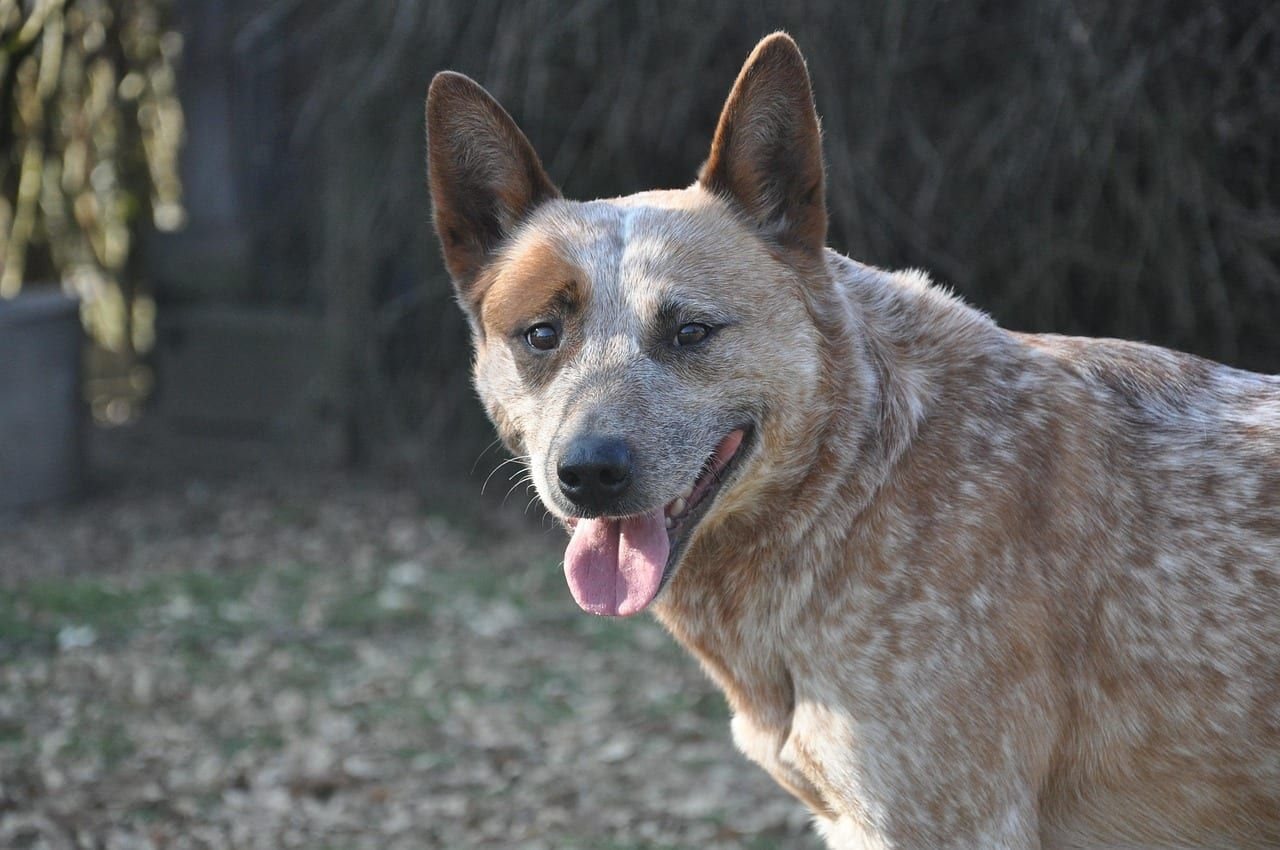
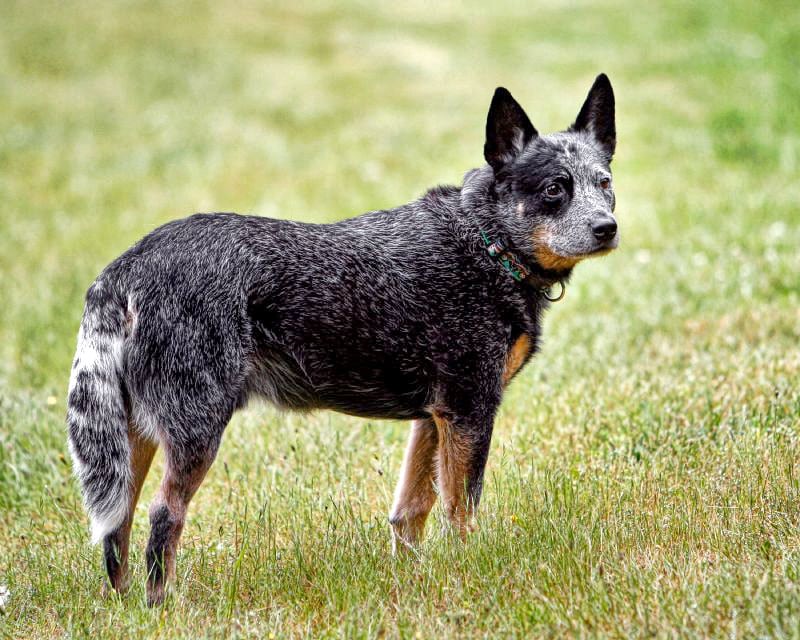
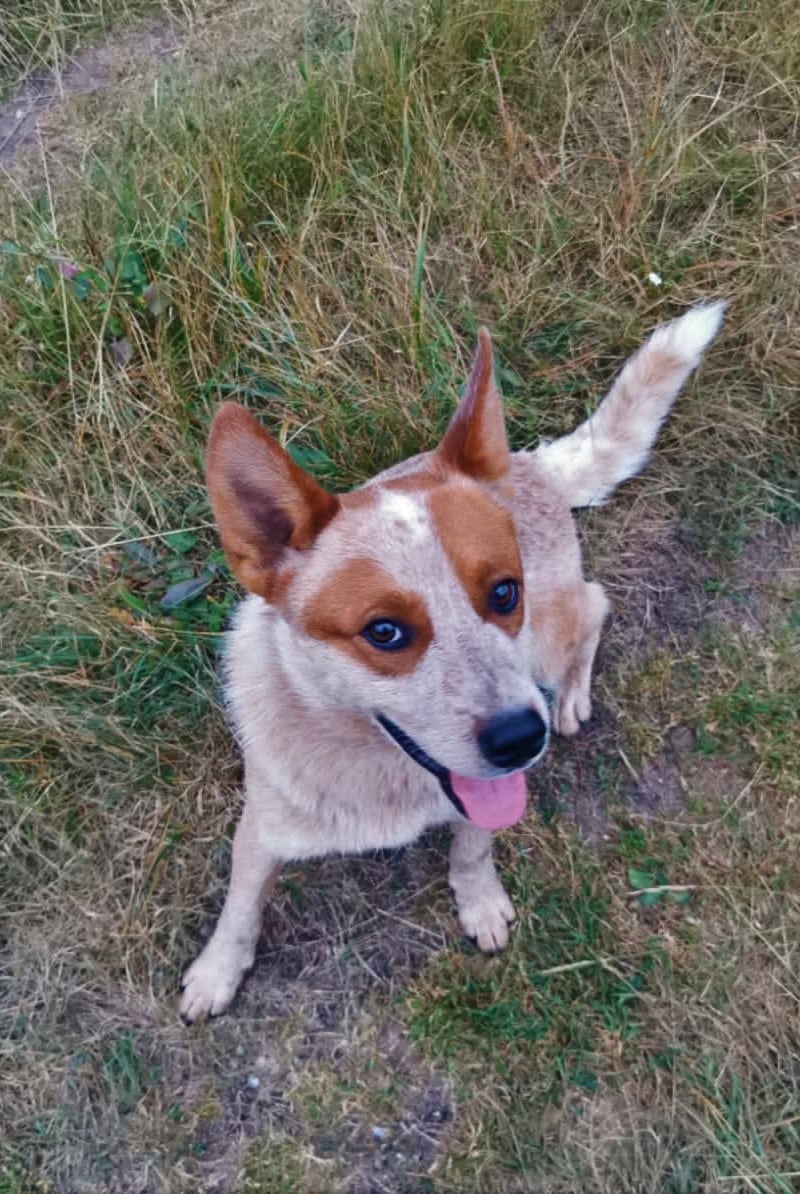
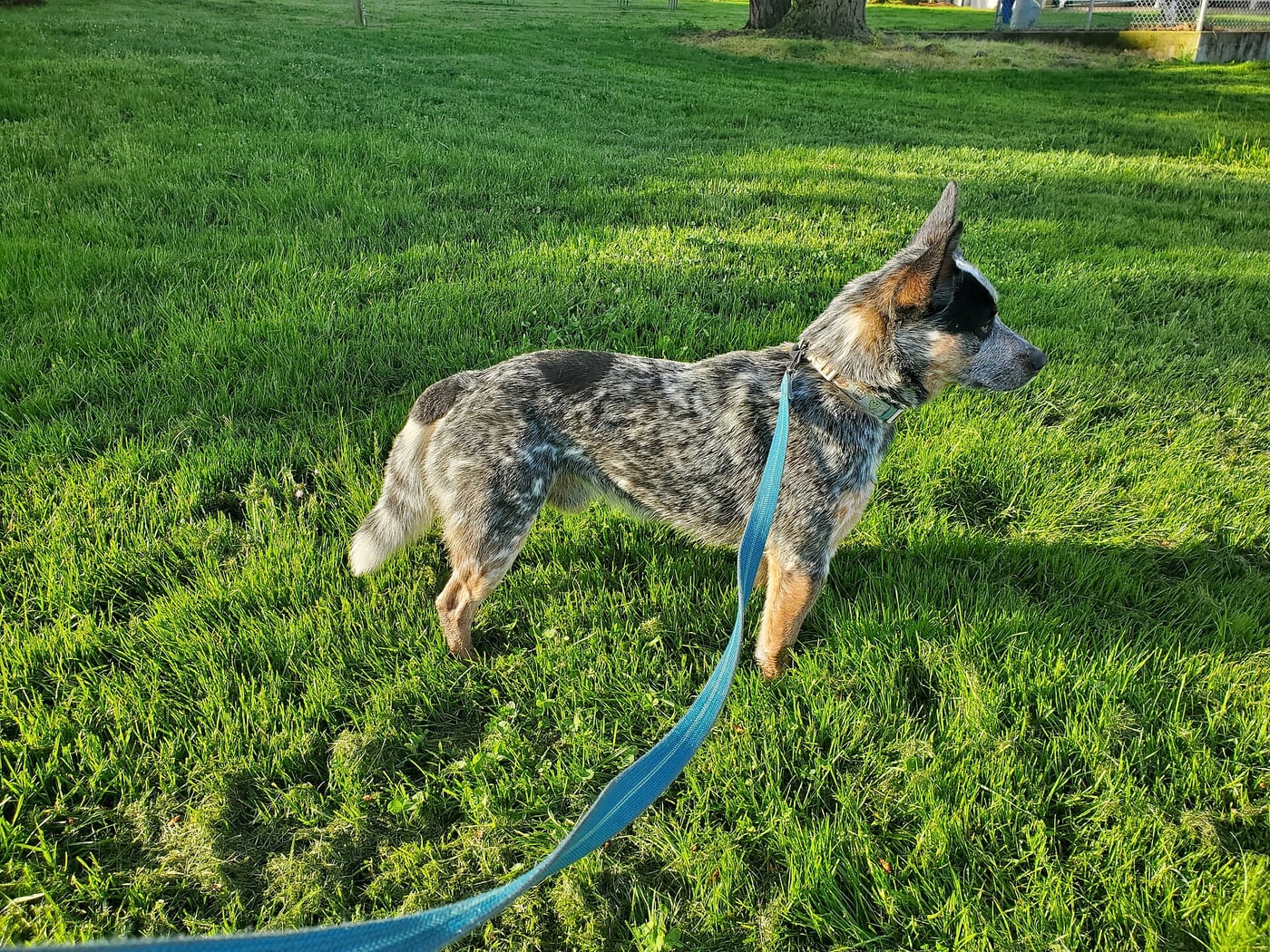
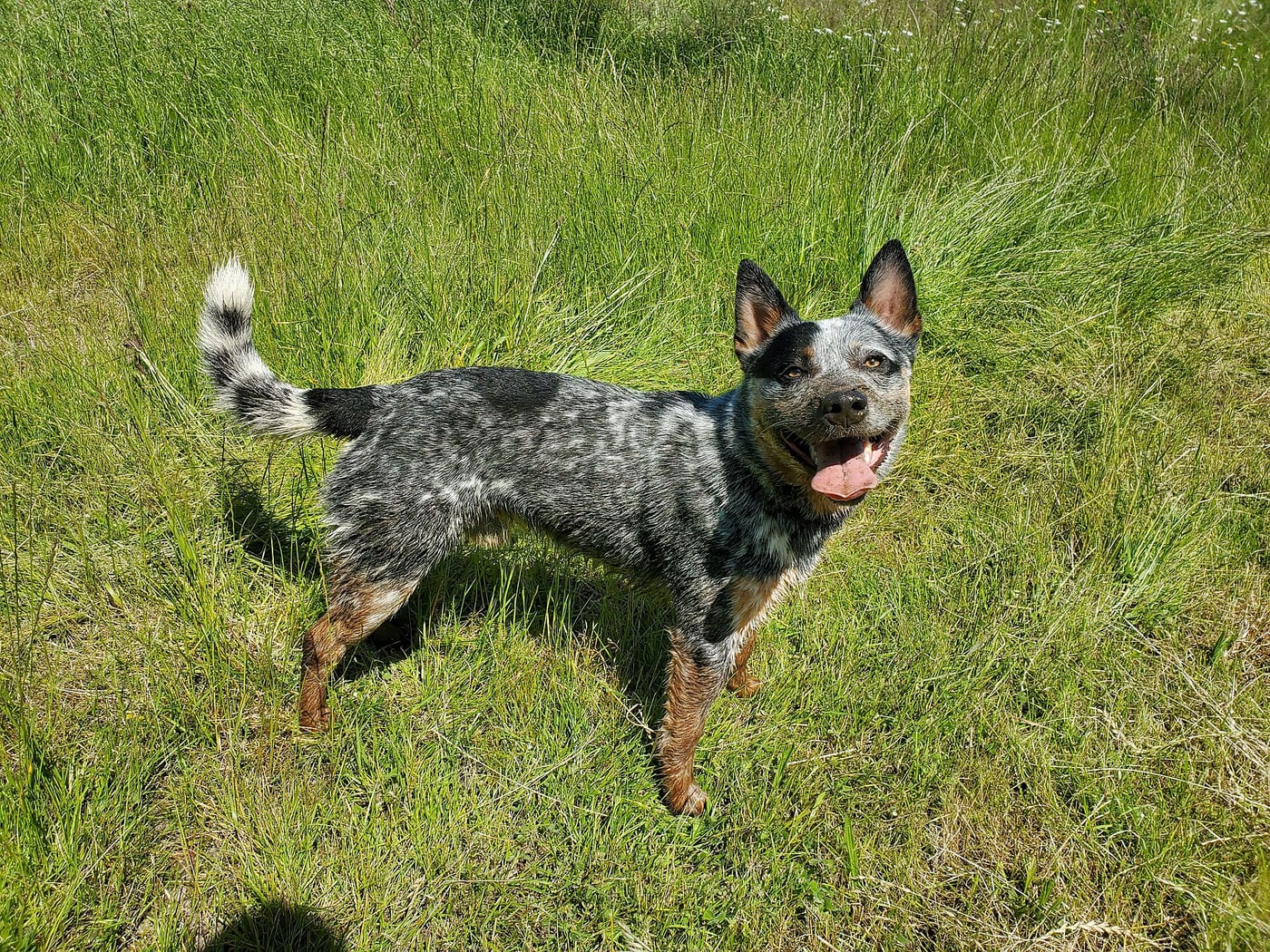
The standard recognizes two basic colors for this breed: blue and red mottled (red marbled pattern). Both variants are based on a base formed by a combination of white and pigmented hairs, which gives the coat a characteristic spotted or marbled appearance.
Blue color
In the blue color, the coat is a mixture of blue-gray and white hairs, and blue or tan markings may appear on the head, neck, chest and legs. Darker patches around the eye and at the base of the tail are also standard.
Red mottled color
The red coloration is created by an even blend of red and white hairs, giving the coat a finely marbled appearance. Here too, darker red patches may appear on the head, including single-colored or double-sided masks over the eyes.
Colors outside this standard framework – such as pure white, significant variations in spot distribution or completely different base shades – are practically not found in lines that conform to the breed standard. If they do appear, they are usually a departure from the typical appearance of the breed, not automatically a health problem; there is no evidence of any specific genetic link between color variant and health risk in this breed.
Australian Cattle Dog Personality
The Australian Cattle Dog is an energetic, intelligent and highly human-oriented hard worker who is not satisfied with just walks - he needs a task. His temperament stems from his original purpose of chasing cattle on the vast Australian pastures, which is manifested in constant alertness, sharp observation of the surroundings and a tendency to control what is happening around him. He builds a very close bond with his owner and likes to be in constant contact with him, he does not tolerate loneliness or being pushed to the sidelines of family events.
The intelligence of this breed is high, but it goes hand in hand with a certain independence and self-confidence - the cattle dog can assess the situation on its own and does not always wait for instructions, which can seem stubborn. In fact, it is more a habit of making decisions autonomously, which it was bred to do while working with the herd without constant human supervision. Training therefore requires patience, consistency and, most importantly, sufficient motivation - the boring repetition of the same exercises will quickly tire it.
This breed has enormous energy and without regular physical and mental exercise, it gets bored easily, which can manifest itself in destructive behavior, excessive chasing of moving objects or restlessness in the household. It is generally open to the company of people and other dogs, but it is initially wary and reserved with strangers, which makes it a good watchdog - it will alert visitors by barking, without being excessively barky.
Typical behavioral manifestations
- Strong attachment to one person or close family, less willing to "share" with strangers
- Tendency to chase moving objects, cyclists, or cars unless taught otherwise
- Vigilance and distrust towards unknown persons in the territory
- The need to constantly be active – both physically and mentally
- Independent decision-making, which can slow down training if there is a lack of consistency
Australian Cattle Dog and Children
Coexistence with children is rather good for this breed, but its strong working temperament must be taken into account. The Australian Cattle Dog is energetic, alert and has a strongly developed herding instinct - some individuals may therefore have a tendency to drive running or screaming children by lightly pinching their legs, similar to herding cattle. This behavior is not a manifestation of aggression, but of an inherited working instinct, and it needs to be specifically directed through training from puppyhood.
Due to his high need for mental stimulation and physical activity, he prefers older children who can actively participate in games, training or sports activities with him. Living with small children who move erratically and loudly can be more challenging, also due to his strength and temperament, which can easily knock down or knock over a smaller child during play.
The role of socialization and supervision
For a smooth functioning in a family with children, consistent and timely socialization is key. The puppy should be accustomed to the presence of children, their sounds, movements and unexpected reactions from a young age. Since this is a breed with medium training requirements, it will master obedience and basic rules of coexistence with systematic and patient guidance, ideally from a more experienced owner.
- Contact between a dog and small children should always be supervised by an adult.
- Children should be taught to respect the dog and not overload it with overly boisterous play.
- Regular walks and sufficient work and mental stress reduce the risk that the dog will inappropriately vent its "herding" energy on children.
Due to the temperament described above, this breed is generally not recommended as a first dog for families without prior experience with active working breeds.
Australian Cattle Dog and other dogs and pets
Cattle dogs usually get along well with dogs from the same household if they are raised in their company from puppyhood – this is a breed that worked in cattle drives in Australia, where multiple individuals were often deployed together. With strange dogs outside the household pack, they can be more reserved and show more dominant behavior, especially towards individuals of the same sex.
The relationship with cats and small animals should be considered with caution. The strongly developed working instinct of this breed, inherited from ancestors bred to bite the heels of cattle and direct them, can manifest itself in chasing fast-moving animals. With the animals it grows up with from puppyhood, it usually forms a stable relationship, but with newly introduced cats or rodents, careful and gradual socialization under supervision is necessary.
Recommendations for living with other animals
- Getting to know puppies and young animals is easier than with adult dogs used to independence.
- It is advisable to channel the hunting instinct into controlled activities - such as dog sports or obedience training - so that it does not transfer to pets.
- It is good to manage encounters with unfamiliar dogs outside the home and not leave them to interact freely, especially with unneutered individuals.
- Small animals (rodents, birds) should not be left unattended in the same room as a cattle dog.
Is the Australian Cattle Dog suitable for an apartment?
Probably not – this dog is only partially suited to an apartment environment. It is a very active working breed with a high need for mental stimulation, which primarily needs plenty of space and the opportunity to regularly discharge its energy through exercise, not just short walks around the corner.
If he should live in an apartment, the owner must take into account that the interior alone is not enough for him - access to an outdoor space where he can run, perform tasks and use his working instinct is key. Without sufficient exercise, he will easily show frustration, which he shows through destructive behavior or increased vocal activity.
- Space: they feel better in a house with a garden than in a closed apartment where there is no possibility of free movement.
- Peace: it needs enough stimuli, but also a space where it can rest without disturbance after physical and mental stress.
- Exercise: requires long and challenging exercise every day, ideally a combination of physical activity and tasks that engage his mind.
- Barking: moderate, which in a panel house can easily become a problem with neighbors due to lack of exercise.
Apartment breeding is therefore only an option for owners who are able to provide the dog with intensive daily exercise and enough mental work - without this, an environment with its own outdoor area is more suitable for this dog.
How much exercise does it need?
The Australian Cattle Dog is a breed with a very high need for exercise - a short walk down the street is not enough for him. He is a working dog bred to chase cattle all day long in difficult terrain, so he needs several hours of active exercise every day, ideally divided into several blocks.
But physical exercise alone is not enough - intense mental stimulation is also a necessary part, without which the dog quickly succumbs to boredom and the associated undesirable behavior (destruction, excessive barking, chasing everything that moves).
Suitable activities
- long walks combined with running or accompanying a bike ride
- dog sports such as agility, obedience or dogfrisbee
- herding tests and cattle training that corresponds to the original purpose of the breed
- search and sniff games, tracking, obedience training with elements of problem-solving
- activities in pairs with another dog, with which the cattle dog usually gets along well
Due to its working origin, it is also suitable for sports with higher demands on cooperation between dog and handler, as it combines physical endurance with quick learning. That is why it is more suitable for experienced and active owners who can offer it enough stimuli - in a less active household or in an apartment without the possibility of regular exercise, it easily becomes frustrated and difficult to handle.
Training and education
Even an owner without professional experience can handle training an Australian Cattle Dog, as long as they take into account that it is an intelligent working dog that needs meaningful use - without it, it will find its own, often undesirable, activity. The breed learns quickly and understands connections, so mechanical repetition of exercises will soon cease to be fun for it and will manifest itself in loss of interest or its own improvisation.
Positive motivation based on movement, play and working with an object or herd works best - a cattle dog responds to activities where it can follow movement, chase, fetch or solve a task on its own initiative. Punishments and a harsh approach easily lead to distrust or stubbornness, while clearly guided but respectful training strengthens its willingness to cooperate.
How to conduct training
- Short but frequent training blocks - maintain attention better than long repeated lessons.
- Alternating types of tasks so that the dog has to think, not just mechanically repeat what has been learned.
- Strict and consistent rules from the puppy – inconsistency leads to testing of boundaries.
- Involving movement and olfactory games as rewards for completing a task.
Socialization should begin as early as possible and be ongoing - the breed tends to be wary of strangers and situations, and without sufficient contact with different environments, people and other dogs, it can become distrustful or overly territorial. Given its original working function, it is appropriate to count on a natural tendency to chase moving objects, including children or cyclists, which needs to be specifically directed at an early age.
Due to its very high need for mental stimulation, the Australian Cattle Dog is more suitable for owners who can offer it regular training, sports or other demanding activities - without it, it will easily become restless or exhibit undesirable behavior.
Hair care and hygiene
The short, smooth, double-layered coat is easy to maintain – just brush it once a week with a brush or rubber glove to remove dead hair and promote blood circulation to the skin. No trimming or grooming is needed, as the coat does not curl or grow in length on its own.
Although the coat care is low, the shedding rate is high, especially during the spring and autumn moulting periods, when the dense undercoat is shed in large quantities. During these weeks, it is advisable to brush the dog every other day to prevent the hair from remaining on clothing and in the home.
Bathing is only necessary in exceptional cases, after visible dirt or a strong odor - frequent bathing unnecessarily disrupts the natural oily layer that protects the skin and short coat from water and dirt.
Ears, eyes, teeth and claws
- It is advisable to check the ears regularly and wipe them gently if necessary. The breed does not have drooping earlobes that are prone to fogging, but the accumulation of dirt should not be underestimated.
- It is enough to check your eyes occasionally to see if they are red or watering excessively.
- It is a good idea to brush your teeth regularly to prevent tartar buildup, ideally several times a week.
- Claws should be trimmed based on how quickly they wear out - in active individuals who spend a lot of time moving around on harder surfaces, they naturally wear out less often than they need to be trimmed.
Skin folds or specific skin problems are not typical for this breed, the coat and skin are adapted to a physically demanding life in the field.
Feeding
Due to its very high activity and energy expenditure, the Australian Cattle Dog needs a high-quality complete food adapted to its working requirements - ideally a range for active or working medium-breed dogs, which will cover higher demands for energy and muscle regeneration.
The amount of food should be adjusted to the current load - a dog that spends most of the day actively moving, training or working needs significantly more energy than an individual with a calmer regime. It is also advisable to change the composition of the diet according to age: a puppy requires food that supports gradual, not too rapid growth, an adult dog needs a balanced ratio of proteins and fats corresponding to its performance, and an older individual usually appreciates a lighter, joint-friendly option.
Although this is a breed with a high energy output, it is not immune to overweight - especially if movement is limited or mental and physical stress is reduced. Regular body condition checks (visibility of the waist, easy palpability of the ribs without them showing through) help to detect possible excess weight in time and adjust the dosage before it becomes a problem.
What to watch out for
- Adjust the daily dose to the current physical load, not just age and weight.
- Monitor your physical condition by regular observation and touch, not just by looking at your weight on a digital scale.
- When changing food, proceed slowly to avoid digestive problems.
- Remember to give treats during training - due to frequent and intense mental stimulation, it is advisable to deduct their amount from the total daily dose.
How long does an Australian Cattle Dog live?
There is no specific life expectancy range for this breed from a verified source, but it is generally considered a medium-sized dog with a reputation for being a tough and resilient working dog. Its lifespan – as with other breeds – depends on a combination of genetics, overall fitness, and the care that the owner provides the dog throughout its life.
What influences life expectancy the most?
- Genetics: The health of the parents and responsible breeding with the selection of genetically tested individuals play a crucial role in how long and in what condition a dog will live its life.
- Physical condition: Due to the high need for exercise, it is important to keep the dog in a lean, muscular condition without excess weight, which unnecessarily burdens the joints and internal organs.
- Exercise: The Australian Cattle Dog needs regular and sufficiently demanding physical activity - without it, there is a risk not only of frustration, but also of health problems associated with a lack of activity.
- Prevention: Regular veterinary checkups, vaccinations, and early detection of any health problems help keep your dog in good shape throughout its life.
- Nutrition: A quality diet appropriate to the dog's age, weight and activity level supports healthy coat, joints and overall vitality.
- Health predisposition: The breed may have an increased predisposition to progressive retinal atrophy (PRA), so it is advisable to ask the breeder about genetic testing of the parents.
Who is the Australian Cattle Dog suitable for?
The Australian Cattle Dog is a working breed with a strong bond with its owner and a need for permanent employment - it is best suited to families or individuals who can provide it with enough exercise and mental stimulation every day. Without these needs met, it can find employment on its own, usually in a way that does not please its owner.
Who is the breed suitable for?
- For active owners who spend a lot of time outdoors and want to involve their dog in sports, work or long trips
- For more experienced breeders who can handle consistent and stimulating training
- For households with their own land – an apartment is usually not enough
- For families with children, where the dog is led and socialized from puppyhood
- For owners of other dogs with whom he gets along well
- For those who appreciate easy coat care despite a higher rate of shedding
Who is the breed not suitable for?
- For beginners without experience with a more demanding working breed
- For seniors or people looking for a calm, social dog for the couch
- For apartments and households without the possibility of regular intensive movement
- For owners who spend long hours away from home – the high need for company does not allow him to tolerate it well
- For households with cats, where coexistence would have to be carefully built from the start
Interesting facts about the breed
The Australian Cattle Dog originated in Australia by crossing dogs brought by European settlers with the dingo, which gave it the endurance and resilience needed to work with cattle in the harsh climatic conditions of the continent. The English name Australian Cattle Dog directly refers to its original working purpose - herding and controlling cattle on vast pastures.
Its inclusion in FCI Group 1, Cattledogs section (except Swiss Cattledogs), under standard No. 287 confirms its position among specialized cattle breeds distinct from Swiss Mountain Dogs.
The breed has been described to have an increased predisposition to progressive retinal atrophy (PRA), specifically to the form known as rcd4, which is a genetic eye defect also monitored within breeding health programs.
Australian Cattle Dog Health
The Australian Cattle Dog is a robust working breed with relatively good endurance, which is also related to its origin - it was created as a dog intended for all-day work in the demanding climatic conditions of the Australian outback. Nevertheless, it, like other purebred breeds, can develop hereditary predispositions to certain health problems. Responsible breeding using genetic tests significantly reduces the risk of their transmission to offspring. Due to the very high need for exercise and mental stress, it is also necessary to take into account the strain on the musculoskeletal system if the dog does not receive adequate exercise for a long time. The following overview summarizes the areas that should be paid increased attention to in this breed.
Vision
The Australian Cattle Dog has been described to have an increased predisposition to hereditary progressive retinal atrophy (a form known as rcd4), which gradually leads to vision impairment. This is a genetically determined disease for which there is a DNA test that allows the identification of carriers and affected individuals before the onset of clinical symptoms.
Hearing
Due to the type of coat color associated with genes affecting pigmentation, the breed has been described in scientific literature as having an increased predisposition to congenital hearing disorders. This connection between pigmentation and inner ear function is also being studied in other breeds with a similar type of piebald color.
Locomotor system
This is a very active breed built for long-term physical work, which places demands on the healthy development of joints and muscles. Insufficient or excessive exercise in puppyhood can have an adverse effect on the musculoskeletal system, so it is advisable to adapt the load to the age and physical condition of the dog throughout its life.
What to look for when choosing a puppy
- Ask the breeder about the results of the DNA test for progressive retinal atrophy (rcd4) in the puppy's parents.
- Find out if a hearing test (BAER test) has been performed on the parents or puppies, especially for individuals with lighter or spotted coloring.
- Make sure that puppies are raised in a stimulating environment with adequate, but not excessive, exercise.
- Request information about the health status of both parents and possibly older relatives in the line.
Known predispositions
The breed is described to have an increased predisposition to:
- to progressive retinal atrophy (PRA), specifically the RCD4 form, which was identified in this breed through screening conducted by a University of Missouri research team.
- to hip dysplasia, manifested by abnormal development of the joint and gradual wear of the cartilage.
- to elbow dysplasia.
- to cancer.
Discussed risks
- to congenital sensorineural deafness (congenital deafness), which manifests itself in puppies and can affect one or both ears.
- A study of nearly 900 individuals of the breed found a prevalence of deafness of around 10.8%, with the majority of cases being unilateral.
- to progressive retinal atrophy of the prcd type, present in the gene pool and outside the breeds in which it is traditionally described.
- to hereditary progressive sensorineural deafness, in which a connection with coat color and head markings (mask) is described.
This overview is for informational purposes only and does not replace the examination or recommendations of a veterinarian.
What to buy for an Australian Cattle Dog
Practical basis that is suitable for this breed:
- Car seats for dogs – Car seats and safety equipment for transporting a dog by car.
- Toys – Dog toys – fetching, chewing and interactive.
- Cosmetics – Shampoos, conditioners and hair care products.
- Bowls – Feed and water bowls, anti-swallow bowls and stands.
- Collars – Dog collars – leather, textile and semi-tight.
- Beds – Beds and mattresses for dogs of all sizes.
- Leashes – Leashes, switch leashes and tracking lines.
Useful guides
Practical tips that are useful when caring for a dog:
Frequently asked questions
Is the Australian Cattle Dog suitable for an apartment?
Rather not – it is a very active working breed with a high need for exercise and mental stimulation, which suffers in an apartment without sufficient exercise. It thrives better in a house with a garden, where it has space to move around.
Is the Australian Cattle Dog good with children?
Rather yes, but due to his herding instincts he may tend to do business, i.e. gently bite running children on the legs. Coexistence works best with older children who respect his boundaries and join in his training or games.
Why does an Australian Cattle Dog bite its legs?
This is an inherited working instinct from herding cattle, where the dog would nip at the animals' heels to direct them. This behavior can also occur towards people or other animals in the household if the dog does not have enough other work and stimulation.
Is the Australian Cattle Dog suitable for beginners?
Probably not, because it requires an experienced owner who can provide it with consistent training, very high physical exertion and constant mental stimulation. Without sufficient guidance and exercise, it can exhibit problematic behavior and destructiveness.
How much exercise does an Australian Cattle Dog need per day?
This breed has a very high activity level and needs significantly more than just a regular walk – long runs, jogging, fetching or dog sports are ideal. Lack of exercise leads to nervousness and undesirable behavioral manifestations.
How difficult is it to care for an Australian Cattle Dog's coat?
The coat is easy to care for, as it has a short, smooth, double-layered coat that only requires regular brushing. However, the breed does shed significantly, so it is advisable to increase the frequency of brushing during the shedding season.
Does the Australian Cattle Dog get along with other dogs and cats?
It gets along well with dogs, especially if properly socialized from a puppy. Its relationship with cats is rather neutral and depends on the dog's specific nature and how it was accustomed to living with cats from a young age.
What kind of training does an Australian Cattle Dog need?
It requires medium training intensity, but due to its high intelligence and working background, it will appreciate a consistent approach and involvement in more demanding tasks or dog sports. A bored dog without challenges will often find its own, not always desirable, activity.
Is the Australian Cattle Dog suitable for seniors?
No, this breed is not suitable for seniors due to their very high need for exercise and mental stimulation, which the average senior may not be able to provide in the long term. They need an active owner who can devote enough time and energy to them every day.
What health conditions can occur in the Australian Cattle Dog?
The breed may be predisposed to progressive retinal atrophy (PRA), specifically the rcd4 form. Anyone interested in a puppy should check with the breeder whether the parents have been tested for this disease.
How much does an Australian Cattle Dog bark?
The breed has a moderate barking rate, which is consistent with its working nature, where its vocalizations were used to direct livestock. However, the barking rate may increase if the dog does not get enough exercise and stimulation.
Resources and further information
- FCI Standard No. 287 - Australian Cattle Dog - Fédération Cynologique Internationale
- Source for predisposition - ofa.org
- Body Measurement Source – acdca.org
- Resource on predisposition - ncbi.nlm.nih.gov
- Source for predisposition - sciencedirect.com
Professional cooperation
This breed overview was created in cooperation with the Veterinary Clinic VYVET sro and MVDr. Adam Hylák .