
Published 7. 9. 2026
The Airedale Terrier is the largest of the terriers and comes from Great Britain, specifically from the Aire River valley, after which it was named. It belongs to FCI Group 3 among terriers and measures 56–61 cm at the withers, depending on the sex. Its rough coat is not one of the breeds that only needs occasional brushing – it requires regular trimming and a more professional approach, but thanks to this, the coat almost does not shed.
The Airedale Terrier is an intelligent, self-confident and relatively independent-minded dog with a high need for exercise and mental activity. It is friendly to children and strongly attached to its family, but it needs an owner who will give it clear rules and enough activity - it is not very suitable for an apartment or for less active people. It will be appreciated more by those who are looking for a companion for trips and a physically and mentally demanding program.
Professionally consulted
The content was created in cooperation with the veterinary clinic Veterinární klinika VYVET sro and MVDr. Adam Hylák.
Quick overview
What is the Airedale Terrier like?
The Airedale Terrier is the largest of all terriers and belongs to FCI Group 3 among large and medium-sized terriers, originating from Great Britain. The male measures 58–61 cm at the withers, the female 56–59 cm, and lives on average 10–13 years. Externally, it is characterized by a rough, short coat that sheds little, but requires regular grooming in the form of trimming.
By nature, it is an energetic, confident and intelligent dog with a strong need for exercise and mental activity. It is devoted to its people and seeks their company, it is friendly towards children, and its reaction to other dogs and cats is individual. It handles training well with a little consistency, although it appreciates variety and motivation.
It is best suited to active owners who provide it with plenty of walks and mental stimulation - the Airedale Terrier is less suited to living in an apartment or to less mobile and beginner breeders.
Origin and history of the Airedale Terrier
The Airedale Terrier originated in the second half of the 19th century in the valley of the River Aire in Yorkshire, after which it is named. It was bred by local workers and miners who needed a versatile dog capable of hunting otters, rats and small game along the river, but also to guard and accompany its master. The basis of the breed was the Old English Black and Tan Terrier, crossed with the Otterhound, from which the Airedale Terrier inherited a good sense of smell, swimming ability and coarser coat. The blood of other terriers from the area probably also got into the crossing, which resulted in a larger and more robust dog than the small terriers used to hunt rodents at the time.
The breed was initially known by various local names, such as Waterside Terrier or Bingley Terrier, before the name derived from the Aire Valley became established. Due to its versatility, the Airedale Terrier quickly gained popularity not only as a hunting and guard dog, but later as a service breed - it was used by the police and the military, including as a liaison and patrol dog during the First World War. This experience contributed to the spread of the breed outside the British Isles, including North America.
The Airedale Terrier was recognized as a separate breed by the English Kennel Club at the end of the 19th century, and its standard, now under the auspices of the FCI, was gradually refined. The original versatile working dog has become a recognized breed bred all over the world.
Appearance and size
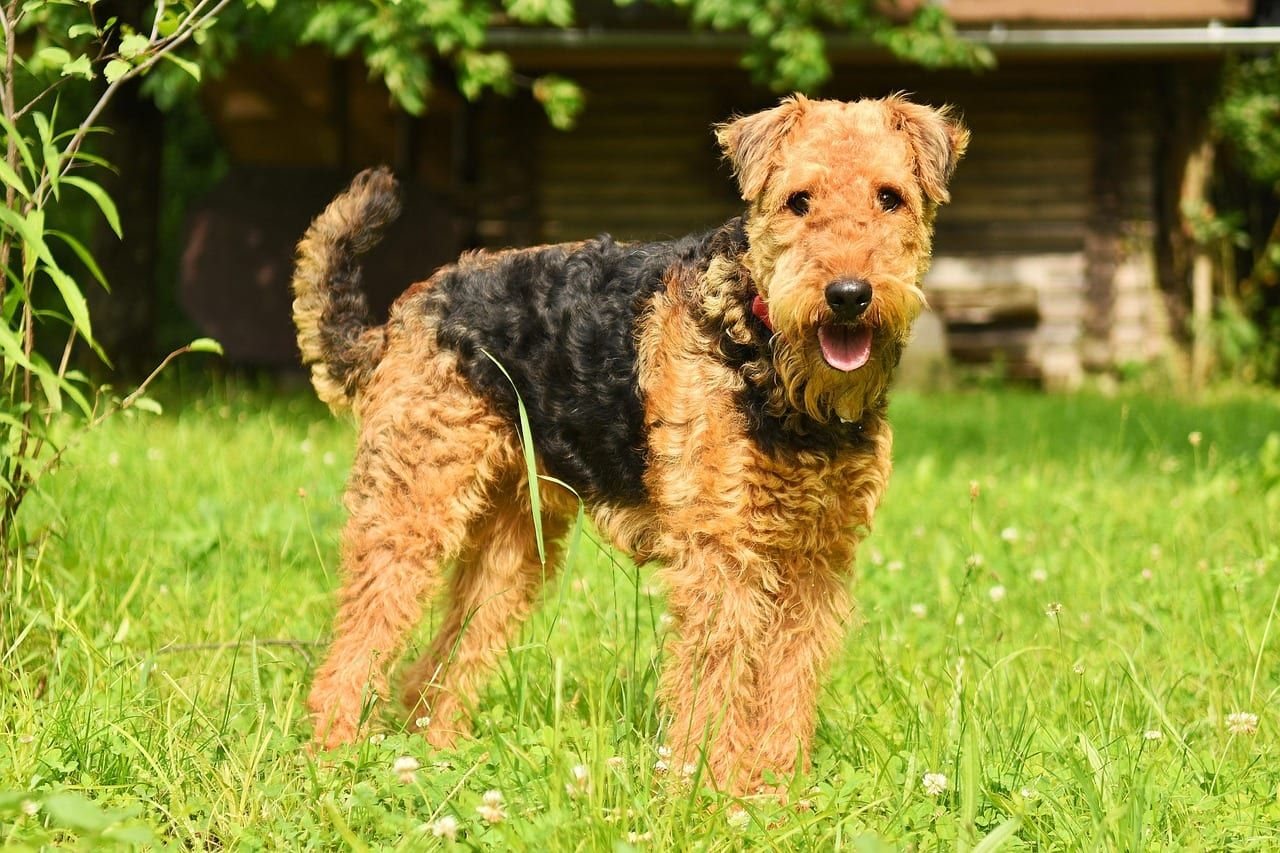
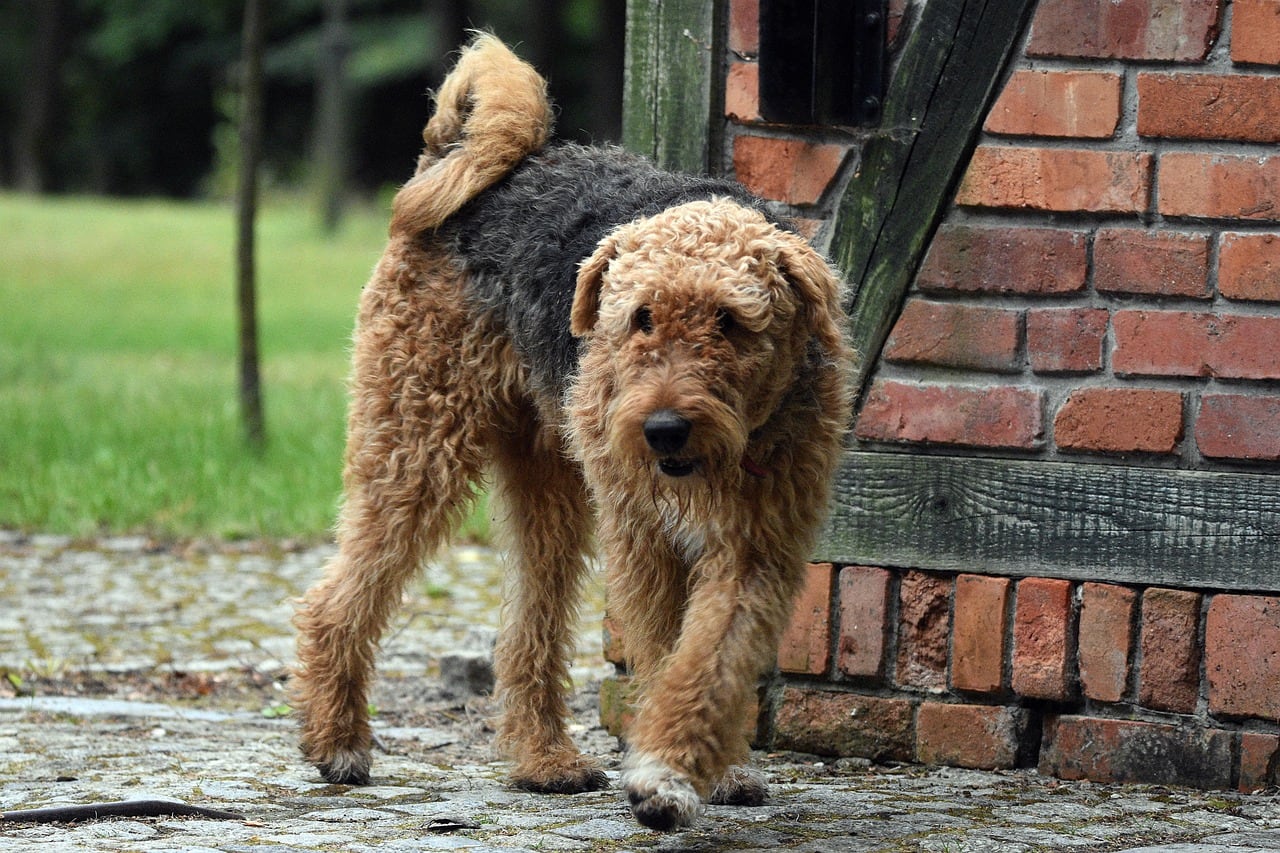
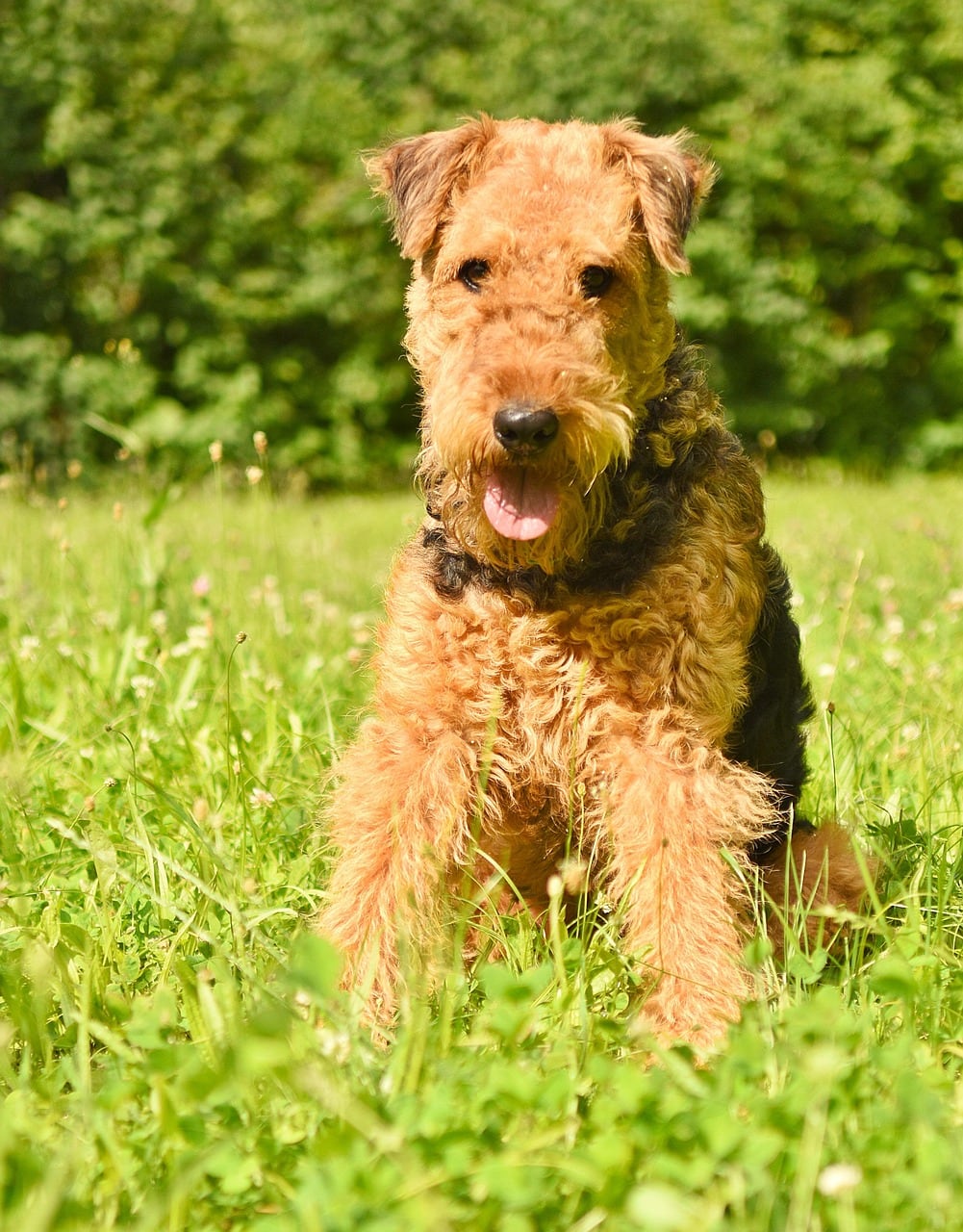
The Airedale Terrier is the largest of the terrier breeds, with a square and massive build that gives it the appearance of a robust but still elegant dog. The male dog stands 58-61 cm tall at the withers, the female is slightly smaller, standing 56-59 cm tall. The body is compact, with a straight back and deep chest, giving it a characteristic "square" profile.
Head and expression
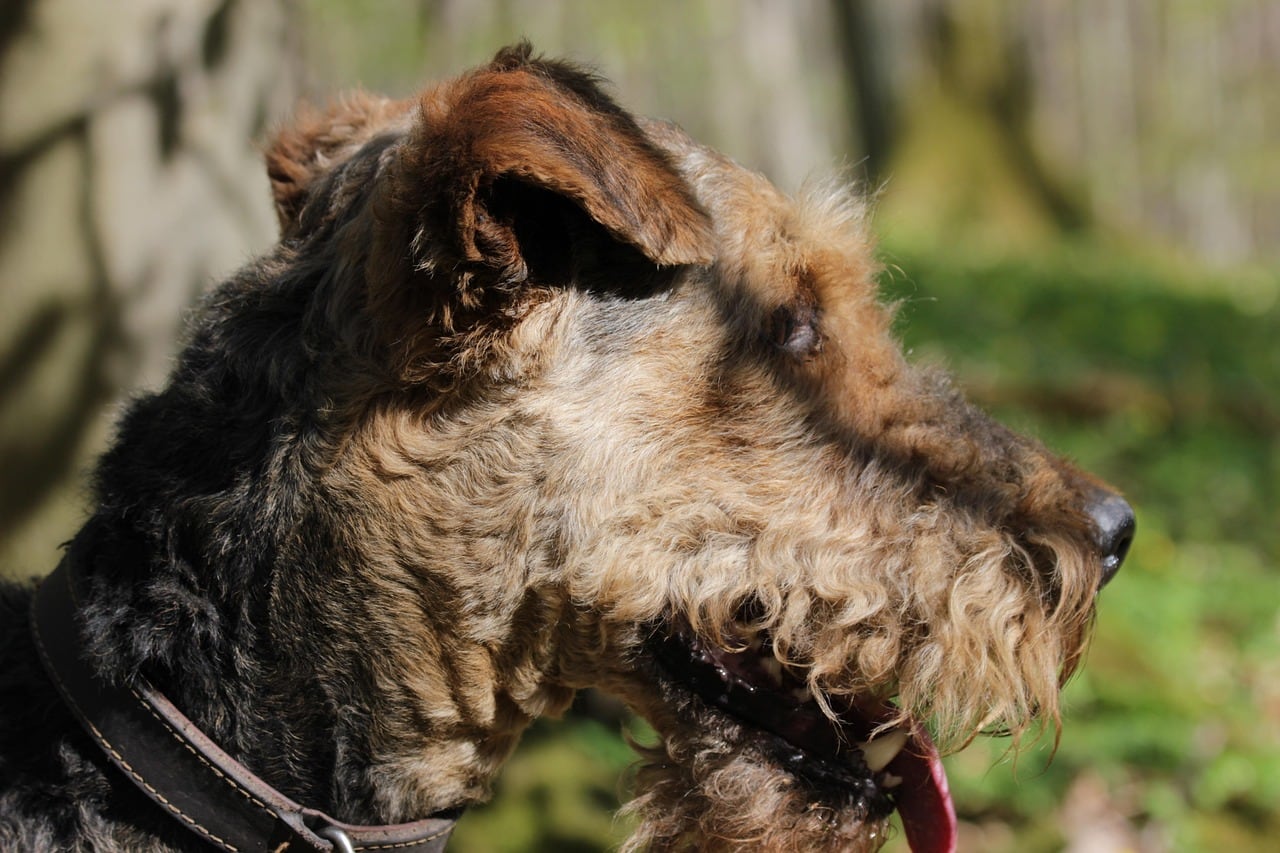
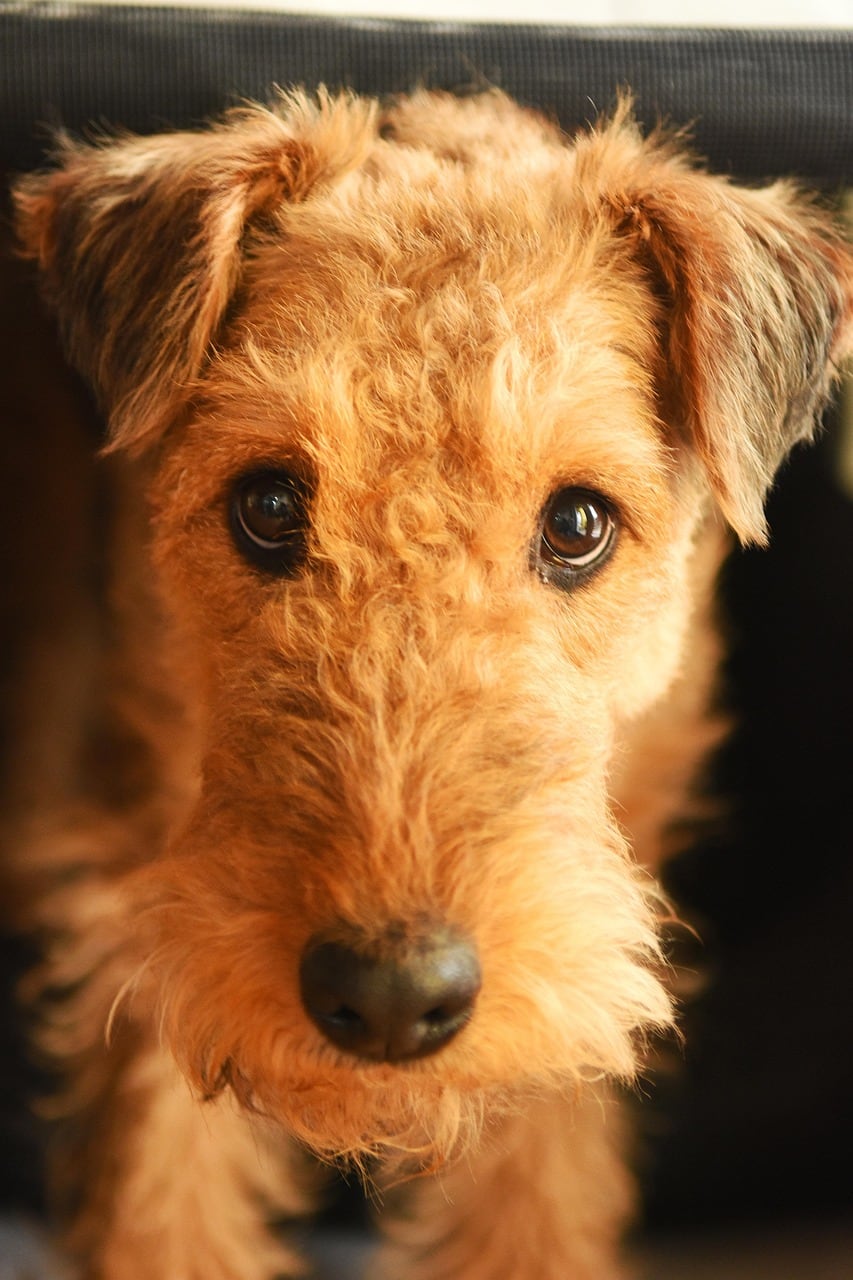
The head is long, flat and slightly wedge-shaped, with a prominent but not too broad muzzle. The eyes are small, dark and full of energy, giving the dog a sharp and alert expression. The ears are small, V-shaped, carried close to the head, a typical terrier trait.
Fur and tail
The coat is rough, dense and short, with an undercoat that protects the dog from adverse weather. Due to its structure, the Airedale Terrier's coat requires more care, including regular trimming, to maintain its characteristic appearance. The tail is carried cheerfully high, not too curled, giving the dog an upright, active impression.
The differences between the sexes are mainly noticeable in height, with the male generally being slightly taller than the female, but both have a similar robust build. Coat colours are not described in detail in this standard, more information can be found in the colour section.
Airedale Terrier Colors
The breed standard sets specific requirements for coat color, but an exact list of recognized color patterns and their distribution (typical combinations on the back, head, and limbs) is not available in this overview - for a binding assessment of color, we recommend using the current version of FCI standard No. 7.
Similarly, without reference to the standard, it is impossible to reliably distinguish which shades or markings are considered non-standard, and any speculation about the connection between color and the health of the Airedale Terrier would be misleading without support from a professional source.
Airedale Terrier personality
The Airedale Terrier is an energetic, confident dog with a strong intelligence and a tendency to make independent decisions. It is strongly attached to its owner and seeks their company, but at the same time it maintains the typical terrier independence - it is not a dog that would mindlessly follow commands just because someone wants it.
High energy levels are reflected in the need for regular physical and mental exercise. A bored Airedale Terrier often finds his own program, which the owner may not like - from rolling to gnawing objects. The combination of intelligence and a certain stubbornness places medium-level demands on training: the dog understands quickly, but needs consistency and motivation, otherwise he interprets the rules in his own way.
He is sociable towards his people and likes to be part of the household. He is rather cautious towards strangers and will bark to let them know when they are coming, so he shows natural guarding tendencies without being an aggressive or overly aggressive dog. In relation to other dogs and animals, his behavior is variable and depends a lot on socialization and the specific situation.
Typical manifestations of character
- High activity and need for mental stimulation – without enough stimuli, they seek their own entertainment.
- A strong bond with the owner, but also a healthy dose of independence and self-confidence.
- Quick understanding of commands combined with stubbornness that requires a patient and consistent approach.
- Wariness towards strangers and vocal reaction to unusual stimuli.
- Social behavior within the family, with variable disposition towards other dogs.
Airedale Terrier and children
The Airedale Terrier is rather suitable for children, but coexistence should always be supervised by an adult and supported by consistent socialization from puppyhood. It is a spirited, strong and energetic breed with a strong need for exercise and mental stimulation, which means that it handles playing with children with enthusiasm, but at the same time it can be ruthless in its liveliness - especially with small or toddler children, who it can easily beat or pull down while playing.
His social nature and need to spend time with his family make him a dog that takes an active interest in household activities and enjoys being involved in children's activities. However, he is also a terrier with his own mind and a certain amount of stubbornness, so training and setting clear rules are more important than with breeds based on unconditional obedience.
What to watch out for
- Children should be guided on how to handle the dog properly, especially when playing and feeding.
- Due to the size and strength of the breed, it is not recommended to leave small children and the dog unattended.
- A high need for activity means that the dog will appreciate being able to play with children on walks or outside - a bored Airedale Terrier may be restless at home.
- Early and consistent socialization helps the dog learn to recognize harmless stimuli associated with child behavior (shouting, sudden movements).
Raising a dog requires patience and consistency - the breed responds well to commands if the management is consistent and interesting, less so to mechanical repetition of exercises. Families that can offer the Airedale Terrier enough exercise, clear rules and time for joint activities with children have the prerequisites for harmonious coexistence.
Airedale Terrier and other dogs and pets
The Airedale Terrier's relationship with other dogs is rather neutral - it is not a breed that seeks out conflict, but its terrier temperament means that in the event of a dispute, it will not back down and is ready to assert itself. Socialization from puppyhood and gradual introduction to other dogs therefore significantly help to manage any dominance or intolerance, especially in unneutered individuals of the same sex.
Cats and small animals should be treated with caution. The Airedale Terrier was originally used to hunt small game and control vermin, so it has a strong innate hunting instinct focused on fast-moving creatures. It usually develops a calm relationship with a cat that it has grown up with since it was a baby, but with unfamiliar cats or small animals (rodents, small birds) it is at risk of perceiving them as potential prey.
What to watch out for
- Uncontrolled stay outdoors near small animals or strange cats - the hunting instinct may prevail over obedience.
- Meeting same-sex, unneutered dogs without prior socialization.
- Leaving a dog unattended with small rodents or caged animals in the same household.
On the contrary, in a family where it grows up with another dog or cat from an early age, the Airedale Terrier usually develops a stable and friendly relationship, and its high need for companionship allows it to function as a socially engaged member of a mixed household.
Is the Airedale terrier suitable for an apartment?
Probably not. The Airedale Terrier is a large, physically active breed with a high need for exercise and mental stimulation, so an apartment usually does not provide enough space for natural movement or exercise.
Living in an apartment would mean a compromise for him, which only works if several conditions are met:
- Enough daily exercise outdoors - due to the high activity level, short walks are not enough, but longer walks and physical activity are needed.
- Mental activity – training, search games or other activities, because a dog with medium training difficulty needs to be kept meaningfully occupied, otherwise it gets bored.
- Space for relaxation – despite their willingness to socialize, they need enough space to rest peacefully after exercise.
- Barking tolerance of the environment – moderate barking can be a problem in an apartment building with thin walls if the dog is not tired enough or is bored.
A household with access to a garden or at least the possibility of spending time outdoors regularly and for a long time is more suitable for him. The ideal owner is an active person who can provide him with exercise and mental stimulation - without this, the Airedale Terrier will suffer in an apartment regardless of the size of the home.
How much exercise does it need?
The Airedale Terrier needs at least an hour or two of active exercise per day, ideally divided into several walks supplemented with free movement off-leash in a safe place. This is a breed with a truly high energy level, and a short walk around the block is not enough - without sufficient exercise, restlessness, barking or destructive behavior in the home will easily manifest.
Suitable activities and dog sports
Due to their terrier origins and hunting background, the Airedale Terrier appreciates variety – alternating fast movement with scent tasks is more enjoyable than mechanically repeating the same route. Suitable activities include:
- running alongside a bike or longer hikes in the field
- fetch and games with a ball or dummy
- agility and maneuvering courses, where they will use their mobility
- burrowing and scent work based on terrier talents
- obedience and dog trekking training for active couples
Mental stimulation
Due to their high need for mental engagement, it is not enough for the Airedale Terrier to just run off energy – they also need tasks that force them to think. Search games, learned tricks, interactive toys or nosework are suitable. The combination of physical and mental stress helps prevent boredom, which often manifests itself in undesirable behavior in this temperamental breed.
Limitations and caution
The short, rough coat of the Airedale Terrier tolerates a variety of conditions well, but it is advisable to adjust the intensity and length of exercise to the cooler parts of the day on hot summer days and to ensure sufficient water. In young individuals with an undeveloped skeletal system, it is recommended to avoid excessive strain and long jumps until growth is complete.
Training and education
The Airedale Terrier is a dog with a mind of its own – it can handle training quickly thanks to its high intelligence, but it needs a reason to do it. Mechanical repetition of meaningless commands will soon bore it and this will manifest itself in obvious non-cooperation. Short, dynamic training works better, where tasks are alternated and where the dog feels like he is solving a problem, not following an order.
He is motivated by movement, play and the opportunity to "solve" something - fetch, search, obstacles or simple sniffing tasks. Rewarding with treats works, but the combination with physical activity and praise is often more effective than food alone. Harsh methods or frequent admonitions tend to lead to stubbornness and refusal to cooperate - a positively guided approach with clear boundaries is significantly more effective with this breed.
Socialization and specifics
Early socialization is important for the Airedale Terrier, especially because of its terrier nature - its tendency to react to other dogs or small animals according to its own judgment. Gradual and regular introduction to different situations, people and animals helps to develop a balanced dog that can remain calm even in a more stimulating environment.
- Short, frequent training blocks work better than long, monotonous lessons.
- Consistency and clear rules are more important than strictness.
- Combining obedience with movement and scent games keeps attention longer.
- A lack of mental stress is easily manifested by the dog's own initiative - that is, disobedience or inventing its own entertainment.
Given their high need for mental stimulation, it pays to involve your dog outside of formal training – in agility, terrier trials, or simply solving everyday tasks. An Airedale Terrier that has something to think about tends to be happier and easier to handle than one that is bored.
Hair care and hygiene
The Airedale Terrier's rough coat requires regular trimming - either by hand plucking out dead hair (called plucking) or by clippers in dogs that are not shown. Without this intervention, the coat loses its typical hardness and wiry texture and the breed begins to shed more than is natural for it. Trimming is usually done every two to four months, depending on the rate of hair growth and the desired appearance.
Between individual treatments, the coat needs to be maintained by brushing - once or twice a week is enough to prevent tangles, especially on the legs, chin and armpits, where the coat forms longer "beards" and hair on the limbs.
Bathing and molting
Thanks to the nature of the Airedale Terrier's coat, it does not shed significantly and bathing is only necessary occasionally, as needed - frequent washing could soften the coat and disrupt its protective function.
Ears, eyes and teeth
It is advisable to regularly check the ears for dirt or wax buildup and clean them gently if necessary. The eyes can be monitored with a simple visual inspection. The teeth should be brushed at regular intervals to prevent tartar buildup.
Claws
Claws need to be trimmed regularly, especially if the dog moves less on hard surfaces that would naturally wear them down.
Feeding
Due to their high activity level, the Airedale Terrier needs a high-quality complete food that matches their energy expenditure – an active adult of this size will use more energy than breeds with low or medium exercise needs. The choice of food should always respect the age, weight and level of exercise of the particular dog.
Life stage adaptation
The Airedale Terrier puppy grows to a relatively large size, so it is advisable to choose a food designed for growing large breed dogs, which supports healthy development of bones and joints without unnecessarily rapid weight gain. For an adult dog, the food is then adapted to the current physical load - an individual who is busy with work or sports has different requirements than a dog with a calmer regime. Seniors usually need a lower energy value of the food and possibly an adjustment of the composition with regard to joints and overall vitality.
Physical fitness check
It is advisable to regularly monitor the body condition of the Airedale Terrier by sight and touch - the ribs should be easily palpable, but not visible, and the waist should be noticeable in the lumbar region. The risk of overweight increases especially if physical activity does not correspond to the amount of energy received, for example, when training is limited or lifestyle changes are made. Excess weight puts a strain on the joints and musculoskeletal system, so it is better to continuously adjust the amount of food according to the dog's actual load rather than following only the approximate recommendations on the package.
- Choose food appropriate for the dog's age, size and activity level.
- Regularly check body condition and adjust feed amount as needed.
- For growing individuals, ensure a balanced ratio of nutrients that support healthy skeletal development.
- For less active or older dogs, reduce the energy value of the diet.
How long does an Airedale Terrier live?
The Airedale Terrier lives an average of 10 to 13 years, which is a solid lifespan for a breed of this size. The specific value in this range is always the result of the interaction of several factors - from genetics to overall condition to the way of care throughout life.
What affects lifespan?
The genetic makeup of the breed is the foundation upon which everything else builds. A responsible breeder should select parents with a good health background, thereby reducing the risk of passing on predispositions to more serious problems to their offspring.
- Body condition and weight – keeping your dog in a lean, muscular condition without being overweight reduces the strain on the joints and internal organs.
- Exercise – this is a breed with high demands on activity, regular and sufficiently demanding exercise supports cardiovascular health and psychological well-being.
- Preventive veterinary care – regular check-ups, vaccinations and early detection of potential problems significantly affect how long and in what quality a dog lives.
- Nutrition - a quality diet appropriate to age, size, and level of exercise helps maintain a healthy body weight, coat, and musculoskeletal condition throughout life.
Health predisposition
As with other breeds of similar size, the Airedale Terrier may be predisposed to certain musculoskeletal diseases, such as hip dysplasia. The specific level of risk for an individual cannot be estimated in advance without a veterinary examination and knowledge of the pedigree, so it is advisable to specifically ask the breeder about these topics and address them as part of preventive care.
Who is the Airedale Terrier suitable for?
The Airedale Terrier is best suited to active households that can provide him with plenty of exercise, mental stimulation, and regular grooming. He is a dog with a high need for companionship and activity, and does not feel well if he is left alone or passively.
Who is the breed suitable for?
- For active owners who will provide their Airedale Terrier with enough exercise and stimulation every day.
- For households with plenty of space - living in an apartment is not suitable for him, a house with a garden is better.
- For families with children, to whom the breed tends to be rather friendly.
- For owners willing to invest time and money in caring for a rough coat, including regular trimming.
- For those looking for a social dog and are able to devote systematic, patient attention to training.
Who is the breed not suitable for?
- For complete beginners with no experience in raising a dog – training requires medium difficulty and consistency.
- For seniors or people with limited physical fitness who would not be able to handle the breed's high activity level.
- For households where the dog would be left alone for long hours without stimulation.
- For owners looking for a dog with minimal coat care.
- For those who don't have time to deal with possible relationships with other dogs or cats, where the Airedale Terrier's reaction tends to be individual.
Interesting facts about the breed
The Airedale Terrier is the largest of the terrier breeds recognized by the FCI, earning it the nickname "king of terriers". It originated in Great Britain, in the valley of the River Aire in the county of Yorkshire, after which it is also named.
Its size and versatility significantly differ from smaller representatives of the terrier group, such as the Border Terrier or Bedlington Terrier - historically it was used not only to hunt small game and otters, but also as a working dog for guarding and companion purposes.
The Airedale Terrier's rough coat does not shed in the usual sense, the shed hairs remain trapped in the undercoat, which requires regular trimming - without this care, the coat loses its typical structure and the dog is more difficult to keep clean.
Airedale Terrier Health
The Airedale Terrier is a breed with a relatively good genetic constitution and, with an average lifespan of 10-13 years, is one of the more vital large breeds. As with most larger dogs, the condition of the musculoskeletal system during growth and aging is particularly worth paying attention to. Due to the rough coat and its specific character, it is necessary to pay constant attention to the condition of the skin under the coat. The specific health status may vary between individual lines, so it makes sense to be interested in the health history of the parents of a particular puppy.
Locomotor system
In larger breeds of similar build, joint and spine development is generally monitored during the growth period, when it is advisable to avoid excessive strain and jumping on hard surfaces. Appropriately guided exercise and gradual loading at a young age help prevent unnecessary strain on the joints in adulthood.
Skin and fur
The Airedale Terrier's rough coat requires regular trimming and removal of dead undercoat - if the coat is neglected, moisture and dirt can be trapped near the skin, increasing the risk of irritation. Regular coat care therefore has a preventive health impact, not just an aesthetic one.
What to look for when choosing a puppy
When choosing a puppy, it is advisable to inquire about the health and age of the parents, the conditions in which they were raised, and whether the breeder provides documents about veterinary care and any examinations of the parental pair. It is also useful to observe how the puppy reacts to stimuli and movement - lively but balanced behavior without signs of pain when moving is a good sign. It is also recommended to ask the breeder about the health history of previous litters of the breeding bitch or dog.
Known predispositions
The breed is described to have an increased predisposition to:
- to cancer.
Discussed risks
The breed is described to have an increased predisposition to:
- to hip dysplasia, which is also confirmed by the recommendation for its screening (OFA or PennHip assessment) within the CHIC database.
- to elbow dysplasia, for which the breed club recommends an optional OFA examination.
- to congenital heart defects, therefore a cardiological examination (OFA evaluation with auscultation) is recommended.
- to kidney disease, which is linked to the recommended examination through the CHIC database.
- to autoimmune thyroiditis, which can be detected by an optional OFA thyroid examination.
- to eye diseases, therefore an optional eye examination by a veterinary ophthalmologist is recommended.
- to musculoskeletal problems including arthritis and tendon injuries, according to data from the British Breed Health Survey.
- to dermatological problems such as dermatitis or hair loss, according to data from the same health survey.
- to eye problems such as entropion (inverted eyelid) or cataracts, according to health survey data.
This overview is for informational purposes only and does not replace the examination or recommendations of a veterinarian.
What to buy for an Airedale Terrier
A practical basis that is suitable for this breed:
- Toys – Dog toys – fetching, chewing and interactive.
- Cosmetics – Shampoos, conditioners and hair care products.
- Bowls – Feed and water bowls, anti-swallow bowls and stands.
- Collars – Dog collars – leather, textile and semi-tight.
- Beds – Beds and mattresses for dogs of all sizes.
- Leashes – Leashes, switch leashes and tracking lines.
Useful guides
Practical tips that are useful when caring for a dog:
Frequently asked questions
Is the Airedale Terrier suitable for an apartment?
Probably not – this is a large and active breed that needs space and plenty of daily exercise. It can only function in an apartment if it is given long walks and plenty of mental stimulation.
How is the Airedale Terrier suitable for children?
The Airedale Terrier is rather suitable for children, thanks to its sociable nature it likes to play with them. However, due to its size and temperament, supervision is advisable when playing with smaller children.
How much does an Airedale Terrier weigh and how tall is it?
The dog measures 58–61 cm at the withers, the bitch is slightly smaller, 56–59 cm. The exact weight is not given in the standard.
How long does an Airedale Terrier live?
The average lifespan is between 10 and 13 years.
How much exercise does an Airedale Terrier need?
The Airedale Terrier has a high activity level and is suitable for active owners. In addition to physical exercise, it needs a high level of mental stimulation, otherwise it gets bored easily.
Line Airedale Terrier a lot?
No, the shedding rate is low in this breed due to its rough coat. However, the coat needs to be trimmed regularly as it does not look as good on its own as other breeds.
Is the Airedale Terrier suitable for beginners?
It is more of a neutral breed choice for beginners – it needs consistent and thorough training at a medium level of difficulty. Without experience with terriers, an owner may struggle with its quirky nature.
How difficult is it to care for an Airedale Terrier's coat?
Grooming is highly demanding because the rough coat requires regular trimming (pulling out dead hairs), not just clipping. Without this care, the coat loses its typical texture and color.
Is the airedale terrier a noisy dog?
Barking is moderate in this breed – it barks when needed, but it is not an extremely barking dog. On the other hand, drooling is low.
Resources and further information
- FCI Standard No. 7 - Airedale Terrier - Fédération Cynologique Internationale
- Source of body measurements – fci.be
- Source for predisposition - instituteofcaninebiology.org
- Predisposition resource - cdn.akc.org
Professional cooperation
This breed overview was created in cooperation with the Veterinary Clinic VYVET sro and MVDr. Adam Hylák .